

7 Sm-Nd Isotope Geochemistry of Argillaceous Sediments 201
contents, with the highest proportion of newly formed chlorite and illite and free
of detectable detrital biotite may have existed in isotopic equilibrium with the
mi~ated oil and also with the diagenetic fluid phases.
The Nd isotopic homogenization model postulated for the Francevillian series
of Gabon was confirmed in a later project involving a bituminous, upper
Carboniferous clay succession from the Weiach borehole in the northwest
Switzerland Permian-Carboniferous 'trough' (Schaltegger et al. 1994). These rocks
are particularly suited to the study of diagenetic isotopic equilibrium as not only
authigenic clay mineral phases together with the bitumen but also alkali feldspar is
present in abundance. The claystones experienced prolonged overprinting by postVariscan hydrothermal events. Some of these hydrothermal pulses occurred about
180 Ma ago as determined by K-Ar investigations on illite fractions (Schaltegger
et al., 1994).
The <0.4jam clay fractions comprise mainly authigenic illite. The phosphate
contents of the clay mineral fractions and their acid leachates lie beneath the
analytic detection limit and allows us to assume that the samples contain no
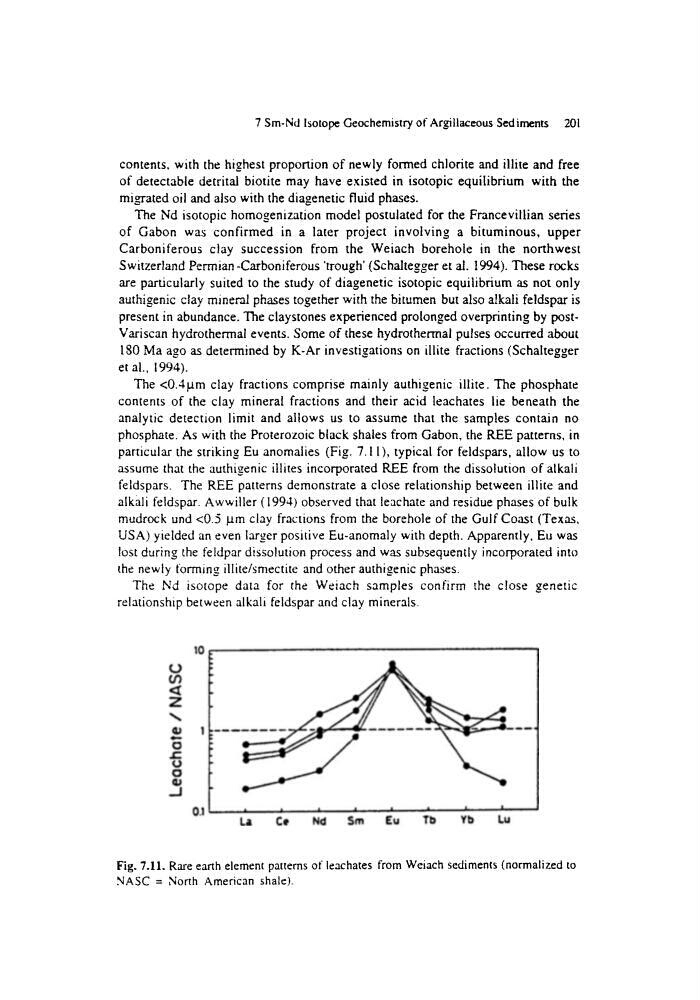
phosphate. As with the Proterozoic black shales from Gabon, the REE patterns, in
particular the striking Eu anomalies (Fig. 7. IlL typical for feldspars, allow us to
assume that the authigenic illites incorporated REE from the dissolution of alkali
feldspars. The REE patterns demonstrate a close relationship between illite and
alkali feldspar. Awwiller (1994) observed that leachate and residue phases of bulk
mudrock und <0.5 ~m clay fractions from the borehole of the Gulf Coast (Texas,
USA) yielded an even larger positive Eu-anomaly with depth. Apparently, Eu was
lost during the feldpar dissolution process and was subsequently incorporated into
the newly forming illite/smectite and other authigenic phases.
The Nd isotope data for the Weiach samples confirm the close genetic
relationship between alkali feldspar and clay minerals.
09
<
Z
o io
_I
tO,
0,}
t
!
!
!
!
, t
!
I
La
Ce
Nd
Sm
Eu
Tb
Vb
Lu
Fig. 7.11. Rare earth element patterns of leachates from Weiaeh sediments (normalized to
NASC = North American shale)_
contents, with the highest proportion of newly formed chlorite and illite and free
of detectable detrital biotite may have existed in isotopic equilibrium with the
mi~ated oil and also with the diagenetic fluid phases.
The Nd isotopic homogenization model postulated for the Francevillian series
of Gabon was confirmed in a later project involving a bituminous, upper
Carboniferous clay succession from the Weiach borehole in the northwest
Switzerland Permian-Carboniferous 'trough' (Schaltegger et al. 1994). These rocks
are particularly suited to the study of diagenetic isotopic equilibrium as not only
authigenic clay mineral phases together with the bitumen but also alkali feldspar is
present in abundance. The claystones experienced prolonged overprinting by postVariscan hydrothermal events. Some of these hydrothermal pulses occurred about
180 Ma ago as determined by K-Ar investigations on illite fractions (Schaltegger
et al., 1994).
The <0.4jam clay fractions comprise mainly authigenic illite. The phosphate
contents of the clay mineral fractions and their acid leachates lie beneath the
analytic detection limit and allows us to assume that the samples contain no
phosphate. As with the Proterozoic black shales from Gabon, the REE patterns, in
particular the striking Eu anomalies (Fig. 7. IlL typical for feldspars, allow us to
assume that the authigenic illites incorporated REE from the dissolution of alkali
feldspars. The REE patterns demonstrate a close relationship between illite and
alkali feldspar. Awwiller (1994) observed that leachate and residue phases of bulk
mudrock und <0.5 ~m clay fractions from the borehole of the Gulf Coast (Texas,
USA) yielded an even larger positive Eu-anomaly with depth. Apparently, Eu was
lost during the feldpar dissolution process and was subsequently incorporated into
the newly forming illite/smectite and other authigenic phases.
The Nd isotope data for the Weiach samples confirm the close genetic
relationship between alkali feldspar and clay minerals.
09
<
Z
o io
_I
tO,
0,}
t
!
!
!
!
, t
!
I
La
Ce
Nd
Sm
Eu
Tb
Vb
Lu
Fig. 7.11. Rare earth element patterns of leachates from Weiaeh sediments (normalized to
NASC = North American shale)_