

7 Sm-Nd Isotope Geochemistry of Argillaceous Sediments 203
to establish that the sediments were hydrothermally overprinted several times
sometime between 100 and 180 Ma. The leachates and residues of the Weiach
samples describe a straight line on the Sr mixing diagram and allow us to suppose
that the straight line relationship observed is likely to represent an "errorchron",
i.e. no age can be resolved from its gradient. The chemical analyses reveal that the
leachates of the clay minerals are strongly enriched in calcium and strontium (Ca:
-20 wt.%; Sr: 3000-10000 ppm). It is therefore probable that the last phase which
enjoyed chemical exchange with the clay minerals represents a late carbonate
diagenesis in the case of Weiach too.
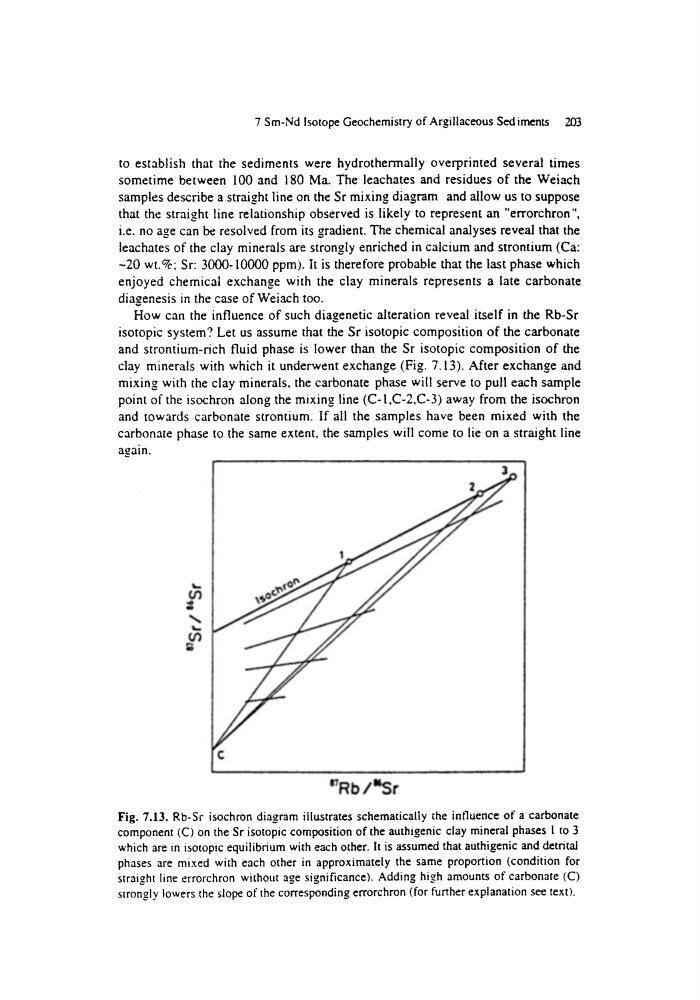
How can the influence of such diagenetic alteration reveal itself in the Rb-Sr
isotopic system? Let us assume that the Sr isotopic composition of the carbonate
and strontium-rich fluid phase is lower than the Sr isotopic composition of the
clay minerals with which it underwent exchange (Fig. 7.13). After exchange and
mixing with the clay minerals, the carbonate phase will serve to pull each sample
point of the isochron along the mixing line (C-!,C-2,C-3) away from the isochron
and towards carbonate strontium. If all the samples have been mixed with the
carbonate phase to the same extent, the samples will come to lie on a straight line
again.
aTR b/USr
Fig. */.13. Rb-Sr isochron diagram illustrates schematically the influence of a carbonate
component (C) on the Sr isotopic composition of the authigenic clay mineral phases 1 to 3
which are in isotopic equilibrium with each other. It is assumed that authigenic and detrit~l
phases are mixed with each other in approximately the same proportion (condition for
straight line errorchron without age significance). Adding high amounts of carbonate (C)
strongly lowers the slope of the corresponding errorchron (for further explanation see text).
to establish that the sediments were hydrothermally overprinted several times
sometime between 100 and 180 Ma. The leachates and residues of the Weiach
samples describe a straight line on the Sr mixing diagram and allow us to suppose
that the straight line relationship observed is likely to represent an "errorchron",
i.e. no age can be resolved from its gradient. The chemical analyses reveal that the
leachates of the clay minerals are strongly enriched in calcium and strontium (Ca:
-20 wt.%; Sr: 3000-10000 ppm). It is therefore probable that the last phase which
enjoyed chemical exchange with the clay minerals represents a late carbonate
diagenesis in the case of Weiach too.
How can the influence of such diagenetic alteration reveal itself in the Rb-Sr
isotopic system? Let us assume that the Sr isotopic composition of the carbonate
and strontium-rich fluid phase is lower than the Sr isotopic composition of the
clay minerals with which it underwent exchange (Fig. 7.13). After exchange and
mixing with the clay minerals, the carbonate phase will serve to pull each sample
point of the isochron along the mixing line (C-!,C-2,C-3) away from the isochron
and towards carbonate strontium. If all the samples have been mixed with the
carbonate phase to the same extent, the samples will come to lie on a straight line
again.
aTR b/USr
Fig. */.13. Rb-Sr isochron diagram illustrates schematically the influence of a carbonate
component (C) on the Sr isotopic composition of the authigenic clay mineral phases 1 to 3
which are in isotopic equilibrium with each other. It is assumed that authigenic and detrit~l
phases are mixed with each other in approximately the same proportion (condition for
straight line errorchron without age significance). Adding high amounts of carbonate (C)
strongly lowers the slope of the corresponding errorchron (for further explanation see text).