

196 Peter Stille and Graham Shields
nature to fractional crystallization of a granitic melt. A further component, i.e. the
oil which migrated into these rocks, may have had an additional influence on this
fractionation process. This is demonstrated by the Sm-Nd isotopic analyses on oilrich clays and oil-bitumens which solidified in the higher porosity of the overlying
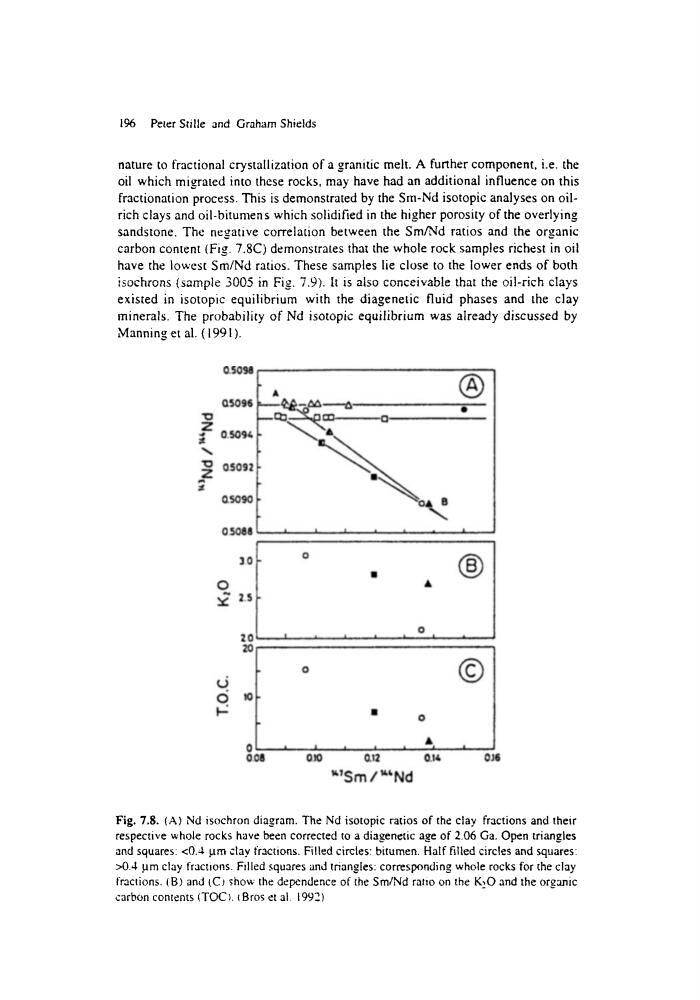
sandstone. The negative correlation between the Sm/Nd ratios and the organic
carbon content (Fig. 7.8C) demonstrates that the whole rock samples richest in oil
have the lowest Sm/Nd ratios. These samples lie close to the lower ends of both
isochrons (sample 3005 in Fig. 7.9). It is also conceivable that the oil-rich cIays
existed in isotopic equilibrium with the diagenetic fluid phases and the clay
minerals. The probability of Nd isotopic equilibrium was already discussed by
Manning et al. (1991).
Z
0
0.5098
05096
0.5094
0.5092
0.5090
0,5088
O 3~ l
~ 2.5
2O
2O
d
to
"
A
m~oo 9 B
1
i
f
i
&
,
i
|
|
0
1
i
&
I
i
O
9
o
0
L
I
J
1
i
1
008
OI0
0.t2
0.t4
0]6
~TSm / ~'Nd
Fig. 7.8. (A) Nd isochron diagram. The Nd isotopic ratios of the clay fractions and their
respective whole rocks have been corrected to a diagenetic age of 2.06 Ga. Open triangles
and squares: <0.4 ~.m clay fractions. Filled circles: bitumen, Half filled circles and squares:
>0.4 .urn clay fractions. Filled squares and triangles: corresponding whole rocks for the clay
fractions. (B) and (C) show the dependence of the Sm/Nd ratio on the K20 and the organic
carbon contents (TOC>. (Bros et al. 1992)
nature to fractional crystallization of a granitic melt. A further component, i.e. the
oil which migrated into these rocks, may have had an additional influence on this
fractionation process. This is demonstrated by the Sm-Nd isotopic analyses on oilrich clays and oil-bitumens which solidified in the higher porosity of the overlying
sandstone. The negative correlation between the Sm/Nd ratios and the organic
carbon content (Fig. 7.8C) demonstrates that the whole rock samples richest in oil
have the lowest Sm/Nd ratios. These samples lie close to the lower ends of both
isochrons (sample 3005 in Fig. 7.9). It is also conceivable that the oil-rich cIays
existed in isotopic equilibrium with the diagenetic fluid phases and the clay
minerals. The probability of Nd isotopic equilibrium was already discussed by
Manning et al. (1991).
Z
0
0.5098
05096
0.5094
0.5092
0.5090
0,5088
O 3~ l
~ 2.5
2O
2O
d
to
"
A
m~oo 9 B
1
i
f
i
&
,
i
|
|
0
1
i
&
I
i
O
9
o
0
L
I
J
1
i
1
008
OI0
0.t2
0.t4
0]6
~TSm / ~'Nd
Fig. 7.8. (A) Nd isochron diagram. The Nd isotopic ratios of the clay fractions and their
respective whole rocks have been corrected to a diagenetic age of 2.06 Ga. Open triangles
and squares: <0.4 ~.m clay fractions. Filled circles: bitumen, Half filled circles and squares:
>0.4 .urn clay fractions. Filled squares and triangles: corresponding whole rocks for the clay
fractions. (B) and (C) show the dependence of the Sm/Nd ratio on the K20 and the organic
carbon contents (TOC>. (Bros et al. 1992)