

7 Sm-Nd Isotope Geochemistry of Ar~llaceous Sediments t97
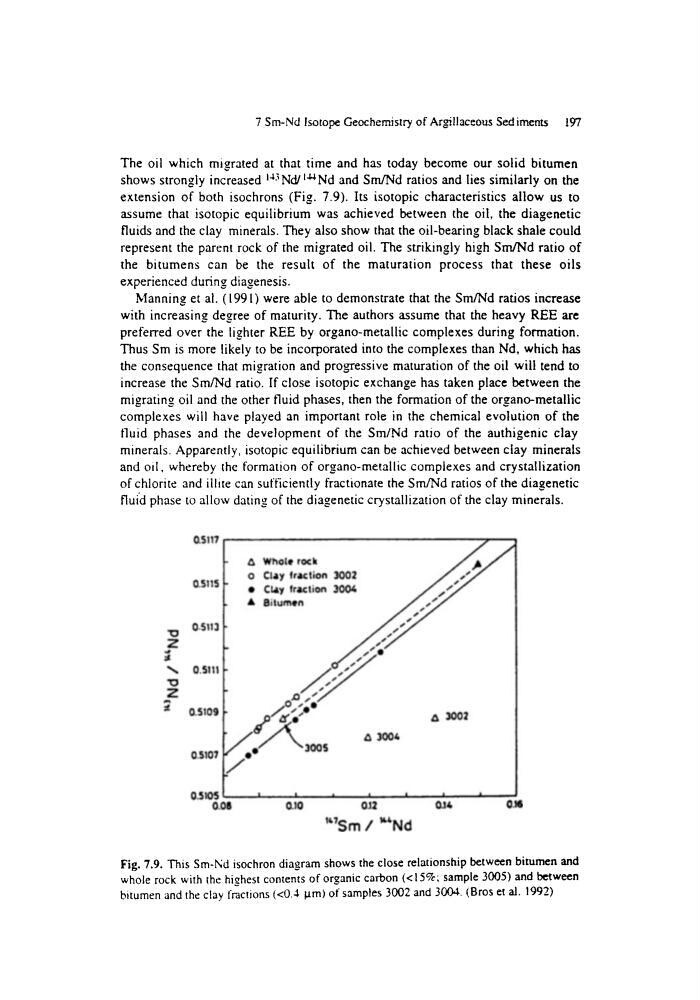
The oil which migrated at that time and has today become our solid bitumen
shows strongly increased 143Nd,/t"Nd and Sm/Nd ratios and lies similarly on the
extension of both isochrons (Fig. 7.9). Its isotopic characteristics allow us to
assume that isotopic equilibrium was achieved between the oil, the diagenetic
fluids and the clay minerals. They also show that the oil-bearing black shale could
represent the parent rock of the migrated oil. The strikingly high Sm/Nd ratio of
the bitumens can be the result of the maturation process that these oils
experienced during diagenesis.
Manning et al. (1991) were able to demonstrate that the Sm/Nd ratios increase
with increasing degree of maturity. The authors assume that the heavy REE are
preferred over the lighter REE by organo-metallic complexes during formation.
Thus Sm is more likely to be incorporated into the complexes than Nd, which has
the consequence that migration and pro~essive maturation of the oil will tend to
increase the Sm/Nd ratio. If close isotopic exchange has taken place between the
migrating oil and the other fluid phases, then the formation of the organo-metallic
complexes will have played an important role in the chemical evolution of the
fluid phases and the development of the Sm/Nd ratio of the authigenic clay
minerals. Apparently, isotopic equilibrium can be achieved between clay minerals
and oil, whereby the formation of organo-metallic complexes and crystallization
of chlorite and illite can sufficiently fractionate the Sm/Nd ratios of the diagenetic
fluid phase to allow dating of the diagenetic crystallization of the clay minerals.
Z
Z
0.51t7
0.5115
0.5113
0.5111
0..5109
0.5107
0.5105
i
008
0.10
/ /
Whole rock
j / ~ /
o Ctay fraction 3002
/
, / ~ "
9 Clay fraction 3004
/ / ~ /
/ , c . -
oZ.y"
"" 9
,~ 3002
3005
|
~
I
I
I
|
0.12
0.It,
O.t6
"~Sm / "'Nd
Fig. 7.9. This Sm-Nd isochron diagram shows the close relationship between bitumen and
whole rock with the highest contents of organic carbon (<15%; sample 3005) and between
bitumen and the clay fractions (<0.4 lain) of samples 3002 and 3004. (Bros et al. 1992)
The oil which migrated at that time and has today become our solid bitumen
shows strongly increased 143Nd,/t"Nd and Sm/Nd ratios and lies similarly on the
extension of both isochrons (Fig. 7.9). Its isotopic characteristics allow us to
assume that isotopic equilibrium was achieved between the oil, the diagenetic
fluids and the clay minerals. They also show that the oil-bearing black shale could
represent the parent rock of the migrated oil. The strikingly high Sm/Nd ratio of
the bitumens can be the result of the maturation process that these oils
experienced during diagenesis.
Manning et al. (1991) were able to demonstrate that the Sm/Nd ratios increase
with increasing degree of maturity. The authors assume that the heavy REE are
preferred over the lighter REE by organo-metallic complexes during formation.
Thus Sm is more likely to be incorporated into the complexes than Nd, which has
the consequence that migration and pro~essive maturation of the oil will tend to
increase the Sm/Nd ratio. If close isotopic exchange has taken place between the
migrating oil and the other fluid phases, then the formation of the organo-metallic
complexes will have played an important role in the chemical evolution of the
fluid phases and the development of the Sm/Nd ratio of the authigenic clay
minerals. Apparently, isotopic equilibrium can be achieved between clay minerals
and oil, whereby the formation of organo-metallic complexes and crystallization
of chlorite and illite can sufficiently fractionate the Sm/Nd ratios of the diagenetic
fluid phase to allow dating of the diagenetic crystallization of the clay minerals.
Z
Z
0.51t7
0.5115
0.5113
0.5111
0..5109
0.5107
0.5105
i
008
0.10
/ /
Whole rock
j / ~ /
o Ctay fraction 3002
/
, / ~ "
9 Clay fraction 3004
/ / ~ /
/ , c . -
oZ.y"
"" 9
,~ 3002
3005
|
~
I
I
I
|
0.12
0.It,
O.t6
"~Sm / "'Nd
Fig. 7.9. This Sm-Nd isochron diagram shows the close relationship between bitumen and
whole rock with the highest contents of organic carbon (<15%; sample 3005) and between
bitumen and the clay fractions (<0.4 lain) of samples 3002 and 3004. (Bros et al. 1992)