

7 Sm-Nd Isotope Geochemistry of Argillaceous Sediments 195
15.8
g
r~
15.1
15 6
Residue
Age : 2309 -+ 300 Ma
MSWO: 1.39
A2 R3002
A2 83005
A2 R3004
A1 R 3 0 ~ y
.,~/~A1 L3002
/ / A 2 L3002
L3004
9 keachate
Age- 2265 +- 150 Ma
MSWD : 0.36
15.5 t
J
~ .
I
,
I
J
i
18.0
18.5
190
195
20.0
~~ / ~~
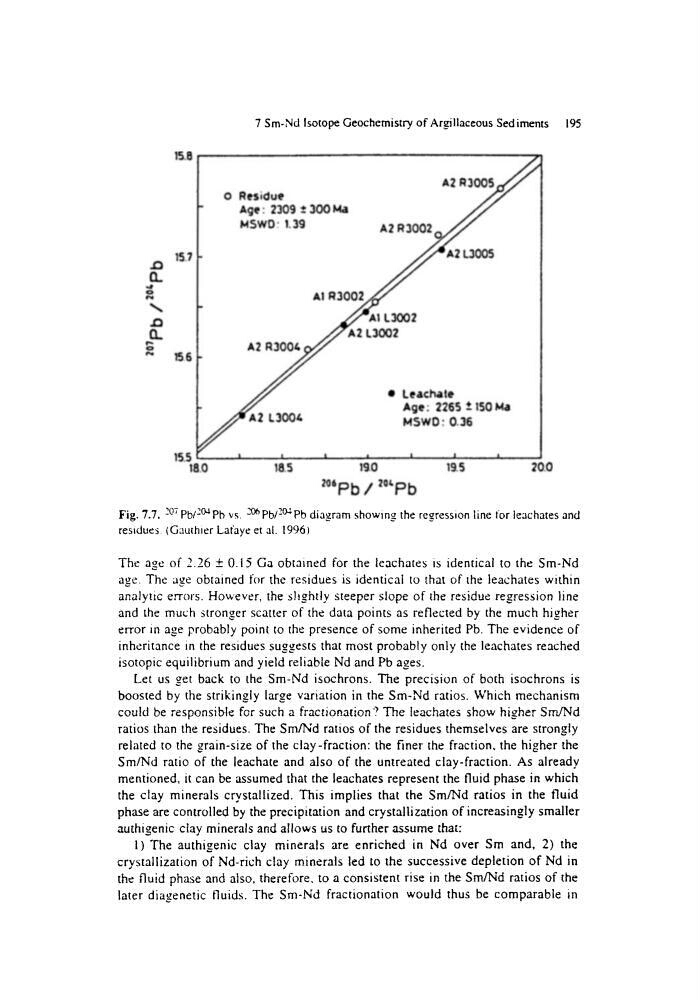
Fig. 7.7. 20; pb/Z0apb vs, 2~ Pb/2~ diagram showing the regression line for leachates and
residues (Gauthier Lafaye et al. 1996)
The age of 2.26 _+ 0.15 Ga obtained for the leachates is identical to the Sm-Nd
age. The age obtained for the residues is identical to that of the leachates within
analytic errors. However, the slightly steeper slope of the residue regression line
and the much stronger scatter of the data points as reflected by the much higher
error in age probably point to the presence of some inherited Pb. The evidence of
inheritance in the residues suggests that most probably only the leachates reached
isotopic equilibrium and yield reliable Nd and Pb ages.
Let us get back to the Sm-Nd isochrons. The precision of both isochrons is
boosted by the strikingly large variation in the Sm-Nd ratios. Which mechanism
could be responsible for such a fractionation ? The teachates show higher Sm/Nd
ratios than the residues. The Sm/Nd ratios of the residues themselves are strongly
related to the grain-size of the clay-fraction: the finer the fraction, the higher the
Sm/Nd ratio of the leachate and also of the untreated clay-fraction. As already
mentioned, it can be assumed that the leachates represent the fluid phase in which
the clay minerals crystallized. This implies that the Sm/Nd ratios in the fluid
phase are controlled by the precipitation and crystallization of increasingly smaller
authigenic clay minerals and allows us to further assume that:
1) The authigenic clay minerals are enriched in Nd over Sm and, 2) the
crystallization of Nd-rich clay minerals led to the successive depletion of Nd in
the fluid phase and also, therefore, to a consistent rise in the Sm/Nd ratios of the
later diagenetic fluids. The Sm-Nd fractionation would thus be comparable in
15.8
g
r~
15.1
15 6
Residue
Age : 2309 -+ 300 Ma
MSWO: 1.39
A2 R3002
A2 83005
A2 R3004
A1 R 3 0 ~ y
.,~/~A1 L3002
/ / A 2 L3002
L3004
9 keachate
Age- 2265 +- 150 Ma
MSWD : 0.36
15.5 t
J
~ .
I
,
I
J
i
18.0
18.5
190
195
20.0
~~ / ~~
Fig. 7.7. 20; pb/Z0apb vs, 2~ Pb/2~ diagram showing the regression line for leachates and
residues (Gauthier Lafaye et al. 1996)
The age of 2.26 _+ 0.15 Ga obtained for the leachates is identical to the Sm-Nd
age. The age obtained for the residues is identical to that of the leachates within
analytic errors. However, the slightly steeper slope of the residue regression line
and the much stronger scatter of the data points as reflected by the much higher
error in age probably point to the presence of some inherited Pb. The evidence of
inheritance in the residues suggests that most probably only the leachates reached
isotopic equilibrium and yield reliable Nd and Pb ages.
Let us get back to the Sm-Nd isochrons. The precision of both isochrons is
boosted by the strikingly large variation in the Sm-Nd ratios. Which mechanism
could be responsible for such a fractionation ? The teachates show higher Sm/Nd
ratios than the residues. The Sm/Nd ratios of the residues themselves are strongly
related to the grain-size of the clay-fraction: the finer the fraction, the higher the
Sm/Nd ratio of the leachate and also of the untreated clay-fraction. As already
mentioned, it can be assumed that the leachates represent the fluid phase in which
the clay minerals crystallized. This implies that the Sm/Nd ratios in the fluid
phase are controlled by the precipitation and crystallization of increasingly smaller
authigenic clay minerals and allows us to further assume that:
1) The authigenic clay minerals are enriched in Nd over Sm and, 2) the
crystallization of Nd-rich clay minerals led to the successive depletion of Nd in
the fluid phase and also, therefore, to a consistent rise in the Sm/Nd ratios of the
later diagenetic fluids. The Sm-Nd fractionation would thus be comparable in