

194 Peter Stille and Graham Shields
on the isochron diagram with a precision that might more normally be found in
the comparatively simple system of a magmatic rock. The presence of inherited
detritus would have decreased the quality of resolution of this line and led to a
scattering of individual points on the line. The ~adients of the straight lines are
identical and allow, therefore, identical ages to be obtained.
3) Volcanic rocks found interbedded within the sediments yielded an identical
Rb-Sr isochron age, within error, of 2140 + 140 Ma.
Pb-Pb isotopic analyses were also carried out on the same clay fractions
(Gauthier-Lafaye et al. 1996). The Pb isotope data suggest a more complicated
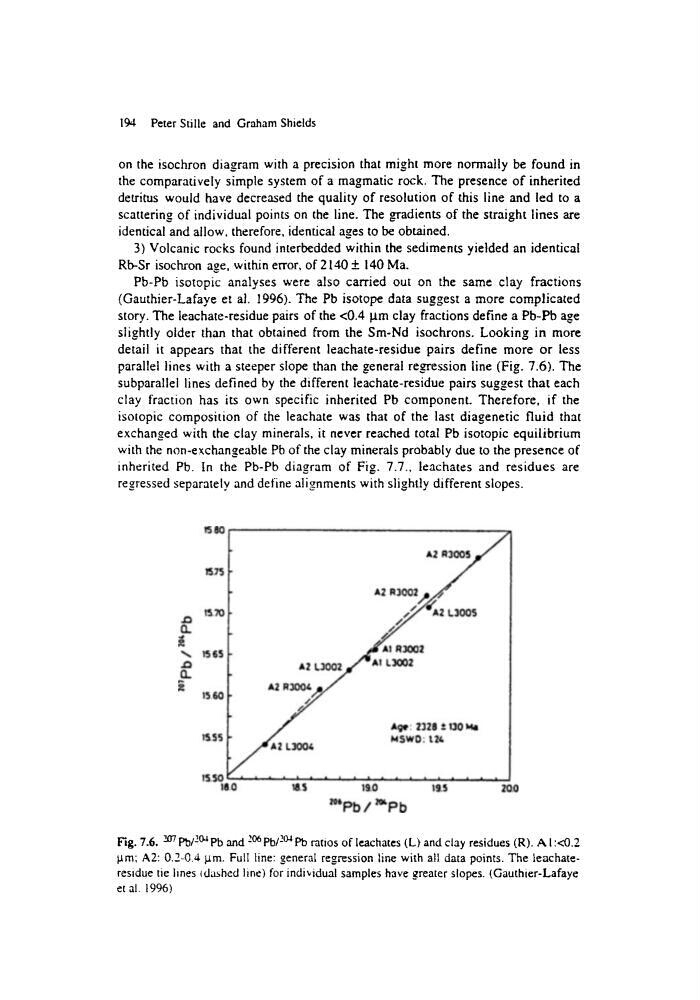
story. The leachate-residue pairs of the <0.4 I, tm clay fractions define a Pb-Pb age
slightly older than that obtained from the Sm-Nd isochrons. Looking in more
detail it appears that the different leachate-residue pairs define more or less
parallel lines with a steeper slope than the general regression line (Fig. 7.6). The
subparallel lines defined by the different leachate-residue pairs suggest that each
clay fraction has its own specific inherited Pb component. Therefore, if the
isotopic composition of the leachate was that of the last diagenetic fluid that
exchanged with the clay minerals, it never reached total Pb isotopic equilibrium
with the non-exchangeable Pb of the clay minerals probably due to the presence of
inherited Pb. tn the Pb-Pb diagram of Fig. 7.7., teachates and residues are
regressed separately and define alignments with slightly different slopes.
n
.JO
[2_
15 80
15.75
1570
15 65
15 60
15.55
15.50 '
18.0
,2 3oo2 ,j"
L3005
A2 k3OOZ/"AT L3002
, /
A2 R a00/.
/ ~ /
Age: 2,328 ~- 130
L 300z,
MSWO: t2~,
18.S
19.0
19.5
20.0
Z~ / ~ P b
Fig. 7.6. ~ Pb/2~ Pb and 206 Pbt_~ Pb ratios of leachates (L) and clay residues (R). A 1 :<0.2
~m; A2: 0.2-0.~ jam. FulI line: genera[ regression line with all data points. The |eachateresidue tie lines (dashed line) for indi~,idual samples have greater slopes. (Gauthier-Lafaye
et al. 1996)
on the isochron diagram with a precision that might more normally be found in
the comparatively simple system of a magmatic rock. The presence of inherited
detritus would have decreased the quality of resolution of this line and led to a
scattering of individual points on the line. The ~adients of the straight lines are
identical and allow, therefore, identical ages to be obtained.
3) Volcanic rocks found interbedded within the sediments yielded an identical
Rb-Sr isochron age, within error, of 2140 + 140 Ma.
Pb-Pb isotopic analyses were also carried out on the same clay fractions
(Gauthier-Lafaye et al. 1996). The Pb isotope data suggest a more complicated
story. The leachate-residue pairs of the <0.4 I, tm clay fractions define a Pb-Pb age
slightly older than that obtained from the Sm-Nd isochrons. Looking in more
detail it appears that the different leachate-residue pairs define more or less
parallel lines with a steeper slope than the general regression line (Fig. 7.6). The
subparallel lines defined by the different leachate-residue pairs suggest that each
clay fraction has its own specific inherited Pb component. Therefore, if the
isotopic composition of the leachate was that of the last diagenetic fluid that
exchanged with the clay minerals, it never reached total Pb isotopic equilibrium
with the non-exchangeable Pb of the clay minerals probably due to the presence of
inherited Pb. tn the Pb-Pb diagram of Fig. 7.7., teachates and residues are
regressed separately and define alignments with slightly different slopes.
n
.JO
[2_
15 80
15.75
1570
15 65
15 60
15.55
15.50 '
18.0
,2 3oo2 ,j"
L3005
A2 k3OOZ/"AT L3002
, /
A2 R a00/.
/ ~ /
Age: 2,328 ~- 130
L 300z,
MSWO: t2~,
18.S
19.0
19.5
20.0
Z~ / ~ P b
Fig. 7.6. ~ Pb/2~ Pb and 206 Pbt_~ Pb ratios of leachates (L) and clay residues (R). A 1 :<0.2
~m; A2: 0.2-0.~ jam. FulI line: genera[ regression line with all data points. The |eachateresidue tie lines (dashed line) for indi~,idual samples have greater slopes. (Gauthier-Lafaye
et al. 1996)