

180 Peter Stifle and Graham Shields
0.~
0.72
. ~ k~ ~ ~
a ~ j
f
0 Palygor$kite
...O...-'o
9 Smectite
~.~---'0.70887 • 0.00036
9 Mixlure
0.70765 -~ 0.00017
~ Carbonate
0.70
i
,
L..
a
,
I
m
0
I0
20
30
'TRb / '~Sr
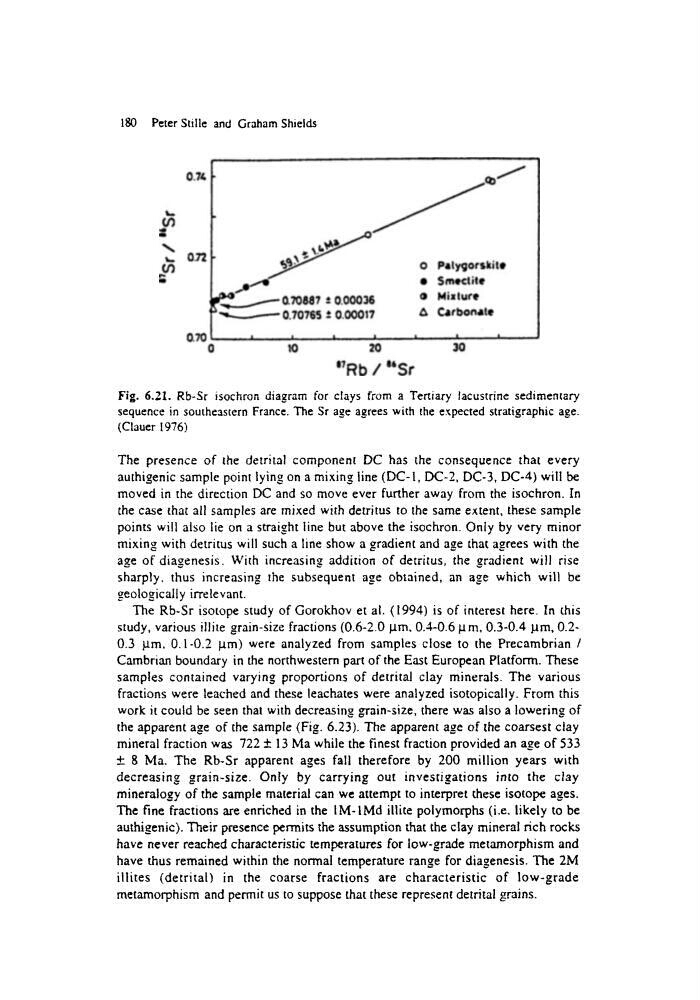
Fig. 6.21. Rb-Sr isochron diagram for ctays from a Tertiary lacustrine sedimentary
sequence in southeastern France. The Sr age agrees with the expected stratigraphic age.
(Clauer 1976)
The presence of the detrital component DC has the consequence that every
authigenic sample point lying on a mixing line (DC-I, DC-2, DC-3, DC-4) will be
moved in the direction DC and so move ever further away from the isochron. In
the case that all samples are mixed with detritus to the same extent, these sample
points will also lie on a straight line but above the isochron. Only by very minor
mixing with detritus will such a line show a gradient and age that agrees with the
age of diagenesis. With increasing addition of detritus, the gradient will rise
sharply, thus increasing the subsequent age obtained, an age which will be
geologically irrelevant.
The Rb-Sr isotope study of Gorokhov et al. (1994) is of interest here. In this
study, various illite grain-size fractions (0.6-2.0 lam, 0.4-0.6/.t m, 0.3-0.4 lam, 0.20.3 ~m, 0. I-0.2 ~tm) were analyzed from samples close to the Precambrian /
Cambrian boundary in the northwestern part of the East European Platform. These
samples contained varying proportions of detrital clay minerals. The various
fractions were leached and these leachates were analyzed isotopically. From this
work it could be seen that with decreasing ~ain-size, there was also a lowering of
the apparent age of the sample (Fig. 6.23). The apparent age of the coarsest clay
mineral fraction was 722 + 13 Ma while the finest fraction provided an age of 533
9 4" 8 Ma. The Rb-Sr apparent ages fall therefore by 200 million years with
decreasing grain-size. Only by carrying out investigations into the clay
mineralogy of the sample material can we attempt to interpret these isotope ages.
The fine fractions are enriched in the IM-IMd iilite polymorphs (i.e. likely to be
authigenic). Their presence permits the assumption that the clay mineral rich rocks
have never reached characteristic temperatures for low-grade metamorphism and
have thus remained within the normal temperature range for diagenesis. The 2M
illites (detrital) in the coarse fractions are characteristic of low-grade
metamorphism and permit us to suppose that these represent detrital grains.
0.~
0.72
. ~ k~ ~ ~
a ~ j
f
0 Palygor$kite
...O...-'o
9 Smectite
~.~---'0.70887 • 0.00036
9 Mixlure
0.70765 -~ 0.00017
~ Carbonate
0.70
i
,
L..
a
,
I
m
0
I0
20
30
'TRb / '~Sr
Fig. 6.21. Rb-Sr isochron diagram for ctays from a Tertiary lacustrine sedimentary
sequence in southeastern France. The Sr age agrees with the expected stratigraphic age.
(Clauer 1976)
The presence of the detrital component DC has the consequence that every
authigenic sample point lying on a mixing line (DC-I, DC-2, DC-3, DC-4) will be
moved in the direction DC and so move ever further away from the isochron. In
the case that all samples are mixed with detritus to the same extent, these sample
points will also lie on a straight line but above the isochron. Only by very minor
mixing with detritus will such a line show a gradient and age that agrees with the
age of diagenesis. With increasing addition of detritus, the gradient will rise
sharply, thus increasing the subsequent age obtained, an age which will be
geologically irrelevant.
The Rb-Sr isotope study of Gorokhov et al. (1994) is of interest here. In this
study, various illite grain-size fractions (0.6-2.0 lam, 0.4-0.6/.t m, 0.3-0.4 lam, 0.20.3 ~m, 0. I-0.2 ~tm) were analyzed from samples close to the Precambrian /
Cambrian boundary in the northwestern part of the East European Platform. These
samples contained varying proportions of detrital clay minerals. The various
fractions were leached and these leachates were analyzed isotopically. From this
work it could be seen that with decreasing ~ain-size, there was also a lowering of
the apparent age of the sample (Fig. 6.23). The apparent age of the coarsest clay
mineral fraction was 722 + 13 Ma while the finest fraction provided an age of 533
9 4" 8 Ma. The Rb-Sr apparent ages fall therefore by 200 million years with
decreasing grain-size. Only by carrying out investigations into the clay
mineralogy of the sample material can we attempt to interpret these isotope ages.
The fine fractions are enriched in the IM-IMd iilite polymorphs (i.e. likely to be
authigenic). Their presence permits the assumption that the clay mineral rich rocks
have never reached characteristic temperatures for low-grade metamorphism and
have thus remained within the normal temperature range for diagenesis. The 2M
illites (detrital) in the coarse fractions are characteristic of low-grade
metamorphism and permit us to suppose that these represent detrital grains.