

6 Isotope Geochemistry of Clay Minerals 179
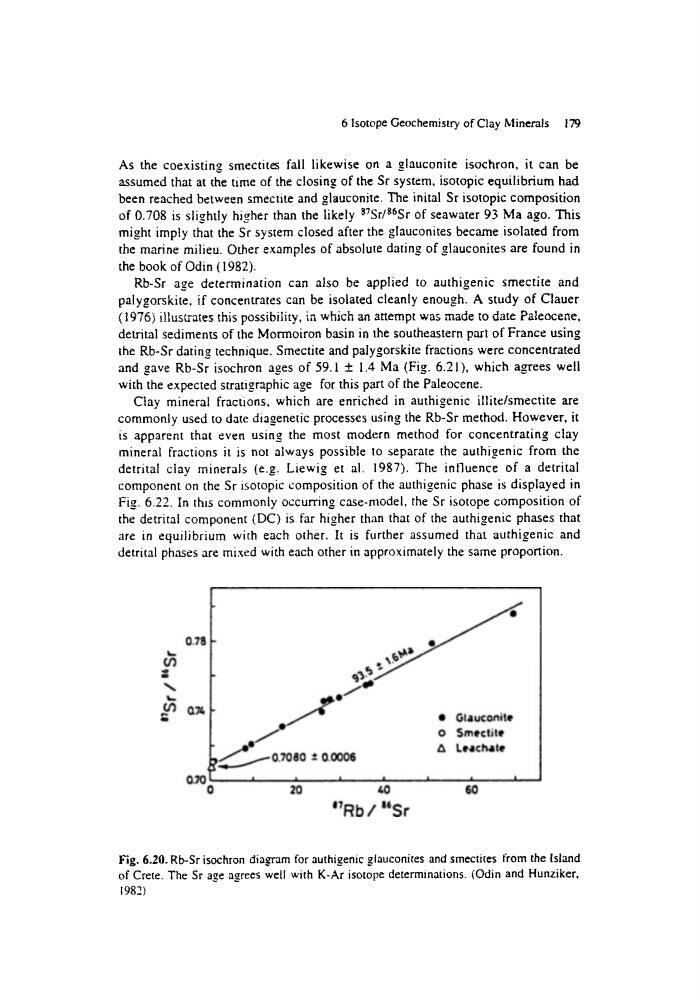
As the coexisting smectites fall likewise on a glauconite isochron, it can be
assumed that at the time of the closing of the Sr system, isotopic equilibrium had
been reached between smectite and glauconite. The inital Sr isotopic composition
of 0.708 is slightly higher than the likely STSr/g6Sr of seawater 93 Ma ago. This
might imply that the Sr system closed after the glauconites became isolated from
the marine milieu. Other examples of absolute dating of glauconites are found in
the book of Odin (1982).
Rb-Sr age determination can also be applied to authigenic smectite and
palygorskite, if concentrates can be isolated cleanly enough. A study of Clauer
(1976) illustrates this possibility, in which an attempt was made to date Paleocene,
detrital sediments of the Mormoiron basin in the southeastern part of France using
the Rb-Sr dating technique. Smectite and palygorskite fractions were concentrated
and gave Rb-Sr isochron ages of 59.1 +- 1.4 Ma (Fig. 6.21), which agTees well
with the expected stratigraphic age for this part of the Paleocene.
Clay mineral fractions, which are enriched in authigenic illite/smectite are
commonly used to date diagenetic processes using the Rb-Sr method. However, it
is apparent that even using the most modern method for concentrating clay
mineral fractions it is not always possible to separate the authigenic from the
detrital clay minerals (e.g. Liewig et al. 1987). The influence of a detrital
component on the Sr isotopic composition of the authigenic phase is displayed in
Fig. 6.22. In this commonly occurring case-model, the Sr isotope composition of
the detrital component (DC) is far higher than that of the authigenic phases that
are in equilibrium with each other. It is further assumed that authigenic and
detrital phases are mixed with each other in approximately the same proportion.
0.78
r
tJ~ 0.74
0.70
0
~e J
9 GZauconite
o $mectite
j e e
.,~..,......-0,7080 • 0.0006
A Leachate
I
i
I
I
I
il
I
20
~0
60
'TRb / a6Sr
Fig. 6.20. Rb-Sr isochron dia~am for authigenic glaueonites and smectites from the Island
of Crete. The Sr age agrees well with K-Ar isotope determinations. (Odin and Hunziker,
1982)
As the coexisting smectites fall likewise on a glauconite isochron, it can be
assumed that at the time of the closing of the Sr system, isotopic equilibrium had
been reached between smectite and glauconite. The inital Sr isotopic composition
of 0.708 is slightly higher than the likely STSr/g6Sr of seawater 93 Ma ago. This
might imply that the Sr system closed after the glauconites became isolated from
the marine milieu. Other examples of absolute dating of glauconites are found in
the book of Odin (1982).
Rb-Sr age determination can also be applied to authigenic smectite and
palygorskite, if concentrates can be isolated cleanly enough. A study of Clauer
(1976) illustrates this possibility, in which an attempt was made to date Paleocene,
detrital sediments of the Mormoiron basin in the southeastern part of France using
the Rb-Sr dating technique. Smectite and palygorskite fractions were concentrated
and gave Rb-Sr isochron ages of 59.1 +- 1.4 Ma (Fig. 6.21), which agTees well
with the expected stratigraphic age for this part of the Paleocene.
Clay mineral fractions, which are enriched in authigenic illite/smectite are
commonly used to date diagenetic processes using the Rb-Sr method. However, it
is apparent that even using the most modern method for concentrating clay
mineral fractions it is not always possible to separate the authigenic from the
detrital clay minerals (e.g. Liewig et al. 1987). The influence of a detrital
component on the Sr isotopic composition of the authigenic phase is displayed in
Fig. 6.22. In this commonly occurring case-model, the Sr isotope composition of
the detrital component (DC) is far higher than that of the authigenic phases that
are in equilibrium with each other. It is further assumed that authigenic and
detrital phases are mixed with each other in approximately the same proportion.
0.78
r
tJ~ 0.74
0.70
0
~e J
9 GZauconite
o $mectite
j e e
.,~..,......-0,7080 • 0.0006
A Leachate
I
i
I
I
I
il
I
20
~0
60
'TRb / a6Sr
Fig. 6.20. Rb-Sr isochron dia~am for authigenic glaueonites and smectites from the Island
of Crete. The Sr age agrees well with K-Ar isotope determinations. (Odin and Hunziker,
1982)