

6 Isotope Geochemistry of Clay Minerals 18t
~Rb / I~Sr
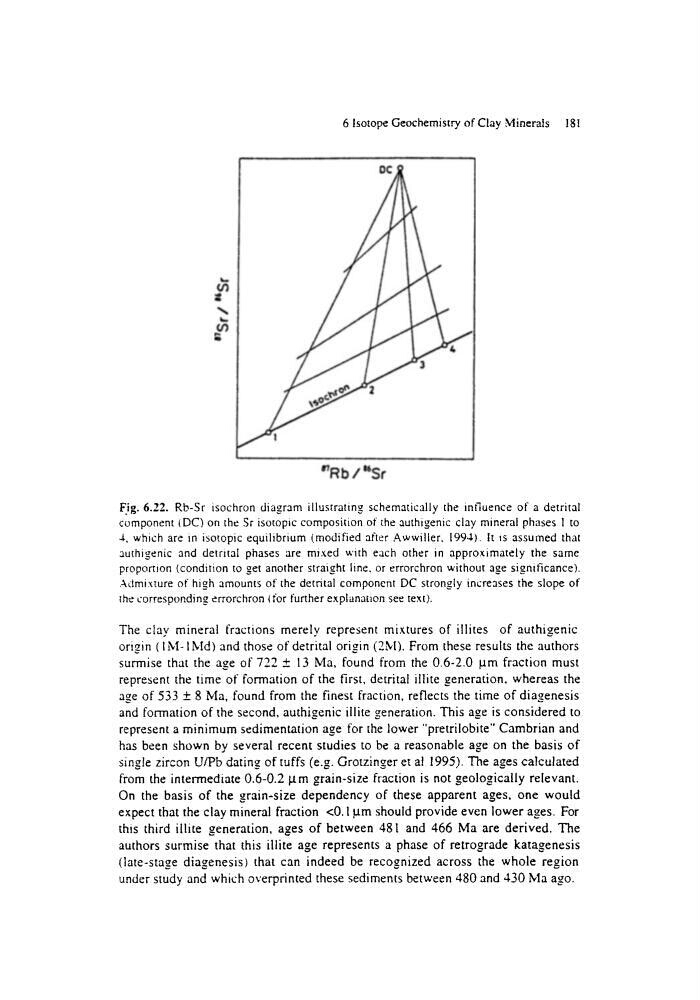
F.ig. 6.22. Rb-Sr isochron diagram illustrating schematically the influence of a detrital
component (DC) on the Sr isotopic composition of the authigenic clay mineral phases I to
4, which are in isotopic equilibrium (modified after Awwiller, 1994). It Is assumed that
authigenic and detrital phases are mixed with each other in approximately the same
proportion (condition to get another straight line, or errorchron without age significance).
Admixture of high amounts of the detrital component DC strongly increases the slope of
the corresponding errorchron (for further explanation see text).
The clay mineral fractions merely represent mixtures of illites of authigenic
origin (I M-IMd) and those of detrital origin (2M). From these results the authors
surmise that the age of 722 + 13 Ma, found from the 0.6-2.0 pm fraction must
represent the time of formation of the first, detrital illite generation, whereas the
age of 533 + 8 Ma, found from the finest fraction, reflects the time of diagenesis
and formation of the second, authigenic illite generation. This age is considered to
represent a minimum sedimentation age for the lower "pretrilobite" Cambrian and
has been shown by several recent studies to be a reasonable age on the basis of
single zircon UtPb dating of tufts (e.g. Grotzinger et at 1995). The ages calculated
from the intermediate 0.6-0.2 I-tin grain-size fraction is not geologically relevant.
On the basis of the grain-size dependency of these apparent ages, one would
expect that the clay mineral fraction <0.1 ,urn should provide even lower ages. For
this third illite generation, ages of between 481 and 466 Ma are derived. The
authors surmise that this illite age represents a phase of retrograde katagenesis
(late-stage diagenesis) that can indeed be recognized across the whole region
under study and which overprinted these sediments between 480 and 430 Ma ago.
~Rb / I~Sr
F.ig. 6.22. Rb-Sr isochron diagram illustrating schematically the influence of a detrital
component (DC) on the Sr isotopic composition of the authigenic clay mineral phases I to
4, which are in isotopic equilibrium (modified after Awwiller, 1994). It Is assumed that
authigenic and detrital phases are mixed with each other in approximately the same
proportion (condition to get another straight line, or errorchron without age significance).
Admixture of high amounts of the detrital component DC strongly increases the slope of
the corresponding errorchron (for further explanation see text).
The clay mineral fractions merely represent mixtures of illites of authigenic
origin (I M-IMd) and those of detrital origin (2M). From these results the authors
surmise that the age of 722 + 13 Ma, found from the 0.6-2.0 pm fraction must
represent the time of formation of the first, detrital illite generation, whereas the
age of 533 + 8 Ma, found from the finest fraction, reflects the time of diagenesis
and formation of the second, authigenic illite generation. This age is considered to
represent a minimum sedimentation age for the lower "pretrilobite" Cambrian and
has been shown by several recent studies to be a reasonable age on the basis of
single zircon UtPb dating of tufts (e.g. Grotzinger et at 1995). The ages calculated
from the intermediate 0.6-0.2 I-tin grain-size fraction is not geologically relevant.
On the basis of the grain-size dependency of these apparent ages, one would
expect that the clay mineral fraction <0.1 ,urn should provide even lower ages. For
this third illite generation, ages of between 481 and 466 Ma are derived. The
authors surmise that this illite age represents a phase of retrograde katagenesis
(late-stage diagenesis) that can indeed be recognized across the whole region
under study and which overprinted these sediments between 480 and 430 Ma ago.