

6 Isotope Geochemistry of Clay Minerals 175
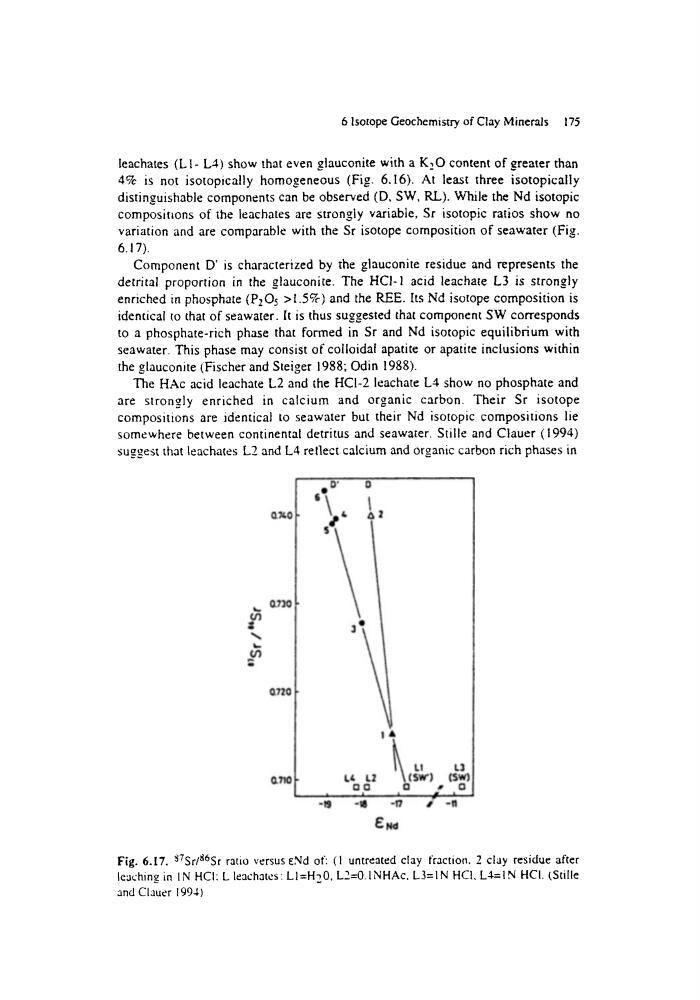
leachates (LI- La) show that even glauconite with a K,O content of greater than
4% is not isotopically homogeneous (Fig. 6.I6). At least three isotopically
distinguishable components can be observed (D, SW, RL). While the Nd isotopic
compositions of the leachates are strongly variable, Sr isotopic ratios show no
variation and are comparable with the Sr isotope composition of seawater (Fig.
6.17).
Component D' is characterized by the glauconite residue and represents the
detrital proportion in the glauconite. The HCI-1 acid leachate L3 is strongly
enriched in phosphate (P20~ >1.5%) and the REE. Its Nd isotope composition is
identical to that of seawater. It is thus suggested that component SW corresponds
to a phosphate-rich phase that formed in Sr and Nd isotopic equilibrium with
seawater. This phase may consist of colloidal apatite or apatite inclusions within
the glauconite (Fischer and Steiger 1988; Odin 1988).
The HAc acid leachate L2 and the HCI-2 leachate L4 show no phosphate and
are strongly enriched in calcium and organic carbon. Their Sr isotope
compositions are identical to seawater but their Nd isotopic compositions lie
somewhere between continental detritus and seawater. Stille and Ciauer (1994)
suggest that leachates L2 and L4 rellect calcium and organic carbon rich phases in
em
0.7,'.0
0.730
0.720
O'
O
A
LI
L'I
0.71o
Lt. L2
|SW')
(SW)
o o
o
,, o
,
J
,,
E Ne
Fig. 6.17. S7Sr/S6Sr ratio versus ~Nd of: (I untreated etay fraction. 2 clay residue after
leaching in IN HCI: L [eachates: LI=H20, L2=0.1NHAc, L3=IN He1. L-~=I N HCI. (Stille
and Clauer 199-~)
leachates (LI- La) show that even glauconite with a K,O content of greater than
4% is not isotopically homogeneous (Fig. 6.I6). At least three isotopically
distinguishable components can be observed (D, SW, RL). While the Nd isotopic
compositions of the leachates are strongly variable, Sr isotopic ratios show no
variation and are comparable with the Sr isotope composition of seawater (Fig.
6.17).
Component D' is characterized by the glauconite residue and represents the
detrital proportion in the glauconite. The HCI-1 acid leachate L3 is strongly
enriched in phosphate (P20~ >1.5%) and the REE. Its Nd isotope composition is
identical to that of seawater. It is thus suggested that component SW corresponds
to a phosphate-rich phase that formed in Sr and Nd isotopic equilibrium with
seawater. This phase may consist of colloidal apatite or apatite inclusions within
the glauconite (Fischer and Steiger 1988; Odin 1988).
The HAc acid leachate L2 and the HCI-2 leachate L4 show no phosphate and
are strongly enriched in calcium and organic carbon. Their Sr isotope
compositions are identical to seawater but their Nd isotopic compositions lie
somewhere between continental detritus and seawater. Stille and Ciauer (1994)
suggest that leachates L2 and L4 rellect calcium and organic carbon rich phases in
em
0.7,'.0
0.730
0.720
O'
O
A
LI
L'I
0.71o
Lt. L2
|SW')
(SW)
o o
o
,, o
,
J
,,
E Ne
Fig. 6.17. S7Sr/S6Sr ratio versus ~Nd of: (I untreated etay fraction. 2 clay residue after
leaching in IN HCI: L [eachates: LI=H20, L2=0.1NHAc, L3=IN He1. L-~=I N HCI. (Stille
and Clauer 199-~)