

174 Peter Stitle and Graham Shields
Z
Z
Z
z
0.51174
3/~
R2 i~--- e-o
/ e R 3
0.51164
0.17
Lt,
@
----k2
0.t8
0.19
o.s121
1
;
!
I
0.5119
/
Or7
RL~
I
0.27
|
a,-o
L2
S m / N d
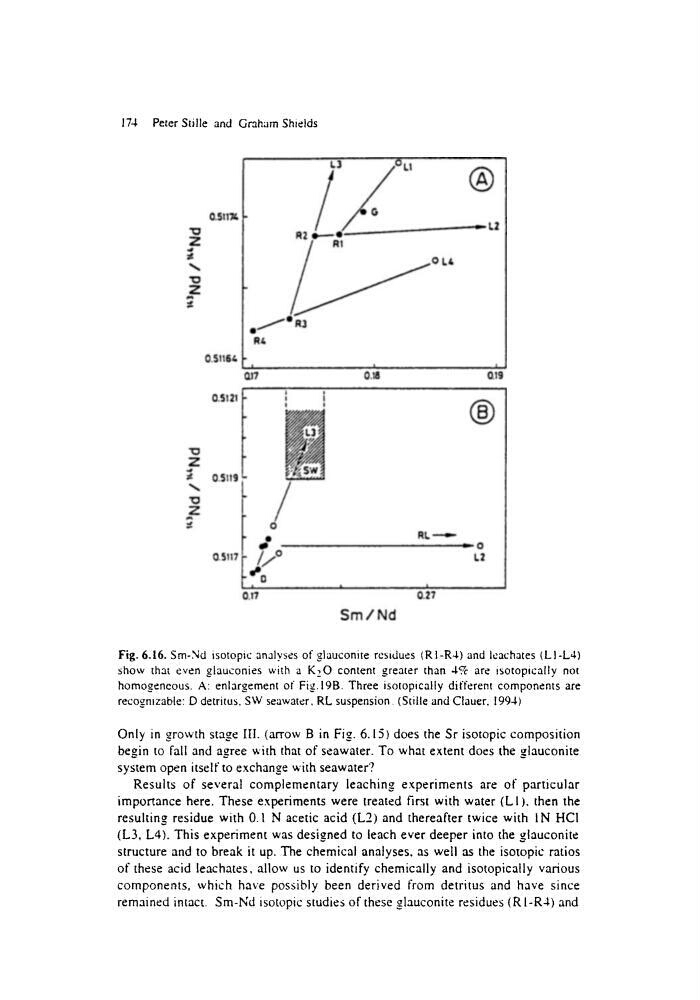
Fig. 6.16. Sm-Nd isotopic analyses of glauconite residues (R I-R4) and leachates (L I-L4)
show that even glauconies with a K_,O content greater than 4% are isotopically not
homogeneous. A: enlargement of Fig. 19B. Three isotopically different components are
recognizable: D detritus. SW seawater. RL suspension. (Stitle and Clauer, 1994)
Only in growth stage IIl. (arrow B in Fig. 6. [5) does the Sr isotopic composition
begin to fall and agree with that of seawater. To what extent does the glauconite
system open itself to exchange with seawater?
Results of several complementary leaching experiments are of particular
importance here. These experiments were treated first with water (LI), then the
resulting residue with 0.1 N acetic acid (L2) and thereafter twice with IN HCI
(L3, L4). This experiment was designed to leach ever deeper into the glauconite
structure and to break it up. The chemical analyses, as well as the isotopic ratios
of these acid leachates, allow us to identify chemically and isotopically various
components, which have possibly been derived from detritus and have since
remained intact. Sm-Nd isotopic studies of these glauconite residues (R I-R4) and
Z
Z
Z
z
0.51174
3/~
R2 i~--- e-o
/ e R 3
0.51164
0.17
Lt,
@
----k2
0.t8
0.19
o.s121
1
;
!
I
0.5119
/
Or7
RL~
I
0.27
|
a,-o
L2
S m / N d
Fig. 6.16. Sm-Nd isotopic analyses of glauconite residues (R I-R4) and leachates (L I-L4)
show that even glauconies with a K_,O content greater than 4% are isotopically not
homogeneous. A: enlargement of Fig. 19B. Three isotopically different components are
recognizable: D detritus. SW seawater. RL suspension. (Stitle and Clauer, 1994)
Only in growth stage IIl. (arrow B in Fig. 6. [5) does the Sr isotopic composition
begin to fall and agree with that of seawater. To what extent does the glauconite
system open itself to exchange with seawater?
Results of several complementary leaching experiments are of particular
importance here. These experiments were treated first with water (LI), then the
resulting residue with 0.1 N acetic acid (L2) and thereafter twice with IN HCI
(L3, L4). This experiment was designed to leach ever deeper into the glauconite
structure and to break it up. The chemical analyses, as well as the isotopic ratios
of these acid leachates, allow us to identify chemically and isotopically various
components, which have possibly been derived from detritus and have since
remained intact. Sm-Nd isotopic studies of these glauconite residues (R I-R4) and