

6 Isotope Geochemistry of Clay Minerals 173
=
O0
0
.z
ul
....;
0
CO
o.7,o
0.730
- ~
0.120
0.7101
+23
+22
+21
+20
+ 19
'1
Seaw,~te~
r
I
i
i
Seclw4~ter
/
o
o/
o?
o
I
I
I
I
2
4
6
8
10
Kz 0 (%)
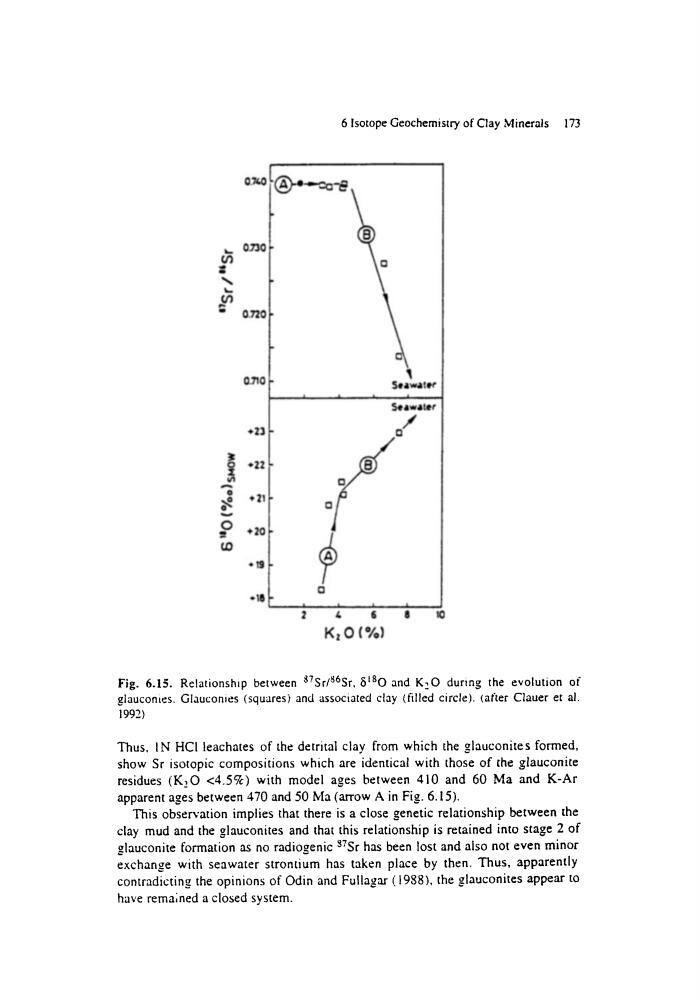
Fig. 6.15. Relationship between STSr/S6Sr, 8180 and K,O during the evolution of
glauconies. Glauconies (squares) and associated clay (filled circle). (after Clauer et al.
1992)
Thus, IN HCI leachates of the detrital clay from which the glauconites formed,
show Sr isotopic compositions which are identical with those of the glauconite
residues (K_,O <4.5%) with model ages between 410 and 60 Ma and K-Ar
apparent ages between 470 and 50 Ma (arrow A in Fig. 6.15).
This observation implies that there is a close genetic relationship between the
clay mud and the glauconites and that this relationship is retained into stage 2 of
glauconite formation as no radiogenic S7Sr has been lost and also not even minor
exchange with seawater strontium has taken place by then. Thus, apparently
contradicting the opinions of Odin and Fullagar (1988), the glauconites appear to
have remained a closed system.
=
O0
0
.z
ul
....;
0
CO
o.7,o
0.730
- ~
0.120
0.7101
+23
+22
+21
+20
+ 19
'1
Seaw,~te~
r
I
i
i
Seclw4~ter
/
o
o/
o?
o
I
I
I
I
2
4
6
8
10
Kz 0 (%)
Fig. 6.15. Relationship between STSr/S6Sr, 8180 and K,O during the evolution of
glauconies. Glauconies (squares) and associated clay (filled circle). (after Clauer et al.
1992)
Thus, IN HCI leachates of the detrital clay from which the glauconites formed,
show Sr isotopic compositions which are identical with those of the glauconite
residues (K_,O <4.5%) with model ages between 410 and 60 Ma and K-Ar
apparent ages between 470 and 50 Ma (arrow A in Fig. 6.15).
This observation implies that there is a close genetic relationship between the
clay mud and the glauconites and that this relationship is retained into stage 2 of
glauconite formation as no radiogenic S7Sr has been lost and also not even minor
exchange with seawater strontium has taken place by then. Thus, apparently
contradicting the opinions of Odin and Fullagar (1988), the glauconites appear to
have remained a closed system.