

172 Peter Stille and Graham Shields
O
c~
O
r
t'CL
CX
<~
500
400
300
200
100
o
I
Q
0
""
!
t
!
2
o 9 K - A r 4ge
Q Q 9 R b - $ r a g e
t
a
,
3
4
5
6
7
K~ 0 I%1
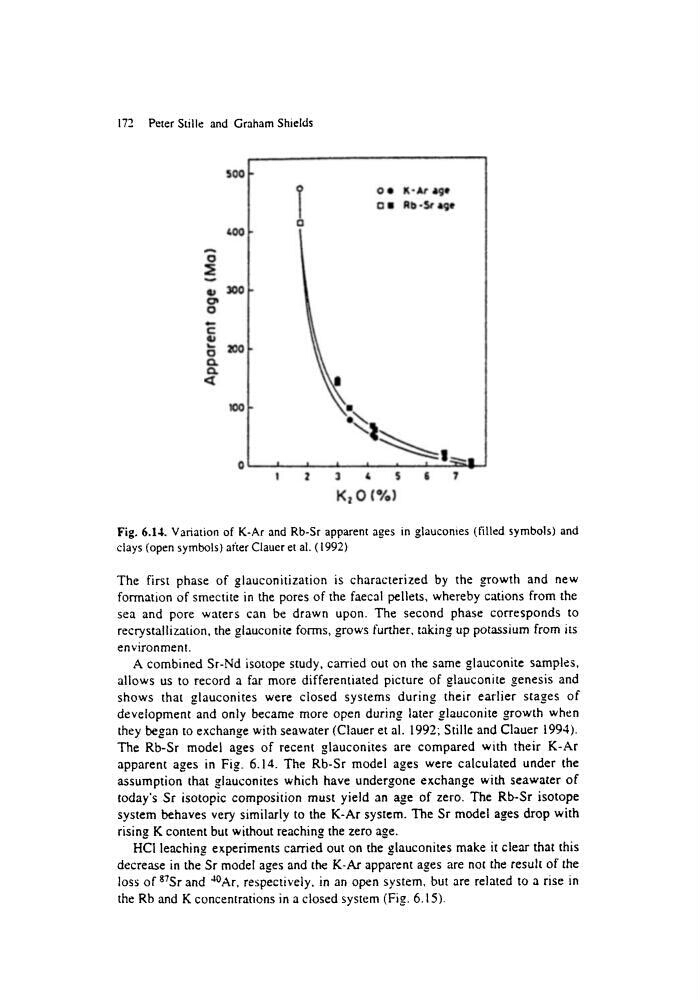
Fig. 6.14. Variation of K-Ar and Rb-Sr apparent ages in glauconies (filled symbols) and
clays (open symbols) after Clauer et al. (1992)
The first phase of glauconitization is characterized by the ~owth and new
formation of smectite in the pores of the faecal pellets, whereby cations from the
sea and pore waters can be drawn upon. The second phase corresponds to
recrystallization, the glauconite forms, grows further, taking up potassium from its
environment.
A combined Sr-Nd isotope study, carried out on the same glauconite samples,
allows us to record a far more differentiated picture of glauconite genesis and
shows that glauconites were closed systems during their earlier stages of
development and only became more open during later glauconite growth when
they began to exchange with seawater (Clauer et al. 1992; Stille and Clauer 1994).
The Rb-Sr model ages of recent glauconites are compared with their K-Ar
apparent ages in Fig. 6.14. The Rb-Sr model ages were calculated under the
assumption that glauconites which have undergone exchange with seawater of
today's Sr isotopic composition must yield an age of zero. The Rb-Sr isotope
system behaves very similarly to the K-Ar system. The Sr model ages drop with
rising K content but without reaching the zero age.
HC1 leaching experiments carried out on the glauconites make it clear that this
decrease in the Sr model ages and the K-At apparent ages are not the result of the
toss of 87Sr and 4~
respectively, in an open system, but are related to a rise in
the Rb and K concentrations in a closed system (Fig. 6.15).
O
c~
O
r
t'CL
CX
<~
500
400
300
200
100
o
I
Q
0
""
!
t
!
2
o 9 K - A r 4ge
Q Q 9 R b - $ r a g e
t
a
,
3
4
5
6
7
K~ 0 I%1
Fig. 6.14. Variation of K-Ar and Rb-Sr apparent ages in glauconies (filled symbols) and
clays (open symbols) after Clauer et al. (1992)
The first phase of glauconitization is characterized by the ~owth and new
formation of smectite in the pores of the faecal pellets, whereby cations from the
sea and pore waters can be drawn upon. The second phase corresponds to
recrystallization, the glauconite forms, grows further, taking up potassium from its
environment.
A combined Sr-Nd isotope study, carried out on the same glauconite samples,
allows us to record a far more differentiated picture of glauconite genesis and
shows that glauconites were closed systems during their earlier stages of
development and only became more open during later glauconite growth when
they began to exchange with seawater (Clauer et al. 1992; Stille and Clauer 1994).
The Rb-Sr model ages of recent glauconites are compared with their K-Ar
apparent ages in Fig. 6.14. The Rb-Sr model ages were calculated under the
assumption that glauconites which have undergone exchange with seawater of
today's Sr isotopic composition must yield an age of zero. The Rb-Sr isotope
system behaves very similarly to the K-Ar system. The Sr model ages drop with
rising K content but without reaching the zero age.
HC1 leaching experiments carried out on the glauconites make it clear that this
decrease in the Sr model ages and the K-At apparent ages are not the result of the
toss of 87Sr and 4~
respectively, in an open system, but are related to a rise in
the Rb and K concentrations in a closed system (Fig. 6.15).