

176 Peter Stille and Graham Shields
suspension in the Congo River, respectively, which ended up deposited in the
river delta (component RL in Fig. 6.18). Contact with Sr-rich and REE-poor
seawater would overprint the Sr isotopic composition in particular but much less
the Nd isotopic signature of the carbonate and the organic components.
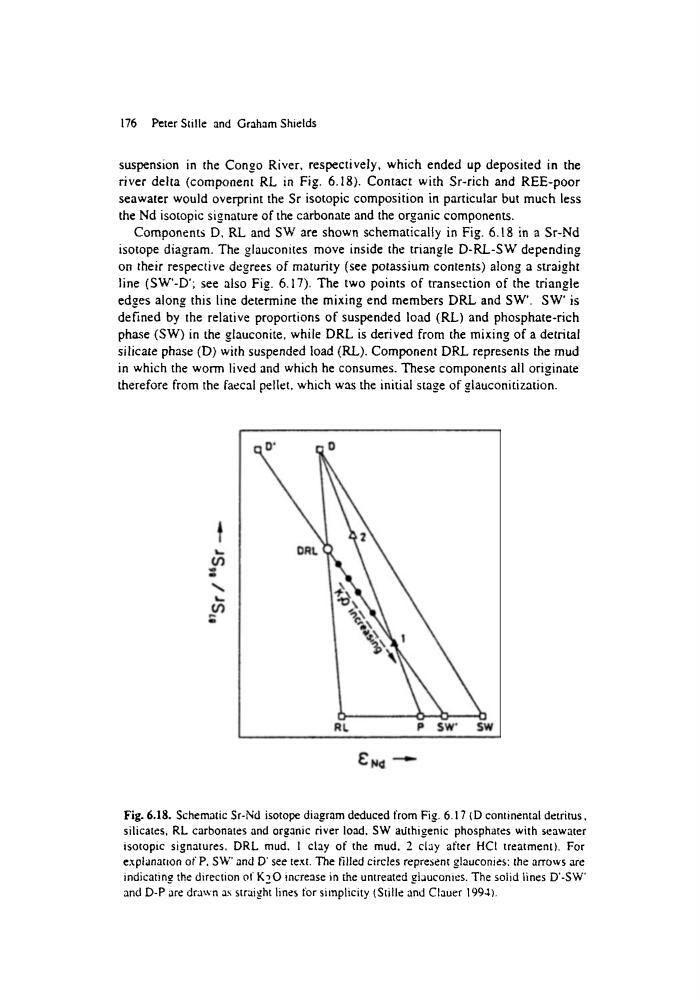
Components D, RL and SW are shown schematically in Fig, 6.18 in a Sr-Nd
isotope diagram. The glauconites move inside the triangle D-RL-SW depending
on their respective degrees of maturity (see potassium contents) along a straight
line (SW'-D'; see also Fig. 6.17), The two points of transection of the triangle
edges along this line determine the mixing end members DRL and SW'. SW' is
defined by the relative proportions of suspended load (RL) and phosphate-rich
phase (SW) in the glauconite, while DRL is derived from the mixing of a detrital
silicate phase (D) with suspended load (RL). Component DRL represents the mud
in which the worm lived and which he consumes. These components all originate
therefore from the faecal pellet, which was the initial stage of glauconitization.
t_
(/3
03
ORL
R
P Sw
SW
ENtl
Fig. 6,18. Schematic Sr-Nd isotope diagram deduced from Fig. 6.17 (D continental detritus,
silicates, RL carbonates and organic river load, SW adthigenic phosphates with seawater
isotopic signatures, DRL mud, 1 clay of the mud, 2 ctay after HCI treatment). For
explanation of P, SW' and D' see text. The tilled circles represent glauconies: the arrows are
indicating the direction of K20 increase in the untreated gt:auconies. The solid lines D'-SW'
and D-P are drawn as straight lines for simplicity (Stille and Clauer 1994).
suspension in the Congo River, respectively, which ended up deposited in the
river delta (component RL in Fig. 6.18). Contact with Sr-rich and REE-poor
seawater would overprint the Sr isotopic composition in particular but much less
the Nd isotopic signature of the carbonate and the organic components.
Components D, RL and SW are shown schematically in Fig, 6.18 in a Sr-Nd
isotope diagram. The glauconites move inside the triangle D-RL-SW depending
on their respective degrees of maturity (see potassium contents) along a straight
line (SW'-D'; see also Fig. 6.17), The two points of transection of the triangle
edges along this line determine the mixing end members DRL and SW'. SW' is
defined by the relative proportions of suspended load (RL) and phosphate-rich
phase (SW) in the glauconite, while DRL is derived from the mixing of a detrital
silicate phase (D) with suspended load (RL). Component DRL represents the mud
in which the worm lived and which he consumes. These components all originate
therefore from the faecal pellet, which was the initial stage of glauconitization.
t_
(/3
03
ORL
R
P Sw
SW
ENtl
Fig. 6,18. Schematic Sr-Nd isotope diagram deduced from Fig. 6.17 (D continental detritus,
silicates, RL carbonates and organic river load, SW adthigenic phosphates with seawater
isotopic signatures, DRL mud, 1 clay of the mud, 2 ctay after HCI treatment). For
explanation of P, SW' and D' see text. The tilled circles represent glauconies: the arrows are
indicating the direction of K20 increase in the untreated gt:auconies. The solid lines D'-SW'
and D-P are drawn as straight lines for simplicity (Stille and Clauer 1994).