

170 Peter Stille and Graham Shields
|
|
KzO - 0.5-1.S%
1 . 5 - 3 . 0 %
Fe~ 03 = 8 - 1 2 %
2 1 - 2 ( , %
Alz Oa =, I S - 2 0 %
7 - 1 1 %
|
~.0 - 7.0 %
6 - 7
~
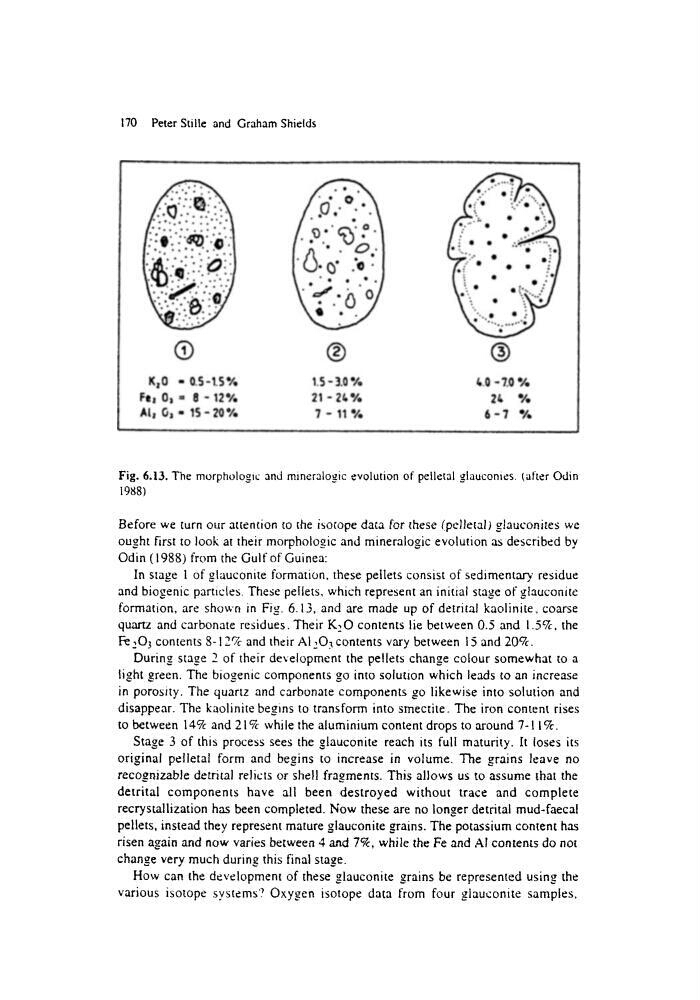
Fig. 6.13. The morphologic and mineralogic evolution of pelletal glauconies, f, after Odin
1988)
Before we turn our attention to the isotope data for these (pelleta/) glauconites we
ought first to look at their morphologic and mineralogic evolution as described by
Odin (1988) from the Gulf of Guinea:
In stage 1 of glauconite formation, these pellets consist of sedimentary residue
and biogenic particles. These pellets, which represent an initial stage of glauconite
formation, are shown in Fig, 6. t 3, and are made up of detrital kaolinite, coarse
quartz and carbonate residues. Their K:O contents lie between 0.5 and 1.5ck. the
Fe203 contents 8-12% and their A1_,O3 contents vary between 15 and 20ok.
During stage 2 of their development the pellets change colour somewhat to a
light green. The biogenic components go into solution which leads to an increase
in porosity. The quartz and carbonate components go likewise into solution and
disappear. The kaolinite begins to transform into smectite, The iron content rises
to between 14% and 21~ while the aluminium content drops to around 2-11%.
Stage 3 of this process sees the glauconite reach its full maturity. It loses its
original pelletal form and begins to increase in volume. The grains leave no
recognizable detrital relicts or shell fragments. This allows us to assume that the
detrital components have all been destroyed without trace and complete
recrystallization has been completed. Now these are no longer detrital mud-faecal
pellets, instead they represent mature glauconite grains. The potassium content has
risen again and now varies between 4 and 7%, while the Fe and AI contents do not
change very much during this final stage.
How can the development of these glauconite grains be represented using the
various isotope systems? Oxygen isotope data from four glauconite samples,
|
|
KzO - 0.5-1.S%
1 . 5 - 3 . 0 %
Fe~ 03 = 8 - 1 2 %
2 1 - 2 ( , %
Alz Oa =, I S - 2 0 %
7 - 1 1 %
|
~.0 - 7.0 %
6 - 7
~
Fig. 6.13. The morphologic and mineralogic evolution of pelletal glauconies, f, after Odin
1988)
Before we turn our attention to the isotope data for these (pelleta/) glauconites we
ought first to look at their morphologic and mineralogic evolution as described by
Odin (1988) from the Gulf of Guinea:
In stage 1 of glauconite formation, these pellets consist of sedimentary residue
and biogenic particles. These pellets, which represent an initial stage of glauconite
formation, are shown in Fig, 6. t 3, and are made up of detrital kaolinite, coarse
quartz and carbonate residues. Their K:O contents lie between 0.5 and 1.5ck. the
Fe203 contents 8-12% and their A1_,O3 contents vary between 15 and 20ok.
During stage 2 of their development the pellets change colour somewhat to a
light green. The biogenic components go into solution which leads to an increase
in porosity. The quartz and carbonate components go likewise into solution and
disappear. The kaolinite begins to transform into smectite, The iron content rises
to between 14% and 21~ while the aluminium content drops to around 2-11%.
Stage 3 of this process sees the glauconite reach its full maturity. It loses its
original pelletal form and begins to increase in volume. The grains leave no
recognizable detrital relicts or shell fragments. This allows us to assume that the
detrital components have all been destroyed without trace and complete
recrystallization has been completed. Now these are no longer detrital mud-faecal
pellets, instead they represent mature glauconite grains. The potassium content has
risen again and now varies between 4 and 7%, while the Fe and AI contents do not
change very much during this final stage.
How can the development of these glauconite grains be represented using the
various isotope systems? Oxygen isotope data from four glauconite samples,