

6 Isotope Geochemistry of Clay Minerals 169
interface. A much debated form of originally detrital glauconite is that of 'worm'
faecal pellets (Odin and Matter 1981). The genesis of these glauconites is
discussed in a little more detail here:
Glauconites of this type have been investigated from sediments in the Gulf of
Guinea. This region is particularly suitable because it is possible to observe
various stages of glauconitization and neither strong subsidence nor high
sedimentation rates have disturbed the progressive evolution of these glauconites
in the sediment / seawater transition zone.
,.///
o j
~ s~
P
~,:~: 7//~I L / /
12 ET
I~// ~o.7o9to = 25
, ~
0,0889 -- 2,
s
lo
/
/
0~9
0 R
~
R ljs
~"'----,----070830
: 18
" ~ - 0 7 0 7 M
= ~Z
0705~
,
,
~
~
,
,
0
2
~
8
S~Rb / )'Sr
--234
O.II-Z)Jm 0 /
0
--170
/ -~0 I.~,,.
36 Z4
8
I
I
ICO
GO
20
SO
,
a
~ ,
I00
60
Laths ( % )
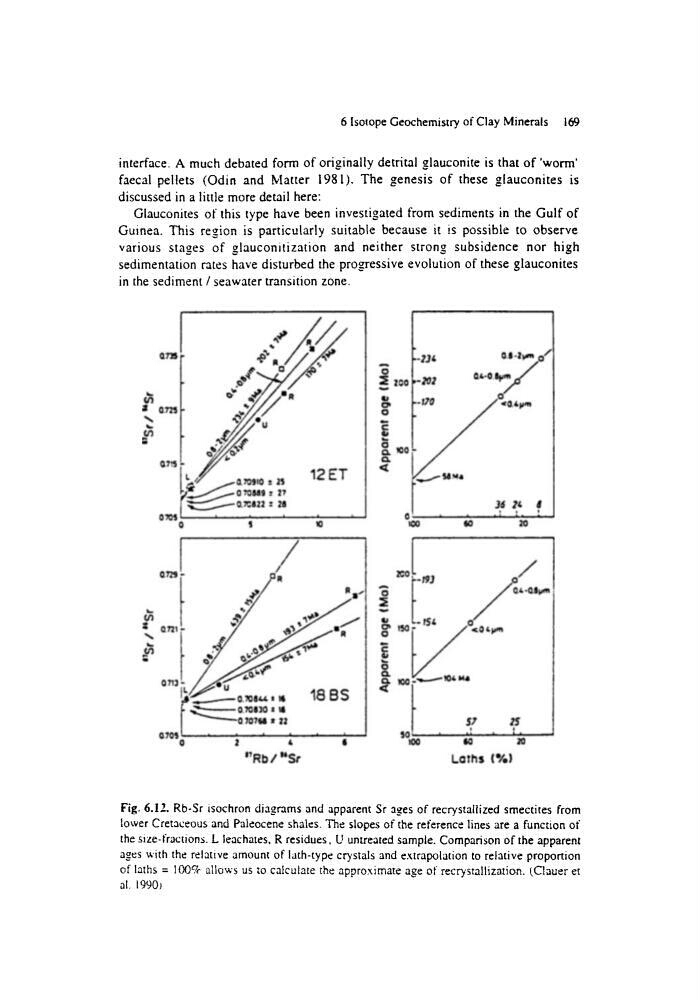
Fig. 6.12. Rb-Sr isochron diagrams and apparent Sr ages of recrystallized smectites from
lower Cretaceous and Paleocene shales The slopes of the reference lines are a function of
the size-fractions. L leachates, R residues, U untreated sample. Comparison of the apparent
ages with the relative amount of lath-type crystals and extrapolation to relative proportion
of laths = 10(39,- allows us to calculate the approximate age of recrystallization. (,Clauer et
al. 1990)
interface. A much debated form of originally detrital glauconite is that of 'worm'
faecal pellets (Odin and Matter 1981). The genesis of these glauconites is
discussed in a little more detail here:
Glauconites of this type have been investigated from sediments in the Gulf of
Guinea. This region is particularly suitable because it is possible to observe
various stages of glauconitization and neither strong subsidence nor high
sedimentation rates have disturbed the progressive evolution of these glauconites
in the sediment / seawater transition zone.
,.///
o j
~ s~
P
~,:~: 7//~I L / /
12 ET
I~// ~o.7o9to = 25
, ~
0,0889 -- 2,
s
lo
/
/
0~9
0 R
~
R ljs
~"'----,----070830
: 18
" ~ - 0 7 0 7 M
= ~Z
0705~
,
,
~
~
,
,
0
2
~
8
S~Rb / )'Sr
--234
O.II-Z)Jm 0 /
0
--170
/ -~0 I.~,,.
36 Z4
8
I
I
ICO
GO
20
SO
,
a
~ ,
I00
60
Laths ( % )
Fig. 6.12. Rb-Sr isochron diagrams and apparent Sr ages of recrystallized smectites from
lower Cretaceous and Paleocene shales The slopes of the reference lines are a function of
the size-fractions. L leachates, R residues, U untreated sample. Comparison of the apparent
ages with the relative amount of lath-type crystals and extrapolation to relative proportion
of laths = 10(39,- allows us to calculate the approximate age of recrystallization. (,Clauer et
al. 1990)