

168 Peter Stille and Graham Shields
A
E
"-" 3
J=
Q.
4
!
/ S
C~ t . <0.1Fm
1
6
t
i
i
l
t
1
t
2 0
3.0
40
S.O
KIO (%)
t
L
I
9
I
I
20
t,0
GO 80
Illite (%}
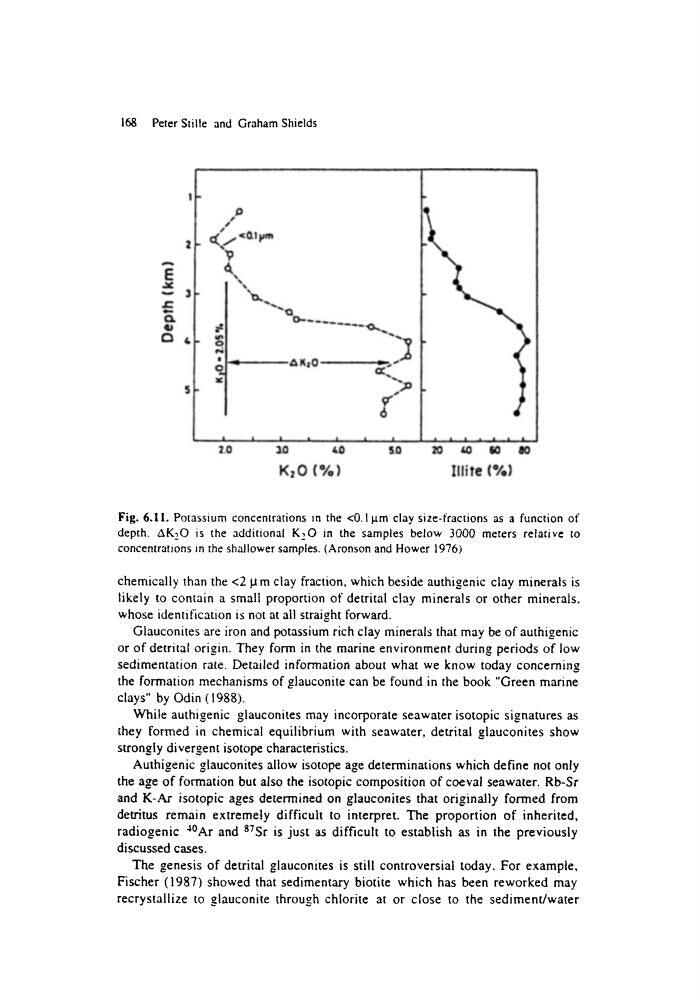
Fig. 6.11. Potassium concentrations m the <0.11.tm clay size-fractions as a function of
depth. AK20 is the additional K,O in the samples below 3000 meters relative to
concentrations in the shallower samples. (Aronson and Hower 1976)
chemically than the <2 lam clay fraction, which beside authigenic clay minerals is
likely to contain a small proportion of detrital clay minerals or other minerals,
whose identification is not at all straight forward.
Glauconites are iron and potassium rich clay minerals that may be of authigenic
or of detrital origin. They form in the marine environment during periods of low
sedimentation rate. Detailed information about what we know today concerning
the formation mechanisms of glauconite can be found in the book "Green marine
clays" by Odin (1988).
While authigenic glauconites may incorporate seawater isotopic signatures as
they formed in chemical equilibrium with seawater, detrital glauconites show
strongly divergent isotope characteristics.
Authigenic glauconites allow isotope age determinations which define not only
the age of formation but also the isotopic composition of coeval seawater. Rb-Sr
and K-Ar isotopic ages determined on glauconites that originally formed from
detritus remain extremely difficult to interpret. The proportion of inherited,
radiogenic 4~ and STSr is just as difficult to establish as in the previously
discussed cases.
The genesis of detrital glauconites is still controversial today. For example,
Fischer (1987) showed that sedimentary biotite which has been reworked may
recrystallize to glauconite through chlorite at or close to the sediment/water
A
E
"-" 3
J=
Q.
4
!
/ S
C~ t . <0.1Fm
1
6
t
i
i
l
t
1
t
2 0
3.0
40
S.O
KIO (%)
t
L
I
9
I
I
20
t,0
GO 80
Illite (%}
Fig. 6.11. Potassium concentrations m the <0.11.tm clay size-fractions as a function of
depth. AK20 is the additional K,O in the samples below 3000 meters relative to
concentrations in the shallower samples. (Aronson and Hower 1976)
chemically than the <2 lam clay fraction, which beside authigenic clay minerals is
likely to contain a small proportion of detrital clay minerals or other minerals,
whose identification is not at all straight forward.
Glauconites are iron and potassium rich clay minerals that may be of authigenic
or of detrital origin. They form in the marine environment during periods of low
sedimentation rate. Detailed information about what we know today concerning
the formation mechanisms of glauconite can be found in the book "Green marine
clays" by Odin (1988).
While authigenic glauconites may incorporate seawater isotopic signatures as
they formed in chemical equilibrium with seawater, detrital glauconites show
strongly divergent isotope characteristics.
Authigenic glauconites allow isotope age determinations which define not only
the age of formation but also the isotopic composition of coeval seawater. Rb-Sr
and K-Ar isotopic ages determined on glauconites that originally formed from
detritus remain extremely difficult to interpret. The proportion of inherited,
radiogenic 4~ and STSr is just as difficult to establish as in the previously
discussed cases.
The genesis of detrital glauconites is still controversial today. For example,
Fischer (1987) showed that sedimentary biotite which has been reworked may
recrystallize to glauconite through chlorite at or close to the sediment/water