

6 Isotope Geochemistry of Clay Minerals 163
in the coarser fraction, which is particularly enriched in detrital alkali feldspar and
micas. These detrital mineral phases display high contents of radiogenic argon.
The destruction and dissolution of these mineral phases must have released argon.
If we look at the clay fractions a little more closely: the rise in K content with
depth has the consequence of a rise in radiogenic argon (through the radioactive
decay of ~ K to argon) and so leads to a fall in the apparent age, which reaches 30
Ma at depths around 5000 m. Under the assumption that all radiogenic argon in
the newly formed illites has been produced by the radioactive decay of potassium
in the illite structure (zLAa" at depths of between 3000 and 4000 meters; Fig. 6.11),
an average age of 18.4 +/-2 Ma can be estimated for diagenesis and smectite-illite
transformation. This diagenesis caused both an increase in potassium ( z ~ 2 0 in
Fig. 6. I 1) and radiogenic argon (A~~ in Fig. 6.10) contents in the fine fractions.
On the basis of sedimentary observations it appears that this age could be
geologically relevant. The investigated sedimentary basin was still undergoing
subsidence and sedimentation about 25 Ma ago. The last 2150 meters of the
sedimentary pile were deposited between 25 and 15 Ma ago, which means that the
sedimentary series, which today lies between depths of 2150 and 5550 m, were at
the surface and at 3400 m depth, respectively, around 25 Ma ago. The diagenetic
process must therefore have set in less than 25 Ma ago.
E 3
eC1.
I.,
.!
I
9 16
,18
*20
* 22
8"0 {~ ) sMow
t.O
60
80
!00
120
-24
O
(p
I,..
41-o
o
o..
E
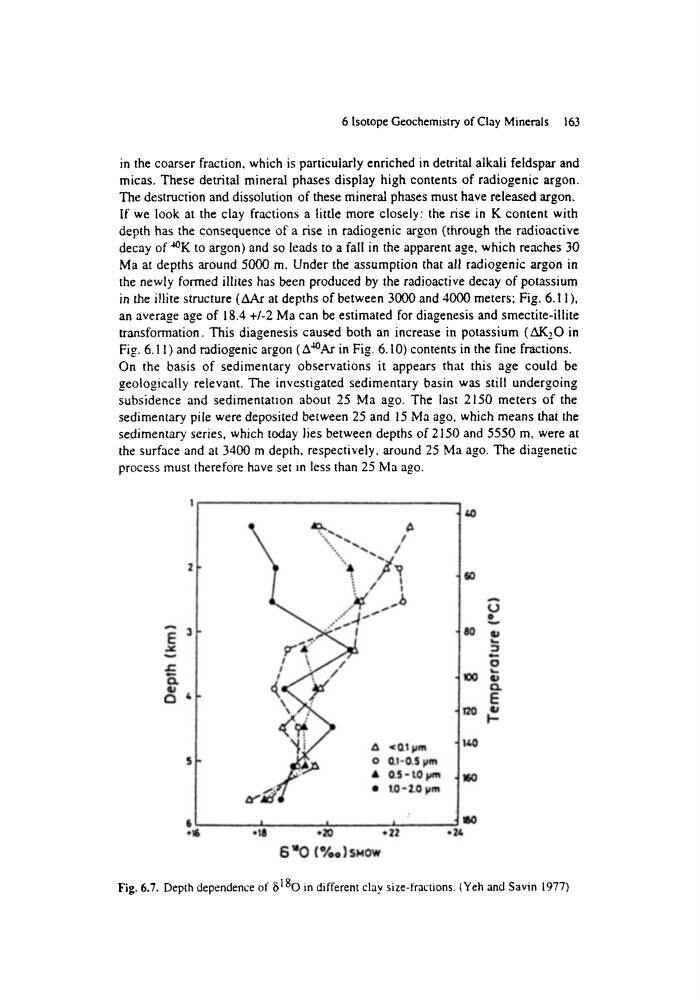
I-Fig. 6.7. Depth dependence of 8180 in different clay size-fracti0ns. (Yeh and Savin 1977)
in the coarser fraction, which is particularly enriched in detrital alkali feldspar and
micas. These detrital mineral phases display high contents of radiogenic argon.
The destruction and dissolution of these mineral phases must have released argon.
If we look at the clay fractions a little more closely: the rise in K content with
depth has the consequence of a rise in radiogenic argon (through the radioactive
decay of ~ K to argon) and so leads to a fall in the apparent age, which reaches 30
Ma at depths around 5000 m. Under the assumption that all radiogenic argon in
the newly formed illites has been produced by the radioactive decay of potassium
in the illite structure (zLAa" at depths of between 3000 and 4000 meters; Fig. 6.11),
an average age of 18.4 +/-2 Ma can be estimated for diagenesis and smectite-illite
transformation. This diagenesis caused both an increase in potassium ( z ~ 2 0 in
Fig. 6. I 1) and radiogenic argon (A~~ in Fig. 6.10) contents in the fine fractions.
On the basis of sedimentary observations it appears that this age could be
geologically relevant. The investigated sedimentary basin was still undergoing
subsidence and sedimentation about 25 Ma ago. The last 2150 meters of the
sedimentary pile were deposited between 25 and 15 Ma ago, which means that the
sedimentary series, which today lies between depths of 2150 and 5550 m, were at
the surface and at 3400 m depth, respectively, around 25 Ma ago. The diagenetic
process must therefore have set in less than 25 Ma ago.
E 3
eC1.
I.,
.!
I
9 16
,18
*20
* 22
8"0 {~ ) sMow
t.O
60
80
!00
120
-24
O
(p
I,..
41-o
o
o..
E
I-Fig. 6.7. Depth dependence of 8180 in different clay size-fracti0ns. (Yeh and Savin 1977)