

162 Peter Stille and Graham Shields
9 "-.
3
E
v
-=_
C3.
C3
/ i ....
~ o.t-o.s ~,,,
9 :>10 iJm
9 %
9
~
'-.
"~,~
./ /
~. ,, o... .,~
I
L
I
i
t
l
1
2
3
~
5
6
K2 0 (%)
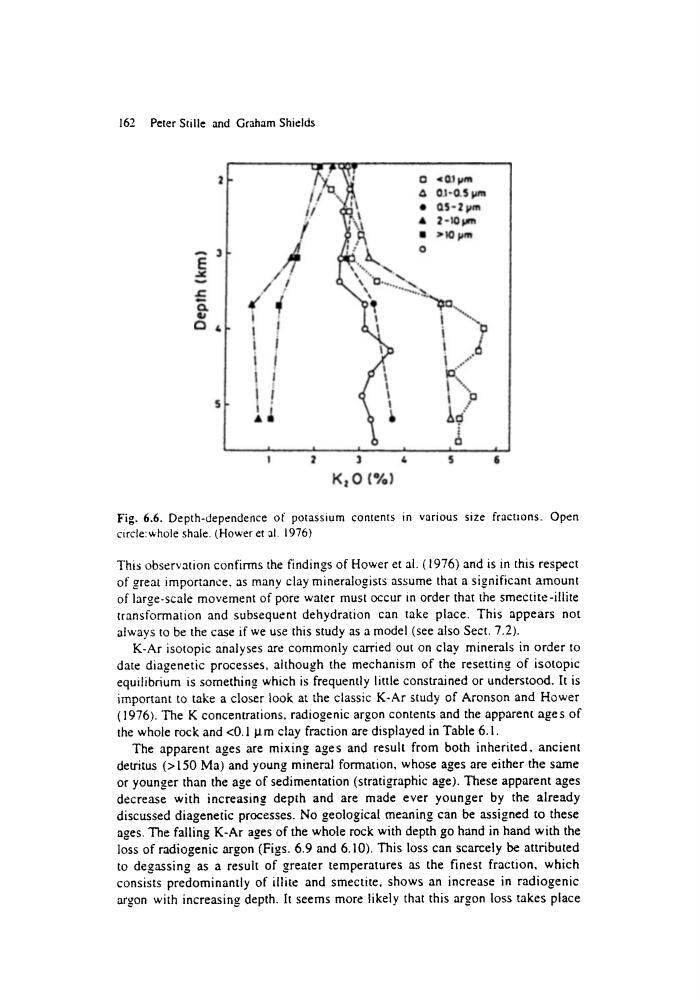
Fig. 6.6. Depth-dependence of potassium contents in various size fractions. Open
circle:whole shale. (Hower et al. 1976)
This observation confirms the findings of Hower et al. (1976) and is in this respect
of great importance, as many clay mineralogists assume that a significant amount
of large-scale movement of pore water must occur in order that the smectite-illite
transformation and subsequent dehydration can take place. This appears not
always to be the case if we use this study as a model (see also Sect. 7.2).
K-At isotopic analyses are commonly carried out on clay minerals in order to
date diagenetic processes, although the mechanism of the resetting of isotopic
equilibrium is something which is frequently little constrained or understood. It is
important to take a closer took at the classic K-At study of Aronson and Hower
(1976). The K concentrations, radiogenic argon contents and the apparent ages of
the whole rock and <0.1 Jam clay fraction are displayed in Table 6.1.
The apparent ages are mixing ages and result from both inherited, ancient
detritus (> 150 Ma) and young mineral formation, whose ages are either the same
or younger than the age of sedimentation (stratigraphic age). These apparent ages
decrease with increasing depth and are made ever younger by the already
discussed diagenetic processes. No geological meaning can be assigned to these
ages. The falling K-Ar ages of the whole rock with depth go hand in hand with the
loss of radiogenic argon (Figs. 6.9 and 6.10). This loss can scarcely be attributed
to degassing as a result of greater temperatures as the finest fraction, which
consists predominantly of illite and smectite, shows an increase in radiogenic
argon with increasing depth. It seems more likely that this argon loss takes place
9 "-.
3
E
v
-=_
C3.
C3
/ i ....
~ o.t-o.s ~,,,
9 :>10 iJm
9 %
9
~
'-.
"~,~
./ /
~. ,, o... .,~
I
L
I
i
t
l
1
2
3
~
5
6
K2 0 (%)
Fig. 6.6. Depth-dependence of potassium contents in various size fractions. Open
circle:whole shale. (Hower et al. 1976)
This observation confirms the findings of Hower et al. (1976) and is in this respect
of great importance, as many clay mineralogists assume that a significant amount
of large-scale movement of pore water must occur in order that the smectite-illite
transformation and subsequent dehydration can take place. This appears not
always to be the case if we use this study as a model (see also Sect. 7.2).
K-At isotopic analyses are commonly carried out on clay minerals in order to
date diagenetic processes, although the mechanism of the resetting of isotopic
equilibrium is something which is frequently little constrained or understood. It is
important to take a closer took at the classic K-At study of Aronson and Hower
(1976). The K concentrations, radiogenic argon contents and the apparent ages of
the whole rock and <0.1 Jam clay fraction are displayed in Table 6.1.
The apparent ages are mixing ages and result from both inherited, ancient
detritus (> 150 Ma) and young mineral formation, whose ages are either the same
or younger than the age of sedimentation (stratigraphic age). These apparent ages
decrease with increasing depth and are made ever younger by the already
discussed diagenetic processes. No geological meaning can be assigned to these
ages. The falling K-Ar ages of the whole rock with depth go hand in hand with the
loss of radiogenic argon (Figs. 6.9 and 6.10). This loss can scarcely be attributed
to degassing as a result of greater temperatures as the finest fraction, which
consists predominantly of illite and smectite, shows an increase in radiogenic
argon with increasing depth. It seems more likely that this argon loss takes place