

5 Isotopic Composition of Seawater 145
easier with strontium isotope analysis providing an additional check on age (Sect.
5.1.1 ) and possible diagenetic alteration (Sect. 5.1.3).
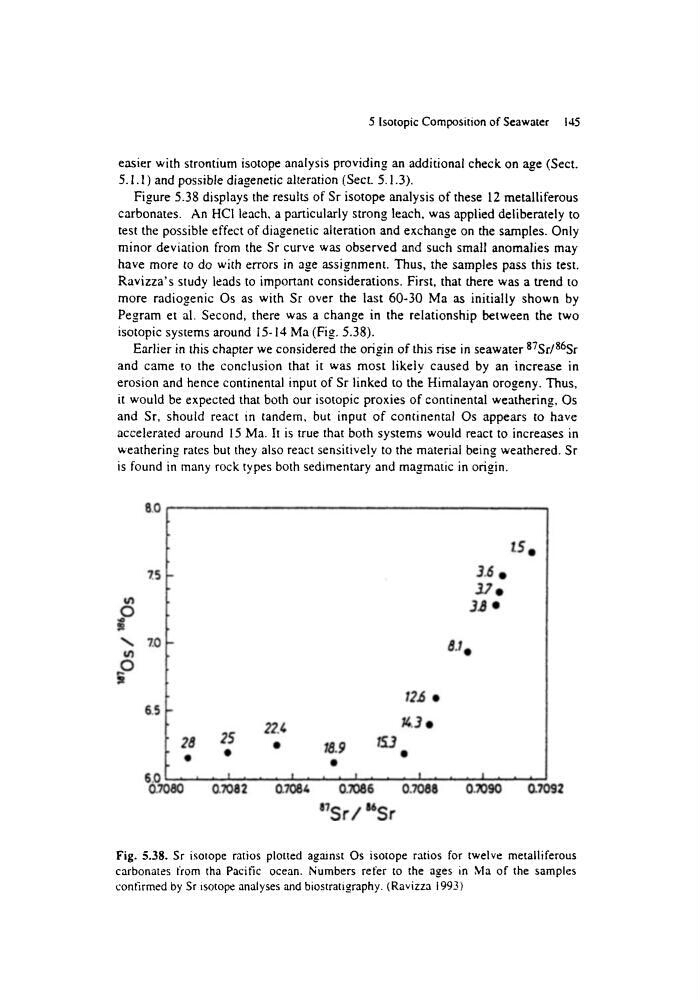
Figure 5.38 displays the results of Sr isotope analysis of these 12 metalliferous
carbonates. An HC1 leach, a particularly strong leach, was applied deliberately to
test the possible effect of diagenetic alteration and exchange on the samples. Only
minor deviation from the Sr curve was observed and such small anomalies may
have more to do with errors in age assignment. Thus, the samples pass this test.
Ravizza's study leads to important considerations. First, that there was a trend to
more radiogenic Os as with Sr over the last 60-30 Ma as initially shown by
Pegram et al. Second, there was a change in the relationship between the two
isotopic systems around I5-14 Ma (Fig. 5.38).
Earlier in this chapter we considered the origin of this rise in seawater 87Sr/86Sr
and came to the conclusion that it was most likely caused by an increase in
erosion and hence continental input of Sr linked to the Himalayan orogeny. Thus,
it would be expected that both our isotopic proxies of continental weathering, Os
and Sr, should react in tandem, but input of continental Os appears to have
accelerated around 15 Ma. It is true that both systems would react to increases in
weathering rates but they also react sensitively to the material being weathered. Sr
is found in many rock types both sedimentary and magmatic in origin.
8.0
0
~O
0
75
gO
6.5
28
6 0
. '
03080
22.~
25
3.6 9
3.7,
3~ 9
;2A 9
g.3o
I
0.7088
82 e
1.5,
18.9
153
9
I
.
.
!
.
9
1
.
|
0.7082
().7084 0.7086
0.7090 0.7092
'TSr/'+Sr
Fig. 5.38. Sr isotope ratios plotted against Os isotope ratios for twelve metalliferous
carbonates from tha Pacific ocean. Numbers refer to the ages in Ma of the samples
confirmed by Sr isotope analyses and biostratigraphy. (Ravizza 1993)
easier with strontium isotope analysis providing an additional check on age (Sect.
5.1.1 ) and possible diagenetic alteration (Sect. 5.1.3).
Figure 5.38 displays the results of Sr isotope analysis of these 12 metalliferous
carbonates. An HC1 leach, a particularly strong leach, was applied deliberately to
test the possible effect of diagenetic alteration and exchange on the samples. Only
minor deviation from the Sr curve was observed and such small anomalies may
have more to do with errors in age assignment. Thus, the samples pass this test.
Ravizza's study leads to important considerations. First, that there was a trend to
more radiogenic Os as with Sr over the last 60-30 Ma as initially shown by
Pegram et al. Second, there was a change in the relationship between the two
isotopic systems around I5-14 Ma (Fig. 5.38).
Earlier in this chapter we considered the origin of this rise in seawater 87Sr/86Sr
and came to the conclusion that it was most likely caused by an increase in
erosion and hence continental input of Sr linked to the Himalayan orogeny. Thus,
it would be expected that both our isotopic proxies of continental weathering, Os
and Sr, should react in tandem, but input of continental Os appears to have
accelerated around 15 Ma. It is true that both systems would react to increases in
weathering rates but they also react sensitively to the material being weathered. Sr
is found in many rock types both sedimentary and magmatic in origin.
8.0
0
~O
0
75
gO
6.5
28
6 0
. '
03080
22.~
25
3.6 9
3.7,
3~ 9
;2A 9
g.3o
I
0.7088
82 e
1.5,
18.9
153
9
I
.
.
!
.
9
1
.
|
0.7082
().7084 0.7086
0.7090 0.7092
'TSr/'+Sr
Fig. 5.38. Sr isotope ratios plotted against Os isotope ratios for twelve metalliferous
carbonates from tha Pacific ocean. Numbers refer to the ages in Ma of the samples
confirmed by Sr isotope analyses and biostratigraphy. (Ravizza 1993)