

2,5
t.~ '
146 Peter Stille and Graham Shields
o
5
to
15
20
25
Age (Me)
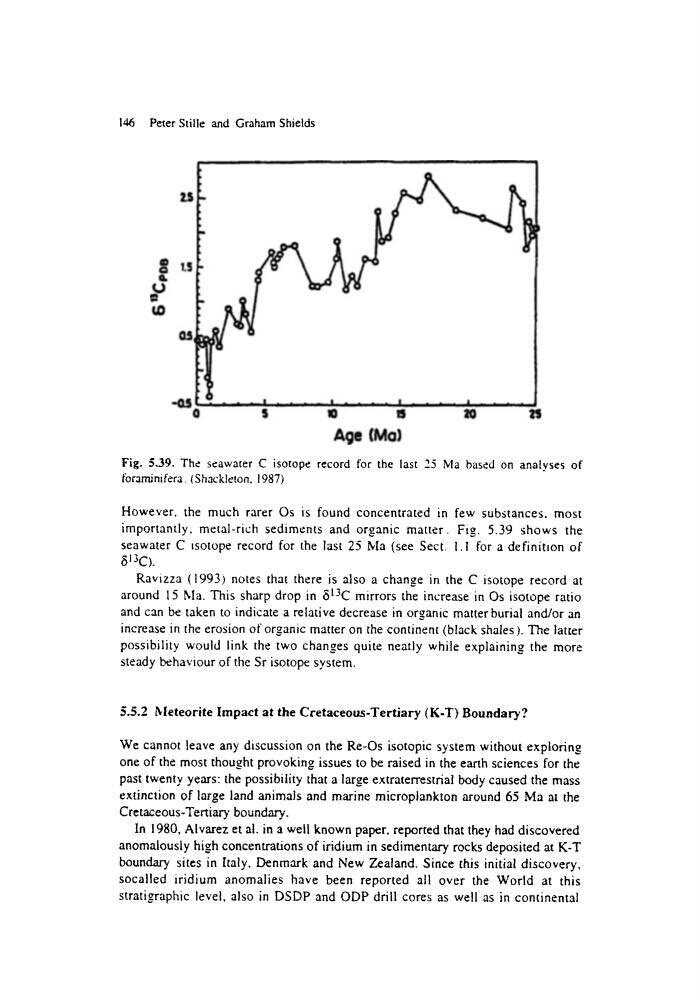
Fig. 5.39. The seawater C isotope record for the last 25 Ma based on analyses of
foraminifera. (Shackleton. 1987)
However, the much rarer Os is found concentrated in few substances, most
importantly, metal-rich sediments and organic matter. Fig. 5.39 shows the
seawater C tsotope record for the last 25 Ma (see Sect. 1.1 for a definition of
8~3C).
Ravizza (1993) notes that there is also a change in the C isotope record at
around 15 Ma. This sharp drop in 813C mirrors the increase in Os isotope ratio
and can be taken to indicate a relative decrease in organic matter burial and/or an
increase in the erosion of organic matter on the continent (black shales). The latter
possibility would link the two changes quite neatly while explaining the more
steady behaviour of the Sr isotope system.
5.5,2 Meteorite Impact at the Cretaceous-Tertiary (K-T) Boundary?
We cannot leave any discussion on the Re-Os isotopic system without exploring
one of the most thought provoking issues to be raised in the earth sciences for the
past twenty years: the possibility that a large extraterrestrial body caused the mass
extinction of large land animals and marine microplankton around 65 Ma at the
Cretaceous-Tertiary boundary.
In 1980, Alvarez et al. in a well known paper, reported that they had discovered
anomalously high concentrations of iridium in sedimentary rocks deposited at K-T
boundary sites in Italy, Denmark and New Zealand. Since this initial discovery,
socalled iridium anomalies have been reported all over the World at this
stratigraphic level, also in DSDP and ODP drill cores as well as in continental
t.~ '
146 Peter Stille and Graham Shields
o
5
to
15
20
25
Age (Me)
Fig. 5.39. The seawater C isotope record for the last 25 Ma based on analyses of
foraminifera. (Shackleton. 1987)
However, the much rarer Os is found concentrated in few substances, most
importantly, metal-rich sediments and organic matter. Fig. 5.39 shows the
seawater C tsotope record for the last 25 Ma (see Sect. 1.1 for a definition of
8~3C).
Ravizza (1993) notes that there is also a change in the C isotope record at
around 15 Ma. This sharp drop in 813C mirrors the increase in Os isotope ratio
and can be taken to indicate a relative decrease in organic matter burial and/or an
increase in the erosion of organic matter on the continent (black shales). The latter
possibility would link the two changes quite neatly while explaining the more
steady behaviour of the Sr isotope system.
5.5,2 Meteorite Impact at the Cretaceous-Tertiary (K-T) Boundary?
We cannot leave any discussion on the Re-Os isotopic system without exploring
one of the most thought provoking issues to be raised in the earth sciences for the
past twenty years: the possibility that a large extraterrestrial body caused the mass
extinction of large land animals and marine microplankton around 65 Ma at the
Cretaceous-Tertiary boundary.
In 1980, Alvarez et al. in a well known paper, reported that they had discovered
anomalously high concentrations of iridium in sedimentary rocks deposited at K-T
boundary sites in Italy, Denmark and New Zealand. Since this initial discovery,
socalled iridium anomalies have been reported all over the World at this
stratigraphic level, also in DSDP and ODP drill cores as well as in continental