

12J, Peter Stille and Graham Shields
In this case, the isotope ratios and the REE patterns should reflect those of
seawater. The high REE concentrations that appear even in early phases of
diagenesis have the consequence that the phosphate may remain relatively
insensitive even to later diagenetic exchange processes and are likely to retain
their original isotopic composition. Such considerations argue very much in
favour of using phosphatic rocks or fossils for Nd isotopic work.
Grandjean et al.'s arguments concerning REE enrichment close to the
sediment/seawater interface are illuminating, although the isotopic data allow us
to establish that not only marine Sr and Nd were incorporated into the phosphate
lattice during diagenetic alteration. Although Sr isotopic ratios for some samples
do lie on or near the Sr evolution curve, some quite clearly do not.
The recent studies of Stille et al. (1994; 1997) und Riggs et al. (1997) on
various types of marine phosphate material (brachiopods, vertebrae, teeth, bone
fragments and peloidal grains) showed that phosphatic peloids are by far the most
suitable phosphatic material for the determination of seawater Sr and Nd isotopic
composition.
0.5126
Z ~
0.512/.
Z
0.5122
0.5120
Pacific ocean
Atlantic ocean
[ ~
Indian ocean
0
2O
~0
6O
80
Age (Mo)
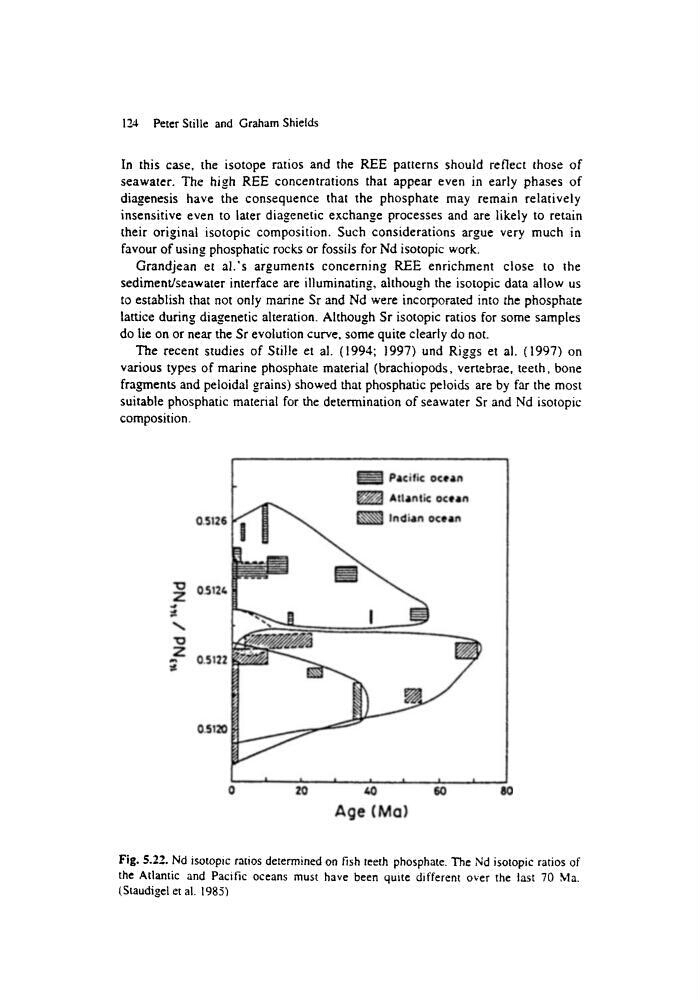
Fig. 5.22. Nd isotopic ratios determined on fish teeth phosphate. The Nd isotopic ratios of
the Atlantic and Pacific oceans must have been quite different over the last 70 Ma.
(Staudigel et al. 19851
In this case, the isotope ratios and the REE patterns should reflect those of
seawater. The high REE concentrations that appear even in early phases of
diagenesis have the consequence that the phosphate may remain relatively
insensitive even to later diagenetic exchange processes and are likely to retain
their original isotopic composition. Such considerations argue very much in
favour of using phosphatic rocks or fossils for Nd isotopic work.
Grandjean et al.'s arguments concerning REE enrichment close to the
sediment/seawater interface are illuminating, although the isotopic data allow us
to establish that not only marine Sr and Nd were incorporated into the phosphate
lattice during diagenetic alteration. Although Sr isotopic ratios for some samples
do lie on or near the Sr evolution curve, some quite clearly do not.
The recent studies of Stille et al. (1994; 1997) und Riggs et al. (1997) on
various types of marine phosphate material (brachiopods, vertebrae, teeth, bone
fragments and peloidal grains) showed that phosphatic peloids are by far the most
suitable phosphatic material for the determination of seawater Sr and Nd isotopic
composition.
0.5126
Z ~
0.512/.
Z
0.5122
0.5120
Pacific ocean
Atlantic ocean
[ ~
Indian ocean
0
2O
~0
6O
80
Age (Mo)
Fig. 5.22. Nd isotopic ratios determined on fish teeth phosphate. The Nd isotopic ratios of
the Atlantic and Pacific oceans must have been quite different over the last 70 Ma.
(Staudigel et al. 19851