

5 Isotopic Composition of Seawater 123
0.7085
t,
03 0.7080
0.7090 I~ .t.~.. ~
I
0.7075
9 e 9 - 9
9 o o 9
9
6
I
i
I 0
I
|
l
l
1o 2o
t,,o 50
60 70
Age (Mo)
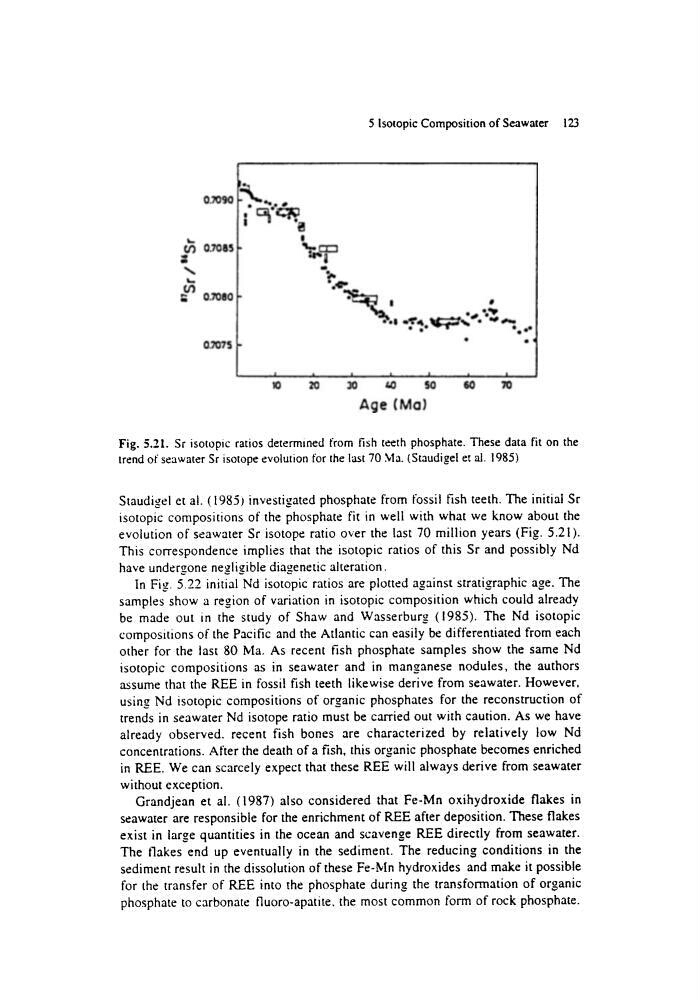
Fig. 5.21. Sr isotopic ratios determined from fish teeth phosphate. These data fit on the
trend of seawater Sr isotope evolution for the last 70 Ma. (Staudigel et al. 1985)
Staudigel et al. ( 19851 investigated phosphate from fossil fish teeth. The initial Sr
isotopic compositions of the phosphate fit in well with what we know about the
evolution of seawater Sr isotope ratio over the last 70 million years (Fig. 5.21).
This correspondence implies that the isotopic ratios of this Sr and possibly Nd
have undergone negligible diagenetic alteration.
In Fig. 5.22 initial Nd isotopic ratios are plotted against stratigraphic age. The
samples show a region of variation in isotopic composition which could already
be made out in the study of Shaw and Wasserburg (1985). The Nd isotopic
compositions of the Pacific and the Atlantic can easily be differentiated from each
other for the last 80 Ma. As recent fish phosphate samples show the same Nd
isotopic compositions as in seawater and in manganese nodules, the authors
assume that the REE in fossil fish teeth likewise derive from seawater. However,
using Nd isotopic compositions of organic phosphates for the reconstruction of
trends in seawater Nd isotope ratio must be carried out with caution. As we have
already observed, recent fish bones are characterized by relatively low Nd
concentrations. After the death of a fish, this organic phosphate becomes enriched
in REE. We can scarcely expect that these REE will always derive from seawater
without exception.
Grandjean et al. (1987) also considered that Fe-Mn oxihydroxide flakes in
seawater are responsible for the enrichment of REE after deposition. These flakes
exist in large quantities in the ocean and scavenge REE directly from seawater.
The flakes end up eventually in the sediment. The reducing conditions in the
sediment result in the dissolution of these Fe-Mn hydroxides and make it possible
for the transfer of REE into the phosphate during the transformation of organic
phosphate to carbonate fluoro-apatite, the most common form of rock phosphate.
0.7085
t,
03 0.7080
0.7090 I~ .t.~.. ~
I
0.7075
9 e 9 - 9
9 o o 9
9
6
I
i
I 0
I
|
l
l
1o 2o
t,,o 50
60 70
Age (Mo)
Fig. 5.21. Sr isotopic ratios determined from fish teeth phosphate. These data fit on the
trend of seawater Sr isotope evolution for the last 70 Ma. (Staudigel et al. 1985)
Staudigel et al. ( 19851 investigated phosphate from fossil fish teeth. The initial Sr
isotopic compositions of the phosphate fit in well with what we know about the
evolution of seawater Sr isotope ratio over the last 70 million years (Fig. 5.21).
This correspondence implies that the isotopic ratios of this Sr and possibly Nd
have undergone negligible diagenetic alteration.
In Fig. 5.22 initial Nd isotopic ratios are plotted against stratigraphic age. The
samples show a region of variation in isotopic composition which could already
be made out in the study of Shaw and Wasserburg (1985). The Nd isotopic
compositions of the Pacific and the Atlantic can easily be differentiated from each
other for the last 80 Ma. As recent fish phosphate samples show the same Nd
isotopic compositions as in seawater and in manganese nodules, the authors
assume that the REE in fossil fish teeth likewise derive from seawater. However,
using Nd isotopic compositions of organic phosphates for the reconstruction of
trends in seawater Nd isotope ratio must be carried out with caution. As we have
already observed, recent fish bones are characterized by relatively low Nd
concentrations. After the death of a fish, this organic phosphate becomes enriched
in REE. We can scarcely expect that these REE will always derive from seawater
without exception.
Grandjean et al. (1987) also considered that Fe-Mn oxihydroxide flakes in
seawater are responsible for the enrichment of REE after deposition. These flakes
exist in large quantities in the ocean and scavenge REE directly from seawater.
The flakes end up eventually in the sediment. The reducing conditions in the
sediment result in the dissolution of these Fe-Mn hydroxides and make it possible
for the transfer of REE into the phosphate during the transformation of organic
phosphate to carbonate fluoro-apatite, the most common form of rock phosphate.