

122 Peter Stille and Graham Shields
0.51230
'10
Z
'Io
Z 0.51220
Q51210
0
L
i
30
i
,
tO
20
t,O
50
Age {Mo)
60
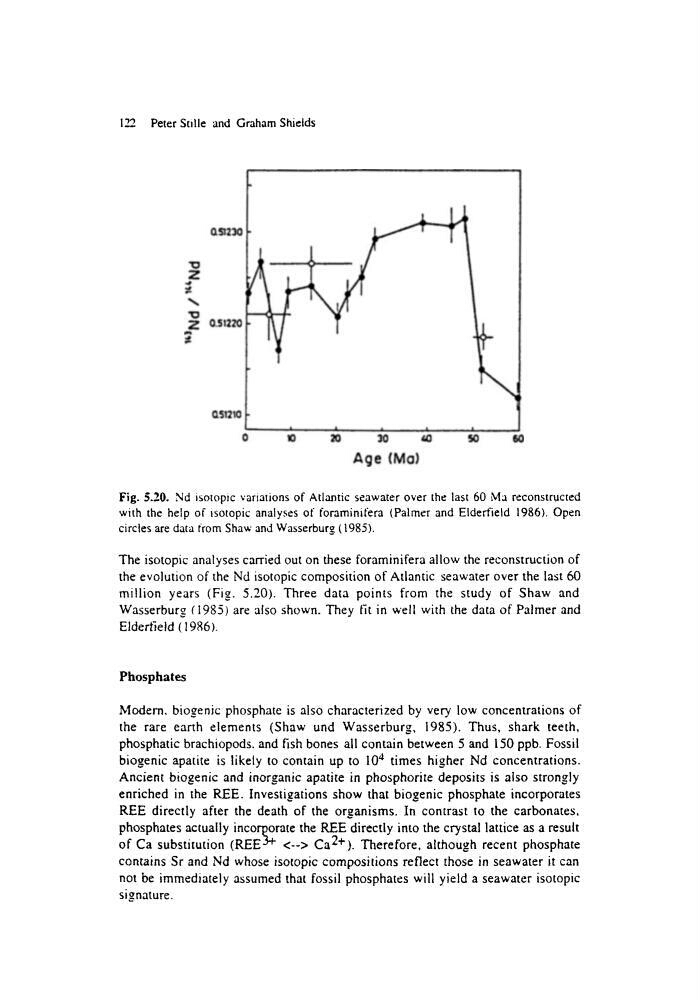
Fig. 5.20. Nd isotopic variations of Atlantic seawater over the last 60 Ma reconstructed
with the help of isotopic analyses of foraminifera (Palmer and Elderfield 1986). Open
circles are data (tom Shaw and Wasserburg (1985).
The isotopic analyses carried out on these foraminifera allow the reconstruction of
the evolution of the Nd isotopic composition of Atlantic seawater over the last 60
million years (Fig. 5.20). Three data points from the study of Shaw and
Wasserburg (1985) are also shown. They fit in well with the data of Palmer and
Elderfietd (1986).
Phosphates
Modern, biogenic phosphate is also characterized by very low concentrations of
the rare earth elements (Shaw und Wasserburg, 1985). Thus, shark teeth,
phosphatic brachiopods, and fish bones all contain between 5 and 150 ppb. Fossil
biogenic apatite is likely to contain up to 104 times higher Nd concentrations.
Ancient biogenic and inorganic apatite in phosphorite deposits is also strongly
enriched in the REE. Investigations show that biogenic phosphate incorporates
REE directly after the death of the organisms. In contrast to the carbonates,
phosphates actually incorporate the REE directly into the crystal lattice as a result
of Ca substitution (REE -r~" <--> Ca2+). Therefore, although recent phosphate
contains Sr and Nd whose isotopic compositions reflect those in seawater it can
not be immediately assumed that fossil phosphates will yield a seawater isotopic
signature.
0.51230
'10
Z
'Io
Z 0.51220
Q51210
0
L
i
30
i
,
tO
20
t,O
50
Age {Mo)
60
Fig. 5.20. Nd isotopic variations of Atlantic seawater over the last 60 Ma reconstructed
with the help of isotopic analyses of foraminifera (Palmer and Elderfield 1986). Open
circles are data (tom Shaw and Wasserburg (1985).
The isotopic analyses carried out on these foraminifera allow the reconstruction of
the evolution of the Nd isotopic composition of Atlantic seawater over the last 60
million years (Fig. 5.20). Three data points from the study of Shaw and
Wasserburg (1985) are also shown. They fit in well with the data of Palmer and
Elderfietd (1986).
Phosphates
Modern, biogenic phosphate is also characterized by very low concentrations of
the rare earth elements (Shaw und Wasserburg, 1985). Thus, shark teeth,
phosphatic brachiopods, and fish bones all contain between 5 and 150 ppb. Fossil
biogenic apatite is likely to contain up to 104 times higher Nd concentrations.
Ancient biogenic and inorganic apatite in phosphorite deposits is also strongly
enriched in the REE. Investigations show that biogenic phosphate incorporates
REE directly after the death of the organisms. In contrast to the carbonates,
phosphates actually incorporate the REE directly into the crystal lattice as a result
of Ca substitution (REE -r~" <--> Ca2+). Therefore, although recent phosphate
contains Sr and Nd whose isotopic compositions reflect those in seawater it can
not be immediately assumed that fossil phosphates will yield a seawater isotopic
signature.