

5 Isotopic Composition of Seawater 121
altered during diagenesis. Although changes in accumulation rates are possible, it
appears more likely that the Mn/Fe ratios have been altered during diagenesis.
Froehlich et al. (1979) showed that Mn and Fe are very mobile during anoxic
diagenesis. As the concentrations of the REE in recent samples can be correlated
with Fe content, it can be assumed that the transformation of an Fe-rich phase
with low Mn/Fe ratios to a Mn-rich phase with high Mn/Fe ratios must lead to
remobilization of the REE. It is possible that the Fe-rich crusts of recent
foraminifera are dissolved during this kind of diagenetic process leading to a
redistribution of the REE. High Mn/Fe ratios can therefore be used as an indicator
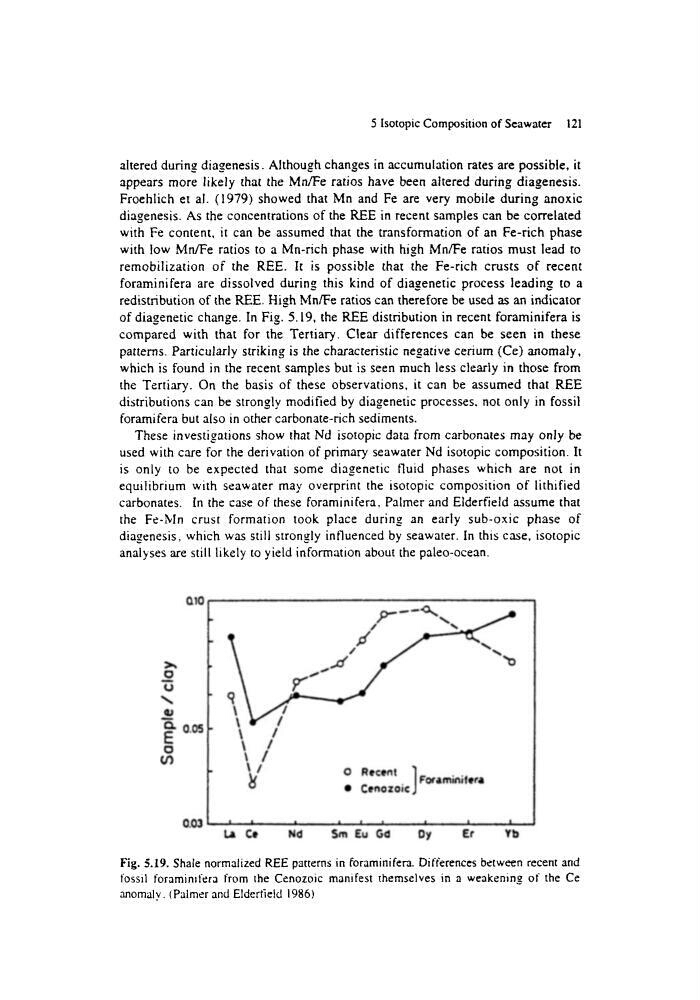
of diagenetic change. In Fig. 5.19, the REE distribution in recent foraminifera is
compared with that for the Tertiary. Clear differences can be seen in these
patterns. Particularly striking is the characteristic negative cerium (Ce) anomaly,
which is found in the recent samples but is seen much less clearly in those from
the Tertiary. On the basis of these observations, it can be assumed that REE
distributions can be strongly modified by diagenetic processes, not only in fossil
foramifera but also in other carbonate-rich sediments.
These investigations show that Nd isotopic data from carbonates may only be
used with care for the derivation of primary seawater Nd isotopic composition. It
is only to be expected that some diagenetic fluid phases which are not in
equilibrium with seawater may overprint the isotopic composition of lithified
carbonates, in the case of these foraminifera, Palmer and Elderfield assume that
the Fe-Mn crust formation took place during an early sub-oxic phase of
diagenesis, which was still strongly influenced by seawater. In this case, isotopic
analyses are still likely to yield information about the paleo-ocean.
(110
i
O
oJ
Q- 0.05
E
o
CO
/
!
/
~ /
0 Recent ] Forami.ifera
9 Cenozoic,]
La Ce
Nd
Sm Eu Gd
Oy
Er
Yb
Fig. 5.19. Shale normalized REE patterns in foraminifera. Differences between recent and
fossil foraminifera from the Cenozoic manifest themselves in a weakening of the Ce
anomaly. (Palmer and Elderfield 1986)
altered during diagenesis. Although changes in accumulation rates are possible, it
appears more likely that the Mn/Fe ratios have been altered during diagenesis.
Froehlich et al. (1979) showed that Mn and Fe are very mobile during anoxic
diagenesis. As the concentrations of the REE in recent samples can be correlated
with Fe content, it can be assumed that the transformation of an Fe-rich phase
with low Mn/Fe ratios to a Mn-rich phase with high Mn/Fe ratios must lead to
remobilization of the REE. It is possible that the Fe-rich crusts of recent
foraminifera are dissolved during this kind of diagenetic process leading to a
redistribution of the REE. High Mn/Fe ratios can therefore be used as an indicator
of diagenetic change. In Fig. 5.19, the REE distribution in recent foraminifera is
compared with that for the Tertiary. Clear differences can be seen in these
patterns. Particularly striking is the characteristic negative cerium (Ce) anomaly,
which is found in the recent samples but is seen much less clearly in those from
the Tertiary. On the basis of these observations, it can be assumed that REE
distributions can be strongly modified by diagenetic processes, not only in fossil
foramifera but also in other carbonate-rich sediments.
These investigations show that Nd isotopic data from carbonates may only be
used with care for the derivation of primary seawater Nd isotopic composition. It
is only to be expected that some diagenetic fluid phases which are not in
equilibrium with seawater may overprint the isotopic composition of lithified
carbonates, in the case of these foraminifera, Palmer and Elderfield assume that
the Fe-Mn crust formation took place during an early sub-oxic phase of
diagenesis, which was still strongly influenced by seawater. In this case, isotopic
analyses are still likely to yield information about the paleo-ocean.
(110
i
O
oJ
Q- 0.05
E
o
CO
/
!
/
~ /
0 Recent ] Forami.ifera
9 Cenozoic,]
La Ce
Nd
Sm Eu Gd
Oy
Er
Yb
Fig. 5.19. Shale normalized REE patterns in foraminifera. Differences between recent and
fossil foraminifera from the Cenozoic manifest themselves in a weakening of the Ce
anomaly. (Palmer and Elderfield 1986)