

5 Isotopic Composition of Seawater 1~
Fish teeth and bones can vary strongly showing isotopic ratios which can be far
removed from that of coeval seawater. This would imply that their diagenetic
systems are more open to exchange rendering them more susceptible to
contamination from non-seawater sources.
In order to derive seawater Nd isotopic composition using phosphates, it is
important that a control be first carried out by measuring the Sr isotopic
composition of the material and comparing this with the established curve for
seawater Sr isotope evolution. Only samples yielding primary Sr isotopic
compositions and seawater REE patterns (HREE enrichment and Ce anomaly)
should then be used to derive the seawater Nd isotopic composition.
+ 10
+8
" 5
"O
z §
~J
-t.
- 6
,d" r "5-,."--~x;
/q i ....
i
.
1
,
l)
. / .
"
~ i~,
, ~ "
?
o , ,,
,,
. /
9
i ,
.--d
'
9
Jt (
~))
9
'
I
!
,
I
I
II
~r'~l I
i I I
I I
,
4
1
~
i
(1 t
It
t
2 3
4 5 6 Z
8 9 t 0
,,
9
I
I
-
I
. . . .
I
1000
2000
3000
/,000
Age (Ma)
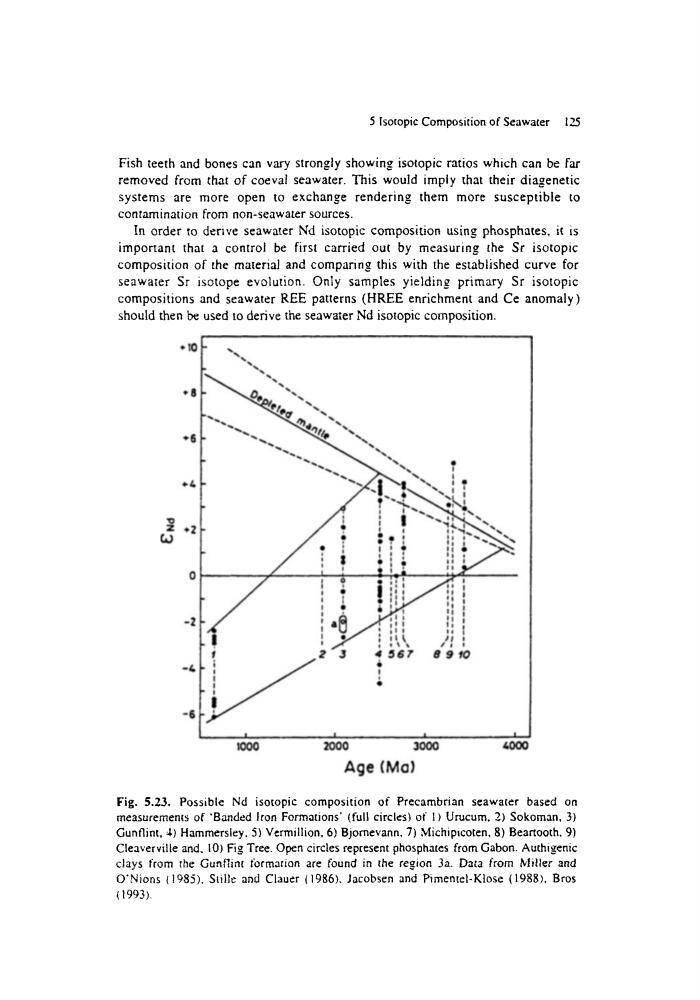
Fig. 5.23. Possible Nd isotopic composition of Precambrian seawater based on
measurements of "Banded Iron Formations' (full circles} of 1) Urucum, 9.2) Sokoman, 3)
Gunflint, ~) Hammersley. 5) Vermillion, 6) Bjomevann, 7) Michiptcoten, 8) Beartooth, 9)
Cleavervilte and. 10) Fig Tree. Open circles represent phosphates from Gabon. Authigenic
clays from the Gunflint formation are found in the region 3a. Data /'tom Miller and
O'Nions (1985), Stifle and Clauer (1986), Jacobsen and Pimentel-Ktose (1988), Bros
(1993).
Fish teeth and bones can vary strongly showing isotopic ratios which can be far
removed from that of coeval seawater. This would imply that their diagenetic
systems are more open to exchange rendering them more susceptible to
contamination from non-seawater sources.
In order to derive seawater Nd isotopic composition using phosphates, it is
important that a control be first carried out by measuring the Sr isotopic
composition of the material and comparing this with the established curve for
seawater Sr isotope evolution. Only samples yielding primary Sr isotopic
compositions and seawater REE patterns (HREE enrichment and Ce anomaly)
should then be used to derive the seawater Nd isotopic composition.
+ 10
+8
" 5
"O
z §
~J
-t.
- 6
,d" r "5-,."--~x;
/q i ....
i
.
1
,
l)
. / .
"
~ i~,
, ~ "
?
o , ,,
,,
. /
9
i ,
.--d
'
9
Jt (
~))
9
'
I
!
,
I
I
II
~r'~l I
i I I
I I
,
4
1
~
i
(1 t
It
t
2 3
4 5 6 Z
8 9 t 0
,,
9
I
I
-
I
. . . .
I
1000
2000
3000
/,000
Age (Ma)
Fig. 5.23. Possible Nd isotopic composition of Precambrian seawater based on
measurements of "Banded Iron Formations' (full circles} of 1) Urucum, 9.2) Sokoman, 3)
Gunflint, ~) Hammersley. 5) Vermillion, 6) Bjomevann, 7) Michiptcoten, 8) Beartooth, 9)
Cleavervilte and. 10) Fig Tree. Open circles represent phosphates from Gabon. Authigenic
clays from the Gunflint formation are found in the region 3a. Data /'tom Miller and
O'Nions (1985), Stifle and Clauer (1986), Jacobsen and Pimentel-Ktose (1988), Bros
(1993).