

5 Isotopic Composition of Seawater
99
Sr has a lower distribution coefficient in calcite than Mn (<1 and >1, respectively)
and so Sr tends to be lost during diagenesis while Mn tends to be incorporporated
into the precipitating calcite depending on availability. On deposition, most
carbonates have minimal Mn contents and contain up to 3-6000 ppm Sr. Veizer et
al. calculated that recrystallization of a calcite in an open diagenetic system would
result in Sr contents of around 400 ppm today. Such Sr loss may be accompanied
by strontium isotopic exchange. Using the same principle, Mg tends to be lost
during dissolution and reprecipitation events, while Fe is gained. Of course, loss
of Sr from the system does not necessarily have to alter the isotopic ratio of the
recrystallized carbonate. The effect of such trace element exchange depends on
the closedness of the system and the presence of other sources having possibly
different Sr isotopic ratios than seawater (hydrotherrnal fluids, detritus. Sr from
older carbonates undergoing dissolution). Such diagenetic indicators may allow us
to constrain initial Sr isotopic ratio (i.e. seawater) by constructing diagenetic
trends.
0.711
f~
0.710
0.709
0.708
0.707
0.706
0305
I t
!
!
I
!
I
I
J
Late Proterozoic
I
I
1000
800
Phanerozoic
,.I
I
I
600
t,O0
200
Age (Ma)
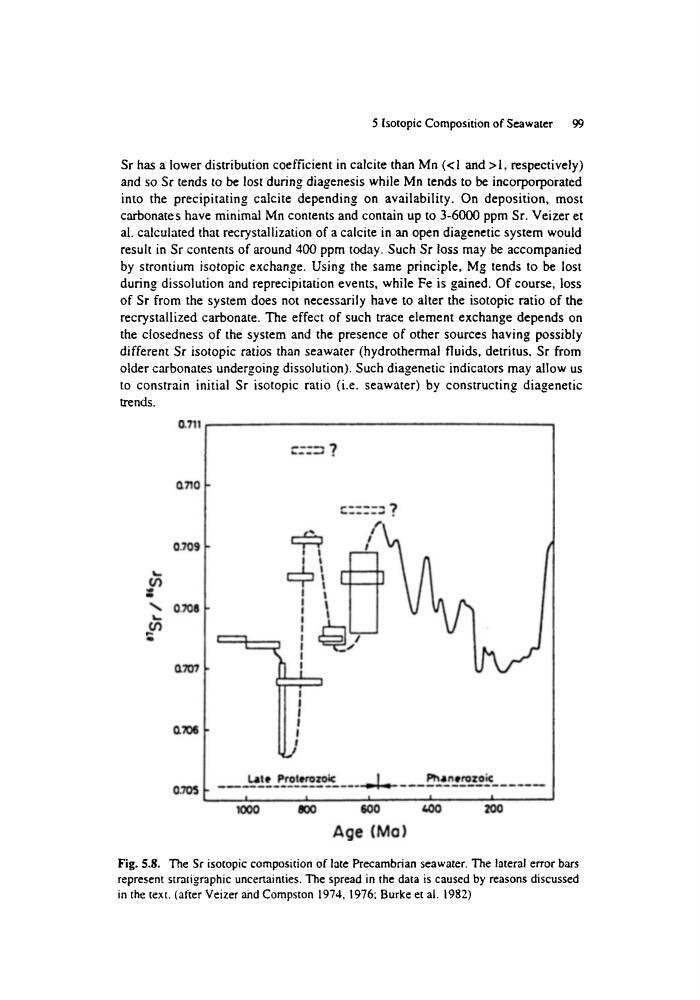
Fig. 5.8. The Sr isotopic composition of late Precambrian seawater. The lateral error bars
represent strafigraphic uncertainties. The spread in the data is caused by reasons discussed
in the text. (after Veizer and Compston 1974, 1976: Burke et al. 1982)
99
Sr has a lower distribution coefficient in calcite than Mn (<1 and >1, respectively)
and so Sr tends to be lost during diagenesis while Mn tends to be incorporporated
into the precipitating calcite depending on availability. On deposition, most
carbonates have minimal Mn contents and contain up to 3-6000 ppm Sr. Veizer et
al. calculated that recrystallization of a calcite in an open diagenetic system would
result in Sr contents of around 400 ppm today. Such Sr loss may be accompanied
by strontium isotopic exchange. Using the same principle, Mg tends to be lost
during dissolution and reprecipitation events, while Fe is gained. Of course, loss
of Sr from the system does not necessarily have to alter the isotopic ratio of the
recrystallized carbonate. The effect of such trace element exchange depends on
the closedness of the system and the presence of other sources having possibly
different Sr isotopic ratios than seawater (hydrotherrnal fluids, detritus. Sr from
older carbonates undergoing dissolution). Such diagenetic indicators may allow us
to constrain initial Sr isotopic ratio (i.e. seawater) by constructing diagenetic
trends.
0.711
f~
0.710
0.709
0.708
0.707
0.706
0305
I t
!
!
I
!
I
I
J
Late Proterozoic
I
I
1000
800
Phanerozoic
,.I
I
I
600
t,O0
200
Age (Ma)
Fig. 5.8. The Sr isotopic composition of late Precambrian seawater. The lateral error bars
represent strafigraphic uncertainties. The spread in the data is caused by reasons discussed
in the text. (after Veizer and Compston 1974, 1976: Burke et al. 1982)