

98
Peter Stille and Graham Shields
relatively high Rb/Sr ratios. The decay of 87Rb to 87Sr means that unintentional
leaching of even authigenic clays wil tend to skew Sr isotopic ratios higher, away
from seawater. Dissolution using a weaker acid, possibly buffered around a
relatively gentle pH, may help solve this problem as we will see in examples to
come. However, some Sr will always be leached from detritus or later diagenetic
carbonate phases and so it is equally important to check the purity of a sample as
well as the type of detritus present.
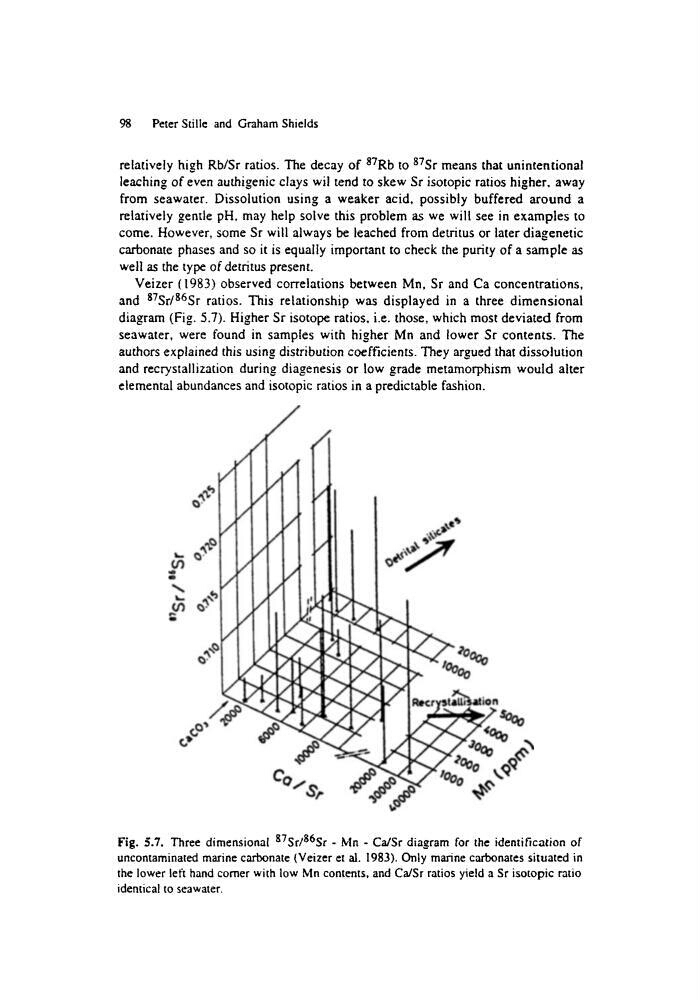
Veizer (1983) observed correlations between Mn, Sr and Ca concentrations,
and 87Sr/S6Sr ratios. This relationship was displayed in a three dimensional
diagram (Fig. 5.7). Higher Sr isotope ratios, i.e. those, which most deviated from
seawater, were found in samples with higher Mn and lower Sr contents. The
authors explained this using distribution coefficients. They a~ued that dissolution
and recrystallization during diagenesis or low grade metamorphism would alter
elemental abundances and isotopic ratios in a predictable fashion.
/
/
...,4
~0
ecryst~ation
r y, ooo ; +
Fig. 5.7. Three dimensional 87$r/86Sr - lVln - Ca/St diagram for the identification of
uncontaminated marine carbonate (Veizer et all. 1983). Only marine carbonates situated in
the lower left hand comer with low Mn contents, and Ca/Sr ratios yield a Sr isotopic ratio
identical to seawater.
Peter Stille and Graham Shields
relatively high Rb/Sr ratios. The decay of 87Rb to 87Sr means that unintentional
leaching of even authigenic clays wil tend to skew Sr isotopic ratios higher, away
from seawater. Dissolution using a weaker acid, possibly buffered around a
relatively gentle pH, may help solve this problem as we will see in examples to
come. However, some Sr will always be leached from detritus or later diagenetic
carbonate phases and so it is equally important to check the purity of a sample as
well as the type of detritus present.
Veizer (1983) observed correlations between Mn, Sr and Ca concentrations,
and 87Sr/S6Sr ratios. This relationship was displayed in a three dimensional
diagram (Fig. 5.7). Higher Sr isotope ratios, i.e. those, which most deviated from
seawater, were found in samples with higher Mn and lower Sr contents. The
authors explained this using distribution coefficients. They a~ued that dissolution
and recrystallization during diagenesis or low grade metamorphism would alter
elemental abundances and isotopic ratios in a predictable fashion.
/
/
...,4
~0
ecryst~ation
r y, ooo ; +
Fig. 5.7. Three dimensional 87$r/86Sr - lVln - Ca/St diagram for the identification of
uncontaminated marine carbonate (Veizer et all. 1983). Only marine carbonates situated in
the lower left hand comer with low Mn contents, and Ca/Sr ratios yield a Sr isotopic ratio
identical to seawater.