

15 Conceptual Models and Computer Models
524
depth x below the sediment surface. Here, t=0 is a
point in time at which the concentration C 0 prevails
in the profile’s entire pore water compartment. At all
later points in time the bottom water displayed a
constant value C bw . An approximation for the
complementary error function (erfc) according to
Kinzelbach (1986) can be found in Section 3.2.4,
where examples are given that employ this
analytical solution of Fick’s Second Law.
Advection and very simple reactions can also
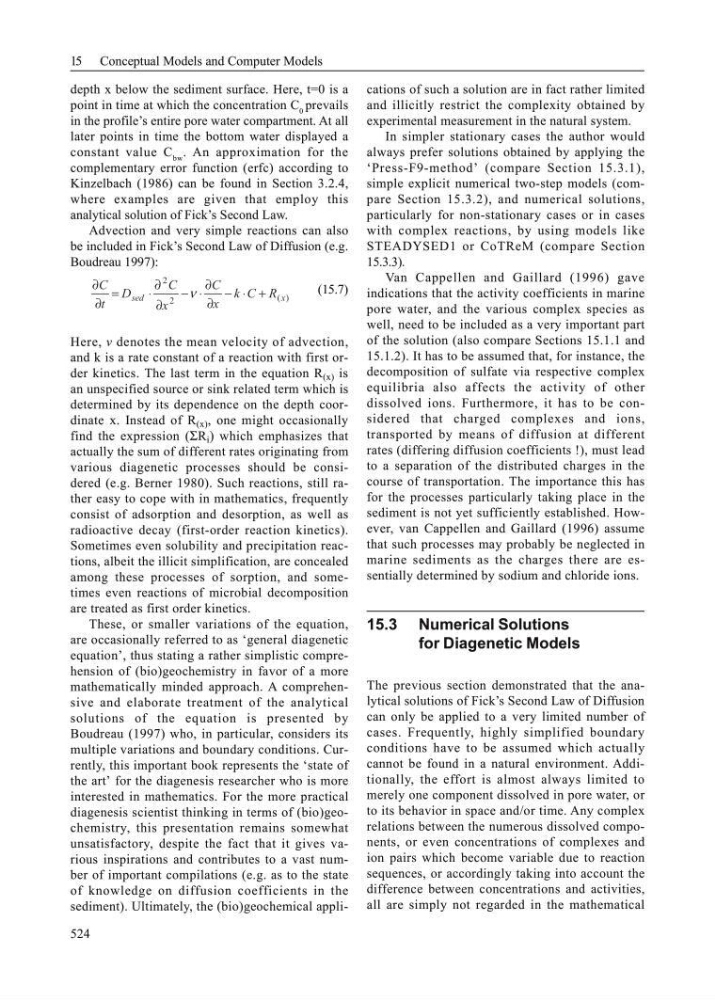
be included in Fick’s Second Law of Diffusion (e.g.
Boudreau 1997):
)
(
2
2
x
sed
R
C
k
x
C
x
C
D
t
C
+
⋅
−
∂
∂
⋅
−
∂
∂
⋅
=
∂
∂
ν
(15.7)
Here, v denotes the mean velocity of advection,
and k is a rate constant of a reaction with first order kinetics. The last term in the equation R (x) is
an unspecified source or sink related term which is
determined by its dependence on the depth coordinate x. Instead of R (x) , one might occasionally
find the expression (ΣR i ) which emphasizes that
actually the sum of different rates originating from
various diagenetic processes should be considered (e.g. Berner 1980). Such reactions, still rather easy to cope with in mathematics, frequently
consist of adsorption and desorption, as well as
radioactive decay (first-order reaction kinetics).
Sometimes even solubility and precipitation reactions, albeit the illicit simplification, are concealed
among these processes of sorption, and sometimes even reactions of microbial decomposition
are treated as first order kinetics.
These, or smaller variations of the equation,
are occasionally referred to as ‘general diagenetic
equation’, thus stating a rather simplistic comprehension of (bio)geochemistry in favor of a more
mathematically minded approach. A comprehensive and elaborate treatment of the analytical
solutions of the equation is presented by
Boudreau (1997) who, in particular, considers its
multiple variations and boundary conditions. Currently, this important book represents the ‘state of
the art’ for the diagenesis researcher who is more
interested in mathematics. For the more practical
diagenesis scientist thinking in terms of (bio)geochemistry, this presentation remains somewhat
unsatisfactory, despite the fact that it gives various inspirations and contributes to a vast number of important compilations (e.g. as to the state
of knowledge on diffusion coefficients in the
sediment). Ultimately, the (bio)geochemical applications of such a solution are in fact rather limited
and illicitly restrict the complexity obtained by
experimental measurement in the natural system.
In simpler stationary cases the author would
always prefer solutions obtained by applying the
‘Press-F9-method’ (compare Section 15.3.1),
simple explicit numerical two-step models (compare Section 15.3.2), and numerical solutions,
particularly for non-stationary cases or in cases
with complex reactions, by using models like
STEADYSED1 or CoTReM (compare Section
15.3.3).
Van Cappellen and Gaillard (1996) gave
indications that the activity coefficients in marine
pore water, and the various complex species as
well, need to be included as a very important part
of the solution (also compare Sections 15.1.1 and
15.1.2). It has to be assumed that, for instance, the
decomposition of sulfate via respective complex
equilibria also affects the activity of other
dissolved ions. Furthermore, it has to be considered that charged complexes and ions,
transported by means of diffusion at different
rates (differing diffusion coefficients !), must lead
to a separation of the distributed charges in the
course of transportation. The importance this has
for the processes particularly taking place in the
sediment is not yet sufficiently established. However, van Cappellen and Gaillard (1996) assume
that such processes may probably be neglected in
marine sediments as the charges there are essentially determined by sodium and chloride ions.
15.3 Numerical Solutions
for Diagenetic Models
The previous section demonstrated that the analytical solutions of Fick’s Second Law of Diffusion
can only be applied to a very limited number of
cases. Frequently, highly simplified boundary
conditions have to be assumed which actually
cannot be found in a natural environment. Additionally, the effort is almost always limited to
merely one component dissolved in pore water, or
to its behavior in space and/or time. Any complex
relations between the numerous dissolved components, or even concentrations of complexes and
ion pairs which become variable due to reaction
sequences, or accordingly taking into account the
difference between concentrations and activities,
all are simply not regarded in the mathematical
524
depth x below the sediment surface. Here, t=0 is a
point in time at which the concentration C 0 prevails
in the profile’s entire pore water compartment. At all
later points in time the bottom water displayed a
constant value C bw . An approximation for the
complementary error function (erfc) according to
Kinzelbach (1986) can be found in Section 3.2.4,
where examples are given that employ this
analytical solution of Fick’s Second Law.
Advection and very simple reactions can also
be included in Fick’s Second Law of Diffusion (e.g.
Boudreau 1997):
)
(
2
2
x
sed
R
C
k
x
C
x
C
D
t
C
+
⋅
−
∂
∂
⋅
−
∂
∂
⋅
=
∂
∂
ν
(15.7)
Here, v denotes the mean velocity of advection,
and k is a rate constant of a reaction with first order kinetics. The last term in the equation R (x) is
an unspecified source or sink related term which is
determined by its dependence on the depth coordinate x. Instead of R (x) , one might occasionally
find the expression (ΣR i ) which emphasizes that
actually the sum of different rates originating from
various diagenetic processes should be considered (e.g. Berner 1980). Such reactions, still rather easy to cope with in mathematics, frequently
consist of adsorption and desorption, as well as
radioactive decay (first-order reaction kinetics).
Sometimes even solubility and precipitation reactions, albeit the illicit simplification, are concealed
among these processes of sorption, and sometimes even reactions of microbial decomposition
are treated as first order kinetics.
These, or smaller variations of the equation,
are occasionally referred to as ‘general diagenetic
equation’, thus stating a rather simplistic comprehension of (bio)geochemistry in favor of a more
mathematically minded approach. A comprehensive and elaborate treatment of the analytical
solutions of the equation is presented by
Boudreau (1997) who, in particular, considers its
multiple variations and boundary conditions. Currently, this important book represents the ‘state of
the art’ for the diagenesis researcher who is more
interested in mathematics. For the more practical
diagenesis scientist thinking in terms of (bio)geochemistry, this presentation remains somewhat
unsatisfactory, despite the fact that it gives various inspirations and contributes to a vast number of important compilations (e.g. as to the state
of knowledge on diffusion coefficients in the
sediment). Ultimately, the (bio)geochemical applications of such a solution are in fact rather limited
and illicitly restrict the complexity obtained by
experimental measurement in the natural system.
In simpler stationary cases the author would
always prefer solutions obtained by applying the
‘Press-F9-method’ (compare Section 15.3.1),
simple explicit numerical two-step models (compare Section 15.3.2), and numerical solutions,
particularly for non-stationary cases or in cases
with complex reactions, by using models like
STEADYSED1 or CoTReM (compare Section
15.3.3).
Van Cappellen and Gaillard (1996) gave
indications that the activity coefficients in marine
pore water, and the various complex species as
well, need to be included as a very important part
of the solution (also compare Sections 15.1.1 and
15.1.2). It has to be assumed that, for instance, the
decomposition of sulfate via respective complex
equilibria also affects the activity of other
dissolved ions. Furthermore, it has to be considered that charged complexes and ions,
transported by means of diffusion at different
rates (differing diffusion coefficients !), must lead
to a separation of the distributed charges in the
course of transportation. The importance this has
for the processes particularly taking place in the
sediment is not yet sufficiently established. However, van Cappellen and Gaillard (1996) assume
that such processes may probably be neglected in
marine sediments as the charges there are essentially determined by sodium and chloride ions.
15.3 Numerical Solutions
for Diagenetic Models
The previous section demonstrated that the analytical solutions of Fick’s Second Law of Diffusion
can only be applied to a very limited number of
cases. Frequently, highly simplified boundary
conditions have to be assumed which actually
cannot be found in a natural environment. Additionally, the effort is almost always limited to
merely one component dissolved in pore water, or
to its behavior in space and/or time. Any complex
relations between the numerous dissolved components, or even concentrations of complexes and
ion pairs which become variable due to reaction
sequences, or accordingly taking into account the
difference between concentrations and activities,
all are simply not regarded in the mathematical