

523
Decomposition of Organic Substance under
Anoxic Conditions
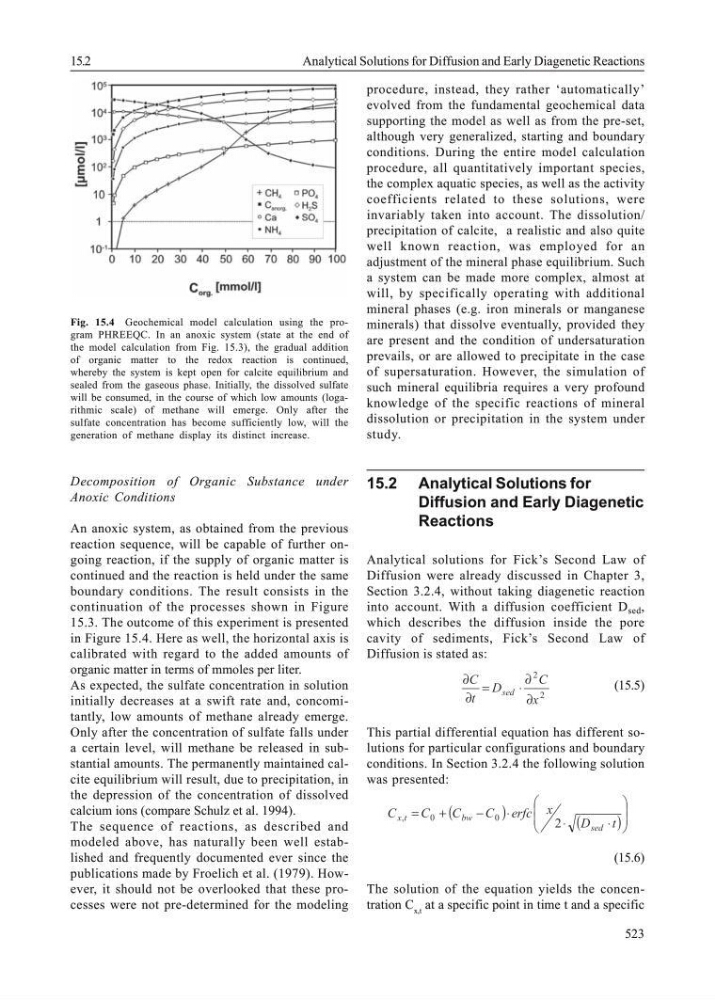
An anoxic system, as obtained from the previous
reaction sequence, will be capable of further ongoing reaction, if the supply of organic matter is
continued and the reaction is held under the same
boundary conditions. The result consists in the
continuation of the processes shown in Figure
15.3. The outcome of this experiment is presented
in Figure 15.4. Here as well, the horizontal axis is
calibrated with regard to the added amounts of
organic matter in terms of mmoles per liter.
As expected, the sulfate concentration in solution
initially decreases at a swift rate and, concomitantly, low amounts of methane already emerge.
Only after the concentration of sulfate falls under
a certain level, will methane be released in substantial amounts. The permanently maintained calcite equilibrium will result, due to precipitation, in
the depression of the concentration of dissolved
calcium ions (compare Schulz et al. 1994).
The sequence of reactions, as described and
modeled above, has naturally been well established and frequently documented ever since the
publications made by Froelich et al. (1979). However, it should not be overlooked that these processes were not pre-determined for the modeling
procedure, instead, they rather ‘automatically’
evolved from the fundamental geochemical data
supporting the model as well as from the pre-set,
although very generalized, starting and boundary
conditions. During the entire model calculation
procedure, all quantitatively important species,
the complex aquatic species, as well as the activity
coefficients related to these solutions, were
invariably taken into account. The dissolution/
precipitation of calcite, a realistic and also quite
well known reaction, was employed for an
adjustment of the mineral phase equilibrium. Such
a system can be made more complex, almost at
will, by specifically operating with additional
mineral phases (e.g. iron minerals or manganese
minerals) that dissolve eventually, provided they
are present and the condition of undersaturation
prevails, or are allowed to precipitate in the case
of supersaturation. However, the simulation of
such mineral equilibria requires a very profound
knowledge of the specific reactions of mineral
dissolution or precipitation in the system under
study.
15.2 Analytical Solutions for
Diffusion and Early Diagenetic
Reactions
Analytical solutions for Fick’s Second Law of
Diffusion were already discussed in Chapter 3,
Section 3.2.4, without taking diagenetic reaction
into account. With a diffusion coefficient D sed ,
which describes the diffusion inside the pore
cavity of sediments, Fick’s Second Law of
Diffusion is stated as:
2
2
x
C
D
t
C
sed ∂
∂
⋅
=
∂
∂
(15.5)
This partial differential equation has different solutions for particular configurations and boundary
conditions. In Section 3.2.4 the following solution
was presented:
(
)
(
) ⎟
⎟
⎠
⎞
⎜
⎜
⎝
⎛
⋅
⋅
⋅
−
+
=
t
D
x
erfc
C
C
C
C
sed
bw
t
x
2
0
0
,
(15.6)
The solution of the equation yields the concentration C x,t at a specific point in time t and a specific
Fig. 15.4 Geochemical model calculation using the program PHREEQC. In an anoxic system (state at the end of
the model calculation from Fig. 15.3), the gradual addition
of organic matter to the redox reaction is continued,
whereby the system is kept open for calcite equilibrium and
sealed from the gaseous phase. Initially, the dissolved sulfate
will be consumed, in the course of which low amounts (logarithmic scale) of methane will emerge. Only after the
sulfate concentration has become sufficiently low, will the
generation of methane display its distinct increase.
15.2
Analytical Solutions for Diffusion and Early Diagenetic Reactions
Decomposition of Organic Substance under
Anoxic Conditions
An anoxic system, as obtained from the previous
reaction sequence, will be capable of further ongoing reaction, if the supply of organic matter is
continued and the reaction is held under the same
boundary conditions. The result consists in the
continuation of the processes shown in Figure
15.3. The outcome of this experiment is presented
in Figure 15.4. Here as well, the horizontal axis is
calibrated with regard to the added amounts of
organic matter in terms of mmoles per liter.
As expected, the sulfate concentration in solution
initially decreases at a swift rate and, concomitantly, low amounts of methane already emerge.
Only after the concentration of sulfate falls under
a certain level, will methane be released in substantial amounts. The permanently maintained calcite equilibrium will result, due to precipitation, in
the depression of the concentration of dissolved
calcium ions (compare Schulz et al. 1994).
The sequence of reactions, as described and
modeled above, has naturally been well established and frequently documented ever since the
publications made by Froelich et al. (1979). However, it should not be overlooked that these processes were not pre-determined for the modeling
procedure, instead, they rather ‘automatically’
evolved from the fundamental geochemical data
supporting the model as well as from the pre-set,
although very generalized, starting and boundary
conditions. During the entire model calculation
procedure, all quantitatively important species,
the complex aquatic species, as well as the activity
coefficients related to these solutions, were
invariably taken into account. The dissolution/
precipitation of calcite, a realistic and also quite
well known reaction, was employed for an
adjustment of the mineral phase equilibrium. Such
a system can be made more complex, almost at
will, by specifically operating with additional
mineral phases (e.g. iron minerals or manganese
minerals) that dissolve eventually, provided they
are present and the condition of undersaturation
prevails, or are allowed to precipitate in the case
of supersaturation. However, the simulation of
such mineral equilibria requires a very profound
knowledge of the specific reactions of mineral
dissolution or precipitation in the system under
study.
15.2 Analytical Solutions for
Diffusion and Early Diagenetic
Reactions
Analytical solutions for Fick’s Second Law of
Diffusion were already discussed in Chapter 3,
Section 3.2.4, without taking diagenetic reaction
into account. With a diffusion coefficient D sed ,
which describes the diffusion inside the pore
cavity of sediments, Fick’s Second Law of
Diffusion is stated as:
2
2
x
C
D
t
C
sed ∂
∂
⋅
=
∂
∂
(15.5)
This partial differential equation has different solutions for particular configurations and boundary
conditions. In Section 3.2.4 the following solution
was presented:
(
)
(
) ⎟
⎟
⎠
⎞
⎜
⎜
⎝
⎛
⋅
⋅
⋅
−
+
=
t
D
x
erfc
C
C
C
C
sed
bw
t
x
2
0
0
,
(15.6)
The solution of the equation yields the concentration C x,t at a specific point in time t and a specific
Fig. 15.4 Geochemical model calculation using the program PHREEQC. In an anoxic system (state at the end of
the model calculation from Fig. 15.3), the gradual addition
of organic matter to the redox reaction is continued,
whereby the system is kept open for calcite equilibrium and
sealed from the gaseous phase. Initially, the dissolved sulfate
will be consumed, in the course of which low amounts (logarithmic scale) of methane will emerge. Only after the
sulfate concentration has become sufficiently low, will the
generation of methane display its distinct increase.
15.2
Analytical Solutions for Diffusion and Early Diagenetic Reactions