

15 Conceptual Models and Computer Models
522
Redfield ratio (Redfield 1958) of C:N:P = 106:16:1 (cf.
Section 3.2.5) is then gradually added to this solution.
Simplified, such a theoretical organic substance is
composed of (CH 2 O) 106 (NH 3 ) 16 (H 3 PO 4 ) 1 or, divided
by 106: (CH 2 O) 1.0 (NH 3 ) 0.15094 (H3PO4) 0.009434 . The
horizontal axis in Figure 15.3 records the substance addition in terms of µmoles per liter. If the
situation in the sediment is to be described, an
equilibrium of calcite should exist as well. The
system under study should not be open to the
gaseous phase any more, instead, these influences should now be determined by the consumption of oxygen within the system and by the
concomitant release of CO 2 .
In the model, the organic substance added to
the reaction automatically triggers a sequence of
redox reactions which becomes evident due to the
concentrations involved which are demonstrated
in Figure 15.3. First, the concentration of oxygen
declines, and the concentration of nitrate and
phosphorus increases according to each of their
proportions in the original organic substance. As
soon as oxygen is consumed, nitrogen will be utilized for further oxidation of the continually added
organic substance. Subsequently, the system
shifts over to an anoxic state.
Seawater from Nordstrom et al. (1979)
Phase
Si
log IAP
log KT
Calcite
0.00
-8.48
-8.47
CO 2 (g)
-3.47
-21.62
-18.15
O2 (g)
-0.68
82.44
83.12
pH
=
7.902
Charge balance
pe
=
12.713
Adjusted to redox
equilibrium
Ionic strength
=
6.734E-1
Temperature (°C)
=
25.0
Elements
Molality
C
8.139E-4
Equilibrium with Calcite and pCO 2
Ca
9.876E-3
Equilibrium with Calcite
Cl
5.657E-1
not changed
Fe
3.711E-8
not changed
K
1.058E-2
not changed
Mg
5.507E-2
not changed
Mn
3.773E-9
not changed
N
6.571E-6
Adjusted to redox equilibrium
Na
4.854E-1
not changed
O(0)
3.951E-4
Equilibrium with pCO 2
S
2.93E-02
not changed
Si
7.382E-5
not changed
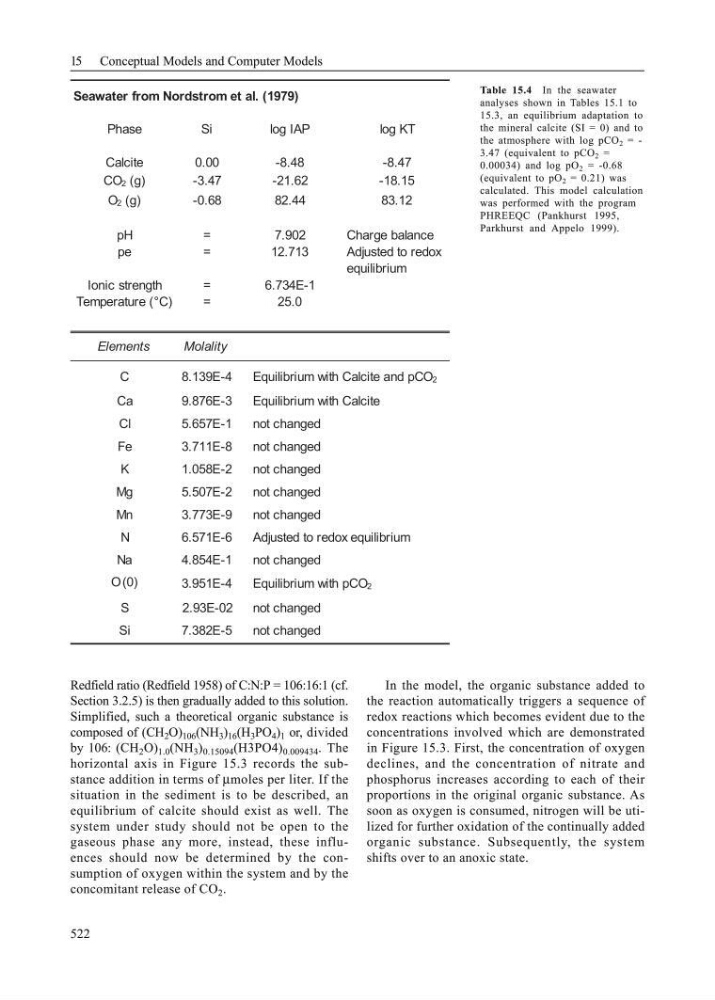
Table 15.4 In the seawater
analyses shown in Tables 15.1 to
15.3, an equilibrium adaptation to
the mineral calcite (SI = 0) and to
the atmosphere with log pCO 2 = -
3.47 (equivalent to pCO 2 =
0.00034) and log pO 2 = -0.68
(equivalent to pO 2 = 0.21) was
calculated. This model calculation
was performed with the program
PHREEQC (Pankhurst 1995,
Parkhurst and Appelo 1999).
522
Redfield ratio (Redfield 1958) of C:N:P = 106:16:1 (cf.
Section 3.2.5) is then gradually added to this solution.
Simplified, such a theoretical organic substance is
composed of (CH 2 O) 106 (NH 3 ) 16 (H 3 PO 4 ) 1 or, divided
by 106: (CH 2 O) 1.0 (NH 3 ) 0.15094 (H3PO4) 0.009434 . The
horizontal axis in Figure 15.3 records the substance addition in terms of µmoles per liter. If the
situation in the sediment is to be described, an
equilibrium of calcite should exist as well. The
system under study should not be open to the
gaseous phase any more, instead, these influences should now be determined by the consumption of oxygen within the system and by the
concomitant release of CO 2 .
In the model, the organic substance added to
the reaction automatically triggers a sequence of
redox reactions which becomes evident due to the
concentrations involved which are demonstrated
in Figure 15.3. First, the concentration of oxygen
declines, and the concentration of nitrate and
phosphorus increases according to each of their
proportions in the original organic substance. As
soon as oxygen is consumed, nitrogen will be utilized for further oxidation of the continually added
organic substance. Subsequently, the system
shifts over to an anoxic state.
Seawater from Nordstrom et al. (1979)
Phase
Si
log IAP
log KT
Calcite
0.00
-8.48
-8.47
CO 2 (g)
-3.47
-21.62
-18.15
O2 (g)
-0.68
82.44
83.12
pH
=
7.902
Charge balance
pe
=
12.713
Adjusted to redox
equilibrium
Ionic strength
=
6.734E-1
Temperature (°C)
=
25.0
Elements
Molality
C
8.139E-4
Equilibrium with Calcite and pCO 2
Ca
9.876E-3
Equilibrium with Calcite
Cl
5.657E-1
not changed
Fe
3.711E-8
not changed
K
1.058E-2
not changed
Mg
5.507E-2
not changed
Mn
3.773E-9
not changed
N
6.571E-6
Adjusted to redox equilibrium
Na
4.854E-1
not changed
O(0)
3.951E-4
Equilibrium with pCO 2
S
2.93E-02
not changed
Si
7.382E-5
not changed
Table 15.4 In the seawater
analyses shown in Tables 15.1 to
15.3, an equilibrium adaptation to
the mineral calcite (SI = 0) and to
the atmosphere with log pCO 2 = -
3.47 (equivalent to pCO 2 =
0.00034) and log pO 2 = -0.68
(equivalent to pO 2 = 0.21) was
calculated. This model calculation
was performed with the program
PHREEQC (Pankhurst 1995,
Parkhurst and Appelo 1999).