

14 Gas Hydrates in Marine Sediments
504
tion varies as a function of mineralogy (Fig.
14.21). The δ
18
O value of the aragonite endmember (+3.68‰ PDB) is lower than the δ
18
O of
Mg-calcite (+4.86‰ PDB). By using appropriate
isotope fractionation equations for each mineral,
Bohrmann et al. (1998) calculated the oxygen
isotopic composition of the pore water from
which the carbonates precipitated. They found
that the aragonite incorporates the isotopic
composition of standard mean ocean water
(SMOW) under recent seafloor conditions, when
gas hydrates are also forming. In contrast, Mgcalcite most likely precipitated in response to
destabilization of gas hydrates, because the pore
water from which Mg-calcite precipitated is
enriched in
18
O relative to SMOW. Similar
associations have since been documented for
authigenic carbonate recovered from the Gulf of
Mexico (Formolo et al. 2004), further establishing
that these minerals are valuable records of gas
hydrate formation and destabilization through
geologic time.
14.5.2 Carbonate Precipitation through
Microbial Activity
Methane from gas hydrates greatly stimulates the
entire ecosystem at cold seeps. (Suess et al. 2001,
Sahling et al. 2002). On the basis of quantitative
analyses of pore water sulfate and methane profiles,
corroborated by isotopic mass balance models,
geochemists postulated the anaerobic oxidation of
methane (AOM) via sulfate reduction, as a dominant
microbial process at cold seeps. (Suess and Whiticar
1989; Borowski et al. 1999), However, the AOM
remained controversial for several years because the
microbes responsible for this reaction proved to be
very elusive. Only recently was a microbial consortium
of methanotrophic archaea and sulfate-reducing
bacteria identified on gas hydrate-bearing samples
from Hydrate Ridge (Boetius et al. 2000). This
interesting discovery was followed by similar findings
on cold seeps and hydrate deposits in the Eel river
basin (Orphan et al. 2004) and the Gulf of Mexico (Joye
et al. 2004). These consortia consists of an inner sphere
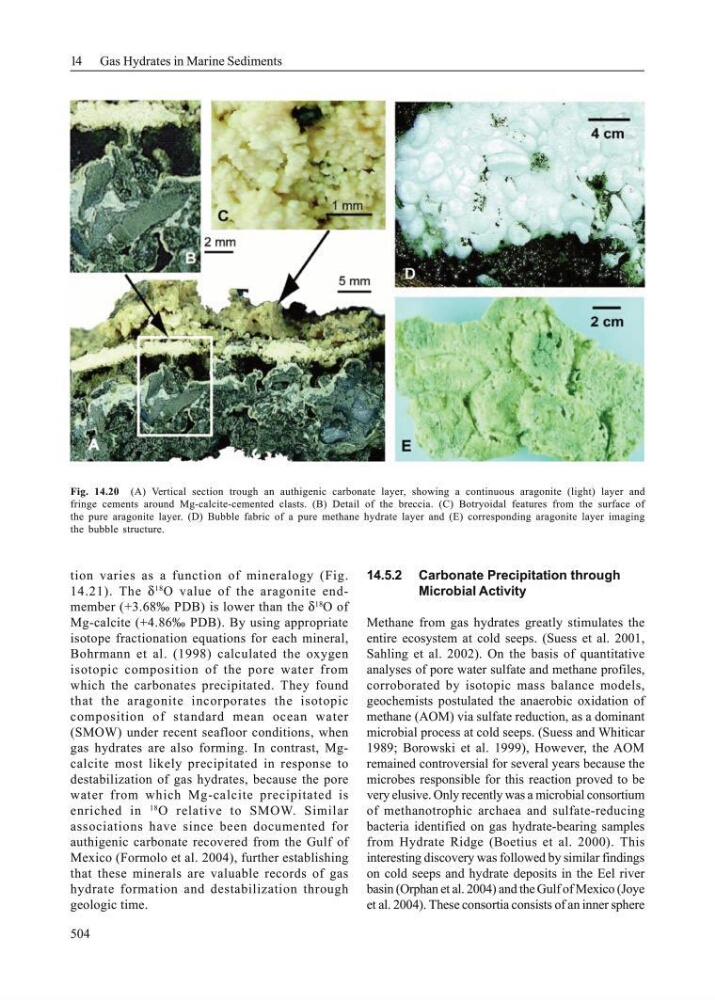
Fig. 14.20 (A) Vertical section trough an authigenic carbonate layer, showing a continuous aragonite (light) layer and
fringe cements around Mg-calcite-cemented clasts. (B) Detail of the breccia. (C) Botryoidal features from the surface of
the pure aragonite layer. (D) Bubble fabric of a pure methane hydrate layer and (E) corresponding aragonite layer imaging
the bubble structure.
504
tion varies as a function of mineralogy (Fig.
14.21). The δ
18
O value of the aragonite endmember (+3.68‰ PDB) is lower than the δ
18
O of
Mg-calcite (+4.86‰ PDB). By using appropriate
isotope fractionation equations for each mineral,
Bohrmann et al. (1998) calculated the oxygen
isotopic composition of the pore water from
which the carbonates precipitated. They found
that the aragonite incorporates the isotopic
composition of standard mean ocean water
(SMOW) under recent seafloor conditions, when
gas hydrates are also forming. In contrast, Mgcalcite most likely precipitated in response to
destabilization of gas hydrates, because the pore
water from which Mg-calcite precipitated is
enriched in
18
O relative to SMOW. Similar
associations have since been documented for
authigenic carbonate recovered from the Gulf of
Mexico (Formolo et al. 2004), further establishing
that these minerals are valuable records of gas
hydrate formation and destabilization through
geologic time.
14.5.2 Carbonate Precipitation through
Microbial Activity
Methane from gas hydrates greatly stimulates the
entire ecosystem at cold seeps. (Suess et al. 2001,
Sahling et al. 2002). On the basis of quantitative
analyses of pore water sulfate and methane profiles,
corroborated by isotopic mass balance models,
geochemists postulated the anaerobic oxidation of
methane (AOM) via sulfate reduction, as a dominant
microbial process at cold seeps. (Suess and Whiticar
1989; Borowski et al. 1999), However, the AOM
remained controversial for several years because the
microbes responsible for this reaction proved to be
very elusive. Only recently was a microbial consortium
of methanotrophic archaea and sulfate-reducing
bacteria identified on gas hydrate-bearing samples
from Hydrate Ridge (Boetius et al. 2000). This
interesting discovery was followed by similar findings
on cold seeps and hydrate deposits in the Eel river
basin (Orphan et al. 2004) and the Gulf of Mexico (Joye
et al. 2004). These consortia consists of an inner sphere
Fig. 14.20 (A) Vertical section trough an authigenic carbonate layer, showing a continuous aragonite (light) layer and
fringe cements around Mg-calcite-cemented clasts. (B) Detail of the breccia. (C) Botryoidal features from the surface of
the pure aragonite layer. (D) Bubble fabric of a pure methane hydrate layer and (E) corresponding aragonite layer imaging
the bubble structure.