

503
14.5
Gas Hydrate Carbonate Formation and Anaerobic Oxidation of Methane
14.5 Gas Hydrate Carbonate
Formation and Anaerobic
Oxidation of Methane
14.5.1 Petrographic Characteristics of
Clathrites
Authigenic carbonates are common features at seafloor
seepage sites where fluids enriched in methane or
oversaturated in bicarbonate escape from seafloor.
Various investigators have described a particularly
large variety of carbonates from the Cascadia margin
(Kulm et al. 1986; Ritger et al. 1987; Sample and Reid
1998; Greinert et al. 2001). Detailed petrographic,
mineralogical and isotopic work was performed on a
wide collection of samples that document several
petrographically distinct lithologies. Carbonates
occurr in boulder fields or in massive autochthonous
chemoherm complexes (Teichert et al. 2005a). Other
carbonates were sampled in direct contact with
hydrates and in others, a direct relationship to gas
hydrates was recognized (Bohrmann et al. 1998;
Teichert et al. 2004). There are two main lithologies: a
breccia composed of micrite-cemented monomict
clasts, and pure aragonite of various appearances.
The breccia show angular clasts composed of the
same fine-grained material as the terrigenous soft
sediment on the seafloor, and submicrometer anhedral
Mg-calcite crystals have been observed in the
intergranular pore space between the terrigenous
components (Bohrmann et al. 1998; Greinert et al. 2001).
Although the grain-supported texture (Figs. 14.20A
and 14.20B) shows up to 20-30% pore space, the clasts
do not appear to have been transported over longer
distances. The breccia is thought to form by the
collapse of the clasts when gas hydrate in the sediment
dissociates, followed by cementation with Mg-calcite
and aragonite.
The second obvious carbonate lithology is composed of aragonite precipitates, that appear either as
pure isopachous fringe cements (Fig. 14.20B) or as
yellow layers of remarkable purity (Figs. 14.20A,
14.20C, and 14.20E). Pieces of isolated yellow aragonite
layers have often been found associated with gas
hydrates. Such layers have variable thicknesses of 1
to 3 cm, occur often in pieces of 10 to 20 cm in diameter
and reveal truncated edges. The continuous aragonite
layers grow directly within pure gas hydrate layers
parallel to stratification and are therefore free of
terrigenous sediment impurities. In several cases the
aragonite precipitates have been directly recovered
from within pure gas-hydrate layers (Greinert et al.
2001). The precipitates often exhibit a shape that
partially images the inner surface morphology of the
gas hydrate bubble fabric (Fig. 14.20E).
Such gas hydrate carbonates are also called
clathrites and form archives in which geochemical
processes of clathrate and clathrite formation is
well documented (Teichert et al. 2005b). Their
carbon isotope values range from -40‰ to -54‰
PDB, identifying methane as the dominant carbon
source (Fig. 14.21). Bohrmann et al. (1998)
analyzed mixtures of Mg-calcite and aragonite
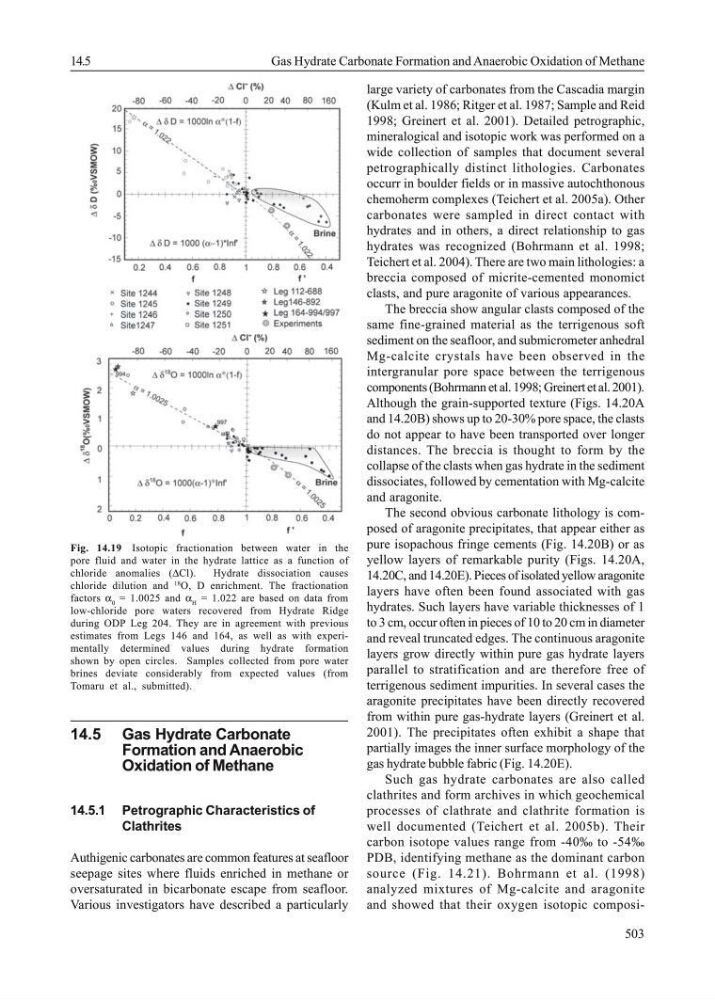
and showed that their oxygen isotopic composiFig. 14.19 Isotopic fractionation between water in the
pore fluid and water in the hydrate lattice as a function of
chloride anomalies (∆Cl).
Hydrate dissociation causes
chloride dilution and
18 O, D enrichment. The fractionation
factors α 0 = 1.0025 and α H = 1.022 are based on data from
low-chloride pore waters recovered from Hydrate Ridge
during ODP Leg 204. They are in agreement with previous
estimates from Legs 146 and 164, as well as with experimentally determined values during hydrate formation
shown by open circles. Samples collected from pore water
brines deviate considerably from expected values (from
Tomaru et al., submitted).
14.5
Gas Hydrate Carbonate Formation and Anaerobic Oxidation of Methane
14.5 Gas Hydrate Carbonate
Formation and Anaerobic
Oxidation of Methane
14.5.1 Petrographic Characteristics of
Clathrites
Authigenic carbonates are common features at seafloor
seepage sites where fluids enriched in methane or
oversaturated in bicarbonate escape from seafloor.
Various investigators have described a particularly
large variety of carbonates from the Cascadia margin
(Kulm et al. 1986; Ritger et al. 1987; Sample and Reid
1998; Greinert et al. 2001). Detailed petrographic,
mineralogical and isotopic work was performed on a
wide collection of samples that document several
petrographically distinct lithologies. Carbonates
occurr in boulder fields or in massive autochthonous
chemoherm complexes (Teichert et al. 2005a). Other
carbonates were sampled in direct contact with
hydrates and in others, a direct relationship to gas
hydrates was recognized (Bohrmann et al. 1998;
Teichert et al. 2004). There are two main lithologies: a
breccia composed of micrite-cemented monomict
clasts, and pure aragonite of various appearances.
The breccia show angular clasts composed of the
same fine-grained material as the terrigenous soft
sediment on the seafloor, and submicrometer anhedral
Mg-calcite crystals have been observed in the
intergranular pore space between the terrigenous
components (Bohrmann et al. 1998; Greinert et al. 2001).
Although the grain-supported texture (Figs. 14.20A
and 14.20B) shows up to 20-30% pore space, the clasts
do not appear to have been transported over longer
distances. The breccia is thought to form by the
collapse of the clasts when gas hydrate in the sediment
dissociates, followed by cementation with Mg-calcite
and aragonite.
The second obvious carbonate lithology is composed of aragonite precipitates, that appear either as
pure isopachous fringe cements (Fig. 14.20B) or as
yellow layers of remarkable purity (Figs. 14.20A,
14.20C, and 14.20E). Pieces of isolated yellow aragonite
layers have often been found associated with gas
hydrates. Such layers have variable thicknesses of 1
to 3 cm, occur often in pieces of 10 to 20 cm in diameter
and reveal truncated edges. The continuous aragonite
layers grow directly within pure gas hydrate layers
parallel to stratification and are therefore free of
terrigenous sediment impurities. In several cases the
aragonite precipitates have been directly recovered
from within pure gas-hydrate layers (Greinert et al.
2001). The precipitates often exhibit a shape that
partially images the inner surface morphology of the
gas hydrate bubble fabric (Fig. 14.20E).
Such gas hydrate carbonates are also called
clathrites and form archives in which geochemical
processes of clathrate and clathrite formation is
well documented (Teichert et al. 2005b). Their
carbon isotope values range from -40‰ to -54‰
PDB, identifying methane as the dominant carbon
source (Fig. 14.21). Bohrmann et al. (1998)
analyzed mixtures of Mg-calcite and aragonite
and showed that their oxygen isotopic composiFig. 14.19 Isotopic fractionation between water in the
pore fluid and water in the hydrate lattice as a function of
chloride anomalies (∆Cl).
Hydrate dissociation causes
chloride dilution and
18 O, D enrichment. The fractionation
factors α 0 = 1.0025 and α H = 1.022 are based on data from
low-chloride pore waters recovered from Hydrate Ridge
during ODP Leg 204. They are in agreement with previous
estimates from Legs 146 and 164, as well as with experimentally determined values during hydrate formation
shown by open circles. Samples collected from pore water
brines deviate considerably from expected values (from
Tomaru et al., submitted).