

505
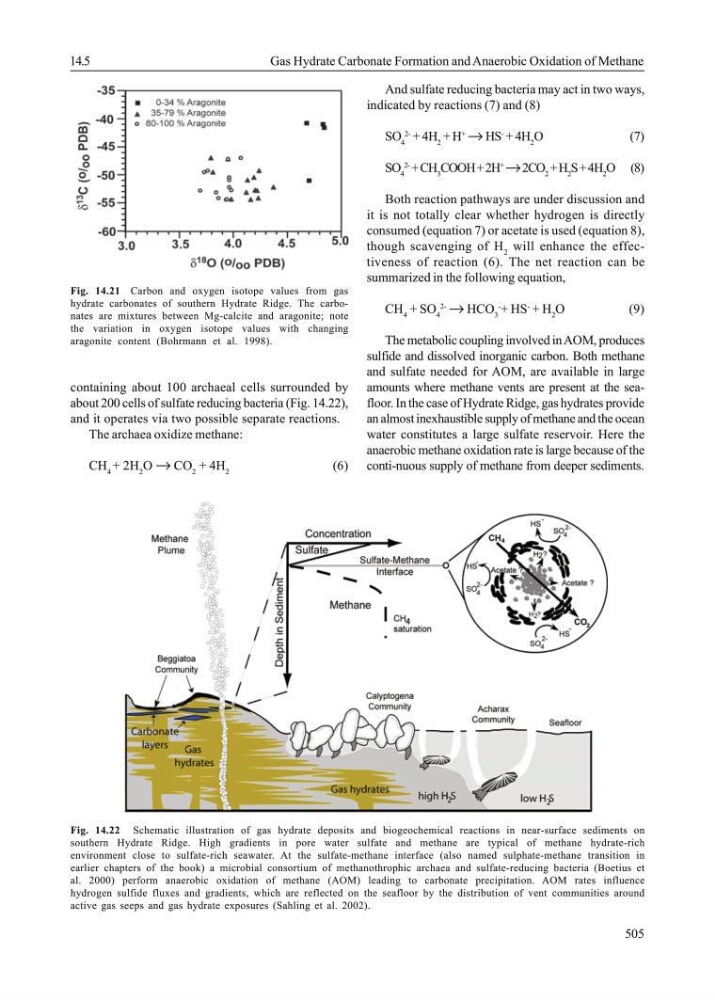
containing about 100 archaeal cells surrounded by
about 200 cells of sulfate reducing bacteria (Fig. 14.22),
and it operates via two possible separate reactions.
The archaea oxidize methane:
CH 4 + 2H 2 O → CO 2 + 4H 2
(6)
And sulfate reducing bacteria may act in two ways,
indicated by reactions (7) and (8)
SO 4
2+ 4H 2 + H
+
→ HS
-
+ 4H 2 O
(7)
SO 4
2+ CH 3 COOH + 2H
+
→ 2CO 2 + H 2 S + 4H 2 O (8)
Both reaction pathways are under discussion and
it is not totally clear whether hydrogen is directly
consumed (equation 7) or acetate is used (equation 8),
though scavenging of H 2 will enhance the effectiveness of reaction (6). The net reaction can be
summarized in the following equation,
CH 4 + SO 4
2→ HCO 3
-
+ HS
-
+ H 2 O
(9)
The metabolic coupling involved in AOM, produces
sulfide and dissolved inorganic carbon. Both methane
and sulfate needed for AOM, are available in large
amounts where methane vents are present at the seafloor. In the case of Hydrate Ridge, gas hydrates provide
an almost inexhaustible supply of methane and the ocean
water constitutes a large sulfate reservoir. Here the
anaerobic methane oxidation rate is large because of the
conti-nuous supply of methane from deeper sediments.
Fig. 14.21 Carbon and oxygen isotope values from gas
hydrate carbonates of southern Hydrate Ridge. The carbonates are mixtures between Mg-calcite and aragonite; note
the variation in oxygen isotope values with changing
aragonite content (Bohrmann et al. 1998).
Fig. 14.22 Schematic illustration of gas hydrate deposits and biogeochemical reactions in near-surface sediments on
southern Hydrate Ridge. High gradients in pore water sulfate and methane are typical of methane hydrate-rich
environment close to sulfate-rich seawater. At the sulfate-methane interface (also named sulphate-methane transition in
earlier chapters of the book) a microbial consortium of methanothrophic archaea and sulfate-reducing bacteria (Boetius et
al. 2000) perform anaerobic oxidation of methane (AOM) leading to carbonate precipitation. AOM rates influence
hydrogen sulfide fluxes and gradients, which are reflected on the seafloor by the distribution of vent communities around
active gas seeps and gas hydrate exposures (Sahling et al. 2002).
14.5
Gas Hydrate Carbonate Formation and Anaerobic Oxidation of Methane
containing about 100 archaeal cells surrounded by
about 200 cells of sulfate reducing bacteria (Fig. 14.22),
and it operates via two possible separate reactions.
The archaea oxidize methane:
CH 4 + 2H 2 O → CO 2 + 4H 2
(6)
And sulfate reducing bacteria may act in two ways,
indicated by reactions (7) and (8)
SO 4
2+ 4H 2 + H
+
→ HS
-
+ 4H 2 O
(7)
SO 4
2+ CH 3 COOH + 2H
+
→ 2CO 2 + H 2 S + 4H 2 O (8)
Both reaction pathways are under discussion and
it is not totally clear whether hydrogen is directly
consumed (equation 7) or acetate is used (equation 8),
though scavenging of H 2 will enhance the effectiveness of reaction (6). The net reaction can be
summarized in the following equation,
CH 4 + SO 4
2→ HCO 3
-
+ HS
-
+ H 2 O
(9)
The metabolic coupling involved in AOM, produces
sulfide and dissolved inorganic carbon. Both methane
and sulfate needed for AOM, are available in large
amounts where methane vents are present at the seafloor. In the case of Hydrate Ridge, gas hydrates provide
an almost inexhaustible supply of methane and the ocean
water constitutes a large sulfate reservoir. Here the
anaerobic methane oxidation rate is large because of the
conti-nuous supply of methane from deeper sediments.
Fig. 14.21 Carbon and oxygen isotope values from gas
hydrate carbonates of southern Hydrate Ridge. The carbonates are mixtures between Mg-calcite and aragonite; note
the variation in oxygen isotope values with changing
aragonite content (Bohrmann et al. 1998).
Fig. 14.22 Schematic illustration of gas hydrate deposits and biogeochemical reactions in near-surface sediments on
southern Hydrate Ridge. High gradients in pore water sulfate and methane are typical of methane hydrate-rich
environment close to sulfate-rich seawater. At the sulfate-methane interface (also named sulphate-methane transition in
earlier chapters of the book) a microbial consortium of methanothrophic archaea and sulfate-reducing bacteria (Boetius et
al. 2000) perform anaerobic oxidation of methane (AOM) leading to carbonate precipitation. AOM rates influence
hydrogen sulfide fluxes and gradients, which are reflected on the seafloor by the distribution of vent communities around
active gas seeps and gas hydrate exposures (Sahling et al. 2002).
14.5
Gas Hydrate Carbonate Formation and Anaerobic Oxidation of Methane