

14 Gas Hydrates in Marine Sediments
498
has recently shown the separate effects of clay
dehydration reactions and gas hydrate dissociation on the dissolved Cl
-
distribution. These data
provide geochemical evidence to evaluate the
baseline question, and provide an example of a
system where hydrate is present and background
chloride contents do not deviate significantly
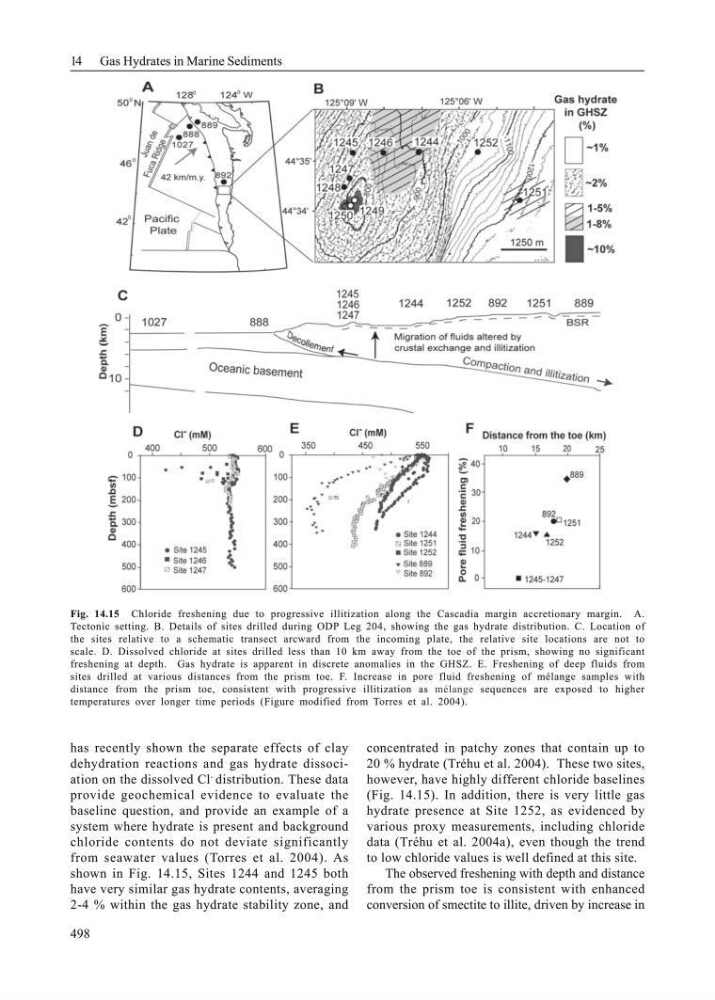
from seawater values (Torres et al. 2004). As
shown in Fig. 14.15, Sites 1244 and 1245 both
have very similar gas hydrate contents, averaging
2-4 % within the gas hydrate stability zone, and
concentrated in patchy zones that contain up to
20 % hydrate (Tréhu et al. 2004). These two sites,
however, have highly different chloride baselines
(Fig. 14.15). In addition, there is very little gas
hydrate presence at Site 1252, as evidenced by
various proxy measurements, including chloride
data (Tréhu et al. 2004a), even though the trend
to low chloride values is well defined at this site.
The observed freshening with depth and distance
from the prism toe is consistent with enhanced
conversion of smectite to illite, driven by increase in
Fig. 14.15 Chloride freshening due to progressive illitization along the Cascadia margin accretionary margin. A.
Tectonic setting. B. Details of sites drilled during ODP Leg 204, showing the gas hydrate distribution. C. Location of
the sites relative to a schematic transect arcward from the incoming plate, the relative site locations are not to
scale. D. Dissolved chloride at sites drilled less than 10 km away from the toe of the prism, showing no significant
freshening at depth. Gas hydrate is apparent in discrete anomalies in the GHSZ. E. Freshening of deep fluids from
sites drilled at various distances from the prism toe. F. Increase in pore fluid freshening of mélange samples with
distance from the prism toe, consistent with progressive illitization as mélange sequences are exposed to higher
temperatures over longer time periods (Figure modified from Torres et al. 2004).
498
has recently shown the separate effects of clay
dehydration reactions and gas hydrate dissociation on the dissolved Cl
-
distribution. These data
provide geochemical evidence to evaluate the
baseline question, and provide an example of a
system where hydrate is present and background
chloride contents do not deviate significantly
from seawater values (Torres et al. 2004). As
shown in Fig. 14.15, Sites 1244 and 1245 both
have very similar gas hydrate contents, averaging
2-4 % within the gas hydrate stability zone, and
concentrated in patchy zones that contain up to
20 % hydrate (Tréhu et al. 2004). These two sites,
however, have highly different chloride baselines
(Fig. 14.15). In addition, there is very little gas
hydrate presence at Site 1252, as evidenced by
various proxy measurements, including chloride
data (Tréhu et al. 2004a), even though the trend
to low chloride values is well defined at this site.
The observed freshening with depth and distance
from the prism toe is consistent with enhanced
conversion of smectite to illite, driven by increase in
Fig. 14.15 Chloride freshening due to progressive illitization along the Cascadia margin accretionary margin. A.
Tectonic setting. B. Details of sites drilled during ODP Leg 204, showing the gas hydrate distribution. C. Location of
the sites relative to a schematic transect arcward from the incoming plate, the relative site locations are not to
scale. D. Dissolved chloride at sites drilled less than 10 km away from the toe of the prism, showing no significant
freshening at depth. Gas hydrate is apparent in discrete anomalies in the GHSZ. E. Freshening of deep fluids from
sites drilled at various distances from the prism toe. F. Increase in pore fluid freshening of mélange samples with
distance from the prism toe, consistent with progressive illitization as mélange sequences are exposed to higher
temperatures over longer time periods (Figure modified from Torres et al. 2004).