

497
is slow enough that high chloride anomalies resulting
from salt exclusion during hydrate formation have been
removed by diffusion and advection. A recurrent issue
in these studies is the need for a robust estimate of
the background chloride values (Cl o in equation 3)
against which the anomalous discrete excursions can
be calculated.
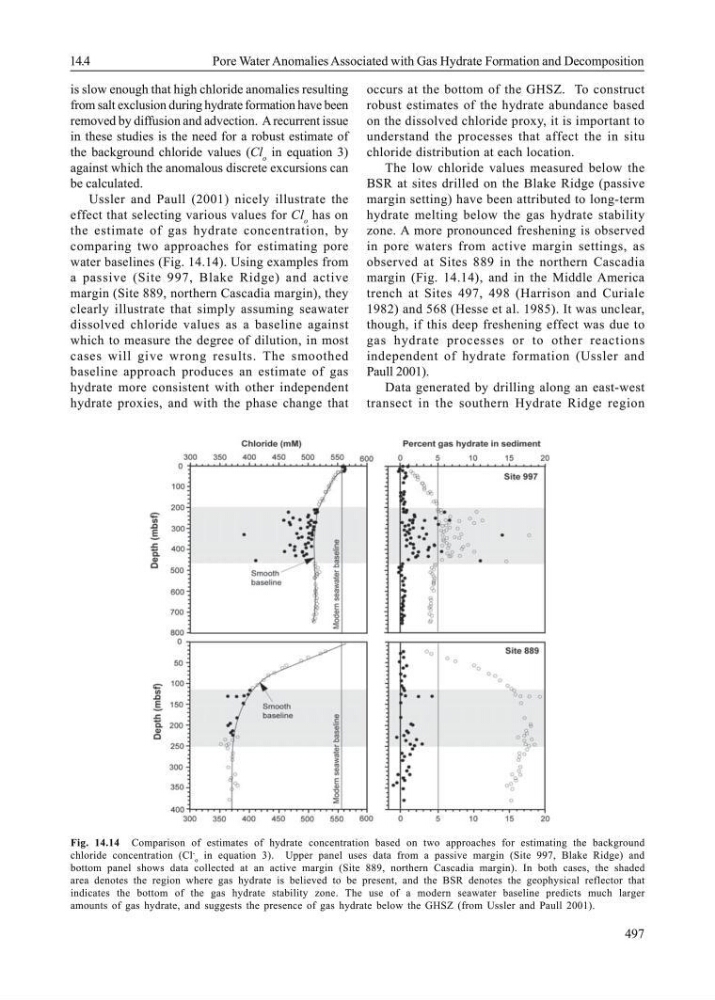
Ussler and Paull (2001) nicely illustrate the
effect that selecting various values for Cl o has on
the estimate of gas hydrate concentration, by
comparing two approaches for estimating pore
water baselines (Fig. 14.14). Using examples from
a passive (Site 997, Blake Ridge) and active
margin (Site 889, northern Cascadia margin), they
clearly illustrate that simply assuming seawater
dissolved chloride values as a baseline against
which to measure the degree of dilution, in most
cases will give wrong results. The smoothed
baseline approach produces an estimate of gas
hydrate more consistent with other independent
hydrate proxies, and with the phase change that
occurs at the bottom of the GHSZ. To construct
robust estimates of the hydrate abundance based
on the dissolved chloride proxy, it is important to
understand the processes that affect the in situ
chloride distribution at each location.
The low chloride values measured below the
BSR at sites drilled on the Blake Ridge (passive
margin setting) have been attributed to long-term
hydrate melting below the gas hydrate stability
zone. A more pronounced freshening is observed
in pore waters from active margin settings, as
observed at Sites 889 in the northern Cascadia
margin (Fig. 14.14), and in the Middle America
trench at Sites 497, 498 (Harrison and Curiale
1982) and 568 (Hesse et al. 1985). It was unclear,
though, if this deep freshening effect was due to
gas hydrate processes or to other reactions
independent of hydrate formation (Ussler and
Paull 2001).
Data generated by drilling along an east-west
transect in the southern Hydrate Ridge region
Fig. 14.14 Comparison of estimates of hydrate concentration based on two approaches for estimating the background
chloride concentration (Cl
-
o
in equation 3). Upper panel uses data from a passive margin (Site 997, Blake Ridge) and
bottom panel shows data collected at an active margin (Site 889, northern Cascadia margin). In both cases, the shaded
area denotes the region where gas hydrate is believed to be present, and the BSR denotes the geophysical reflector that
indicates the bottom of the gas hydrate stability zone. The use of a modern seawater baseline predicts much larger
amounts of gas hydrate, and suggests the presence of gas hydrate below the GHSZ (from Ussler and Paull 2001).
14.4
Pore Water Anomalies Associated with Gas Hydrate Formation and Decomposition
is slow enough that high chloride anomalies resulting
from salt exclusion during hydrate formation have been
removed by diffusion and advection. A recurrent issue
in these studies is the need for a robust estimate of
the background chloride values (Cl o in equation 3)
against which the anomalous discrete excursions can
be calculated.
Ussler and Paull (2001) nicely illustrate the
effect that selecting various values for Cl o has on
the estimate of gas hydrate concentration, by
comparing two approaches for estimating pore
water baselines (Fig. 14.14). Using examples from
a passive (Site 997, Blake Ridge) and active
margin (Site 889, northern Cascadia margin), they
clearly illustrate that simply assuming seawater
dissolved chloride values as a baseline against
which to measure the degree of dilution, in most
cases will give wrong results. The smoothed
baseline approach produces an estimate of gas
hydrate more consistent with other independent
hydrate proxies, and with the phase change that
occurs at the bottom of the GHSZ. To construct
robust estimates of the hydrate abundance based
on the dissolved chloride proxy, it is important to
understand the processes that affect the in situ
chloride distribution at each location.
The low chloride values measured below the
BSR at sites drilled on the Blake Ridge (passive
margin setting) have been attributed to long-term
hydrate melting below the gas hydrate stability
zone. A more pronounced freshening is observed
in pore waters from active margin settings, as
observed at Sites 889 in the northern Cascadia
margin (Fig. 14.14), and in the Middle America
trench at Sites 497, 498 (Harrison and Curiale
1982) and 568 (Hesse et al. 1985). It was unclear,
though, if this deep freshening effect was due to
gas hydrate processes or to other reactions
independent of hydrate formation (Ussler and
Paull 2001).
Data generated by drilling along an east-west
transect in the southern Hydrate Ridge region
Fig. 14.14 Comparison of estimates of hydrate concentration based on two approaches for estimating the background
chloride concentration (Cl
-
o
in equation 3). Upper panel uses data from a passive margin (Site 997, Blake Ridge) and
bottom panel shows data collected at an active margin (Site 889, northern Cascadia margin). In both cases, the shaded
area denotes the region where gas hydrate is believed to be present, and the BSR denotes the geophysical reflector that
indicates the bottom of the gas hydrate stability zone. The use of a modern seawater baseline predicts much larger
amounts of gas hydrate, and suggests the presence of gas hydrate below the GHSZ (from Ussler and Paull 2001).
14.4
Pore Water Anomalies Associated with Gas Hydrate Formation and Decomposition