

14 Gas Hydrates in Marine Sediments
494
The internal fabric of pure gas hydrate has a
peculiar structure with pores that result from rising
methane gas. Such pores occur in variable sizes, and
in some specimens very large pores of up to 3-4 cm in
diameter can be observed (Fig.14.11D). The fabric is
similar to that of gas hydrates experimentally formed
on the sea-floor (Brewer et al. 1997). There are several
lines of evidence that support migration of methane
gas from a reservoir located beneath the GHSZ, which
either turns into macroscopic porous gas hydrates or
escapes at the seafloor. A variety of mechanisms are
currently under investigation to determine how free
gas pass through the gas hydrate stability zone. Gas
may migrate through fractures or along tensional
faults, in which all water is trapped in the gas hydrates,
or gas hydrate formation may be inhibited by capillary
forces or by localized high salinity zones. The free
gas stream may move upwards very fast up to an area
where conditions are favorable to form gas hydrates.
Hydrate formation may plug up the migration conduits, and as high gas pressure builds up, the gas
may be rerouted into soft sediment layers. The dynamic processes that interact with a complicated plumping system may be responsible for the large variety
of gas hydrate and sediment fabrics observed.
Macroscopic hydrate fabrics deeper within the
stability zone are very different from the near-surface
deposits because at depth hydrate formation is
constrained by the pore space in which hydrate
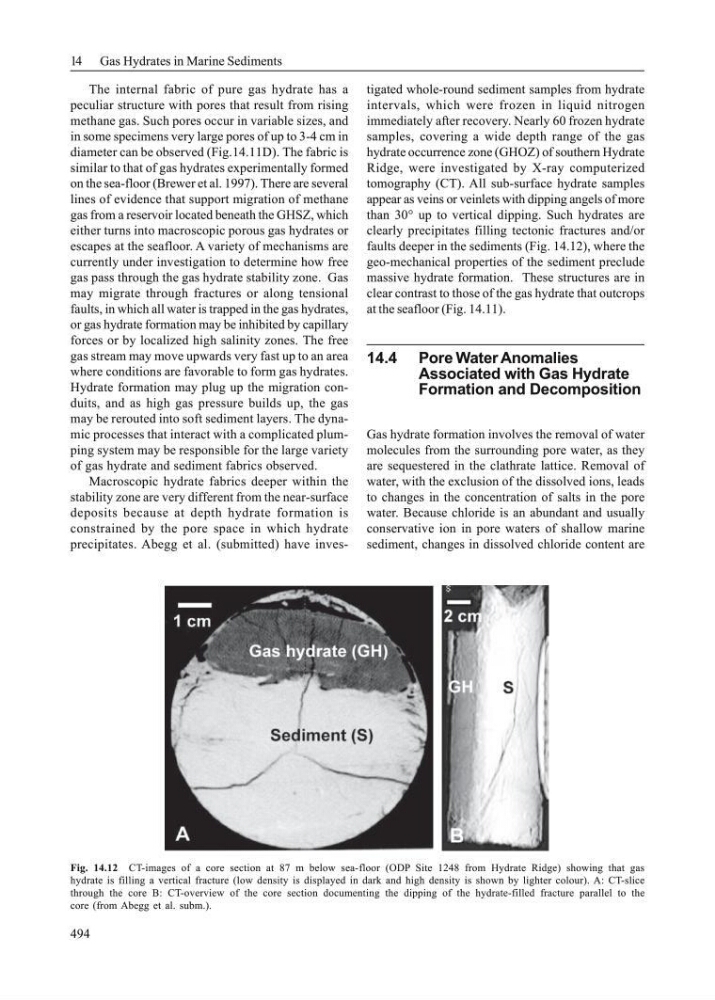
precipitates. Abegg et al. (submitted) have investigated whole-round sediment samples from hydrate
intervals, which were frozen in liquid nitrogen
immediately after recovery. Nearly 60 frozen hydrate
samples, covering a wide depth range of the gas
hydrate occurrence zone (GHOZ) of southern Hydrate
Ridge, were investigated by X-ray computerized
tomography (CT). All sub-surface hydrate samples
appear as veins or veinlets with dipping angels of more
than 30° up to vertical dipping. Such hydrates are
clearly precipitates filling tectonic fractures and/or
faults deeper in the sediments (Fig. 14.12), where the
geo-mechanical properties of the sediment preclude
massive hydrate formation. These structures are in
clear contrast to those of the gas hydrate that outcrops
at the seafloor (Fig. 14.11).
14.4 Pore Water Anomalies
Associated with Gas Hydrate
Formation and Decomposition
Gas hydrate formation involves the removal of water
molecules from the surrounding pore water, as they
are sequestered in the clathrate lattice. Removal of
water, with the exclusion of the dissolved ions, leads
to changes in the concentration of salts in the pore
water. Because chloride is an abundant and usually
conservative ion in pore waters of shallow marine
sediment, changes in dissolved chloride content are
Fig. 14.12 CT-images of a core section at 87 m below sea-floor (ODP Site 1248 from Hydrate Ridge) showing that gas
hydrate is filling a vertical fracture (low density is displayed in dark and high density is shown by lighter colour). A: CT-slice
through the core B: CT-overview of the core section documenting the dipping of the hydrate-filled fracture parallel to the
core (from Abegg et al. subm.).
494
The internal fabric of pure gas hydrate has a
peculiar structure with pores that result from rising
methane gas. Such pores occur in variable sizes, and
in some specimens very large pores of up to 3-4 cm in
diameter can be observed (Fig.14.11D). The fabric is
similar to that of gas hydrates experimentally formed
on the sea-floor (Brewer et al. 1997). There are several
lines of evidence that support migration of methane
gas from a reservoir located beneath the GHSZ, which
either turns into macroscopic porous gas hydrates or
escapes at the seafloor. A variety of mechanisms are
currently under investigation to determine how free
gas pass through the gas hydrate stability zone. Gas
may migrate through fractures or along tensional
faults, in which all water is trapped in the gas hydrates,
or gas hydrate formation may be inhibited by capillary
forces or by localized high salinity zones. The free
gas stream may move upwards very fast up to an area
where conditions are favorable to form gas hydrates.
Hydrate formation may plug up the migration conduits, and as high gas pressure builds up, the gas
may be rerouted into soft sediment layers. The dynamic processes that interact with a complicated plumping system may be responsible for the large variety
of gas hydrate and sediment fabrics observed.
Macroscopic hydrate fabrics deeper within the
stability zone are very different from the near-surface
deposits because at depth hydrate formation is
constrained by the pore space in which hydrate
precipitates. Abegg et al. (submitted) have investigated whole-round sediment samples from hydrate
intervals, which were frozen in liquid nitrogen
immediately after recovery. Nearly 60 frozen hydrate
samples, covering a wide depth range of the gas
hydrate occurrence zone (GHOZ) of southern Hydrate
Ridge, were investigated by X-ray computerized
tomography (CT). All sub-surface hydrate samples
appear as veins or veinlets with dipping angels of more
than 30° up to vertical dipping. Such hydrates are
clearly precipitates filling tectonic fractures and/or
faults deeper in the sediments (Fig. 14.12), where the
geo-mechanical properties of the sediment preclude
massive hydrate formation. These structures are in
clear contrast to those of the gas hydrate that outcrops
at the seafloor (Fig. 14.11).
14.4 Pore Water Anomalies
Associated with Gas Hydrate
Formation and Decomposition
Gas hydrate formation involves the removal of water
molecules from the surrounding pore water, as they
are sequestered in the clathrate lattice. Removal of
water, with the exclusion of the dissolved ions, leads
to changes in the concentration of salts in the pore
water. Because chloride is an abundant and usually
conservative ion in pore waters of shallow marine
sediment, changes in dissolved chloride content are
Fig. 14.12 CT-images of a core section at 87 m below sea-floor (ODP Site 1248 from Hydrate Ridge) showing that gas
hydrate is filling a vertical fracture (low density is displayed in dark and high density is shown by lighter colour). A: CT-slice
through the core B: CT-overview of the core section documenting the dipping of the hydrate-filled fracture parallel to the
core (from Abegg et al. subm.).