

493
Blake Ridge was surprisingly heterogeneous and could
not be explained in detail, except for the observation
of two weakly defined zones where higher hydrate
concentrations may indeed be caused by small
differences in lithology.
Researchers involved in ODP Leg 204 generated
the first high-resolution data set on the threedimensional distribution of gas hydrate within Hydrate
Ridge, in the Cascadia subduction zone (Tréhu et al.
2003). Several gas hydrate proxies were combined, and
thus, the problem of spatial under-sampling inherent
in methods traditionally used for estimating the gas
hydrate was overcome (Tréhu et al. 2004a). The average
gas hydrate content of sediments within the gas
hydrate stability zone was estimated to be 1-2% of the
pore space. Patchy zones of locally higher
concentrations on the ridge flanks occur below ~ 40
mbsf, are structurally and stratigraphically controlled
and occupy up to 20% of the pore space (Fig. 14.10).
In contrast to this overall hydrate distribution, a high
average gas hydrate content of 30-40% of pore space
was found on the upper 30-40 mbsf at the ridge summit.
Cores containing hydrate in massive chunks, lenses,
plates and nodules, where recovered from an area
where there is persistent and vigorous venting of
methane gas (Heeschen et al. 2003).
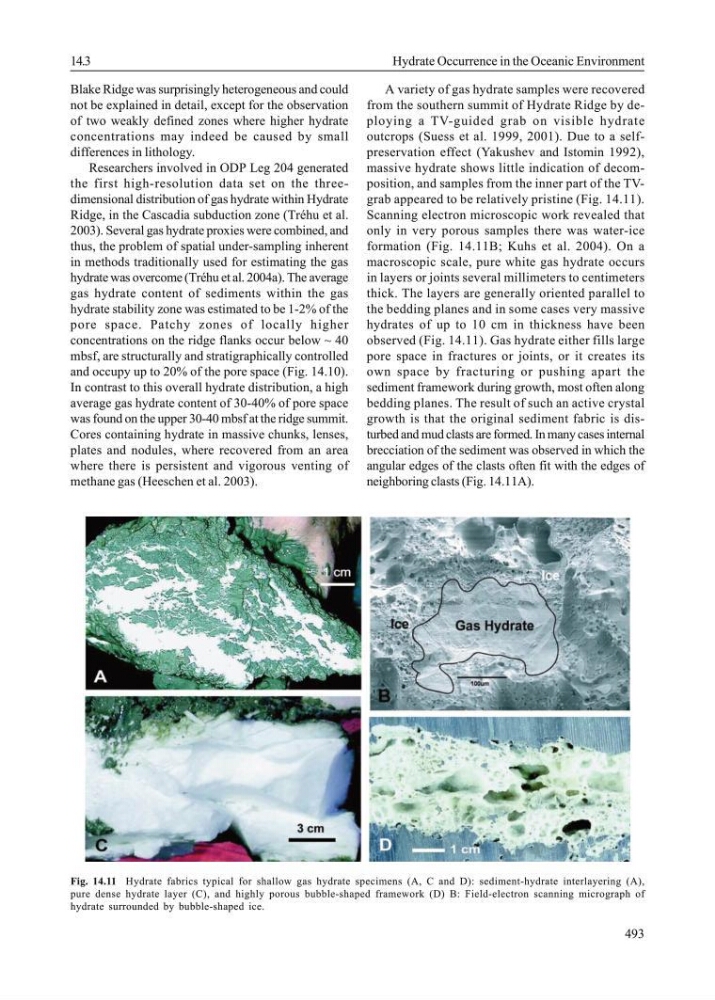
A variety of gas hydrate samples were recovered
from the southern summit of Hydrate Ridge by deploying a TV-guided grab on visible hydrate
outcrops (Suess et al. 1999, 2001). Due to a selfpreservation effect (Yakushev and Istomin 1992),
massive hydrate shows little indication of decomposition, and samples from the inner part of the TVgrab appeared to be relatively pristine (Fig. 14.11).
Scanning electron microscopic work revealed that
only in very porous samples there was water-ice
formation (Fig. 14.11B; Kuhs et al. 2004). On a
macroscopic scale, pure white gas hydrate occurs
in layers or joints several millimeters to centimeters
thick. The layers are generally oriented parallel to
the bedding planes and in some cases very massive
hydrates of up to 10 cm in thickness have been
observed (Fig. 14.11). Gas hydrate either fills large
pore space in fractures or joints, or it creates its
own space by fracturing or pushing apart the
sediment framework during growth, most often along
bedding planes. The result of such an active crystal
growth is that the original sediment fabric is disturbed and mud clasts are formed. In many cases internal
brecciation of the sediment was observed in which the
angular edges of the clasts often fit with the edges of
neighboring clasts (Fig. 14.11A).
Fig. 14.11 Hydrate fabrics typical for shallow gas hydrate specimens (A, C and D): sediment-hydrate interlayering (A),
pure dense hydrate layer (C), and highly porous bubble-shaped framework (D) B: Field-electron scanning micrograph of
hydrate surrounded by bubble-shaped ice.
14.3
Hydrate Occurrence in the Oceanic Environment
Blake Ridge was surprisingly heterogeneous and could
not be explained in detail, except for the observation
of two weakly defined zones where higher hydrate
concentrations may indeed be caused by small
differences in lithology.
Researchers involved in ODP Leg 204 generated
the first high-resolution data set on the threedimensional distribution of gas hydrate within Hydrate
Ridge, in the Cascadia subduction zone (Tréhu et al.
2003). Several gas hydrate proxies were combined, and
thus, the problem of spatial under-sampling inherent
in methods traditionally used for estimating the gas
hydrate was overcome (Tréhu et al. 2004a). The average
gas hydrate content of sediments within the gas
hydrate stability zone was estimated to be 1-2% of the
pore space. Patchy zones of locally higher
concentrations on the ridge flanks occur below ~ 40
mbsf, are structurally and stratigraphically controlled
and occupy up to 20% of the pore space (Fig. 14.10).
In contrast to this overall hydrate distribution, a high
average gas hydrate content of 30-40% of pore space
was found on the upper 30-40 mbsf at the ridge summit.
Cores containing hydrate in massive chunks, lenses,
plates and nodules, where recovered from an area
where there is persistent and vigorous venting of
methane gas (Heeschen et al. 2003).
A variety of gas hydrate samples were recovered
from the southern summit of Hydrate Ridge by deploying a TV-guided grab on visible hydrate
outcrops (Suess et al. 1999, 2001). Due to a selfpreservation effect (Yakushev and Istomin 1992),
massive hydrate shows little indication of decomposition, and samples from the inner part of the TVgrab appeared to be relatively pristine (Fig. 14.11).
Scanning electron microscopic work revealed that
only in very porous samples there was water-ice
formation (Fig. 14.11B; Kuhs et al. 2004). On a
macroscopic scale, pure white gas hydrate occurs
in layers or joints several millimeters to centimeters
thick. The layers are generally oriented parallel to
the bedding planes and in some cases very massive
hydrates of up to 10 cm in thickness have been
observed (Fig. 14.11). Gas hydrate either fills large
pore space in fractures or joints, or it creates its
own space by fracturing or pushing apart the
sediment framework during growth, most often along
bedding planes. The result of such an active crystal
growth is that the original sediment fabric is disturbed and mud clasts are formed. In many cases internal
brecciation of the sediment was observed in which the
angular edges of the clasts often fit with the edges of
neighboring clasts (Fig. 14.11A).
Fig. 14.11 Hydrate fabrics typical for shallow gas hydrate specimens (A, C and D): sediment-hydrate interlayering (A),
pure dense hydrate layer (C), and highly porous bubble-shaped framework (D) B: Field-electron scanning micrograph of
hydrate surrounded by bubble-shaped ice.
14.3
Hydrate Occurrence in the Oceanic Environment