

495
14.4
Pore Water Anomalies Associated with Gas Hydrate Formation and Decomposition
commonly used to monitor formation and decomposition of gas hydrate deposits. In addition, formation
of the hydrate lattice results in preferential uptake of
the heavy oxygen and hydrogen atoms in the solid
phase, with consequent depletion in the pore water.
These two pore water parameters: dissolved chloride
and the isotopic composition of the water itself, have
been widely used to identify and quantify hydrate
distribution and the dynamic processes involved in
formation and destabilization of these deposits.
14.4.1 Gas Hydrate and Chloride Anomalies
The “Ion Exclusion” Effect
It has long been recognized that the formation
and decomposition of gas hydrate lead to
changes in dissolved chloride concentration of
marine pore fluids (e.g. Hesse and Harrison 1981).
Gas hydrates, like normal ice, exclude salts from
the crystal structure, thus increasing the salinity
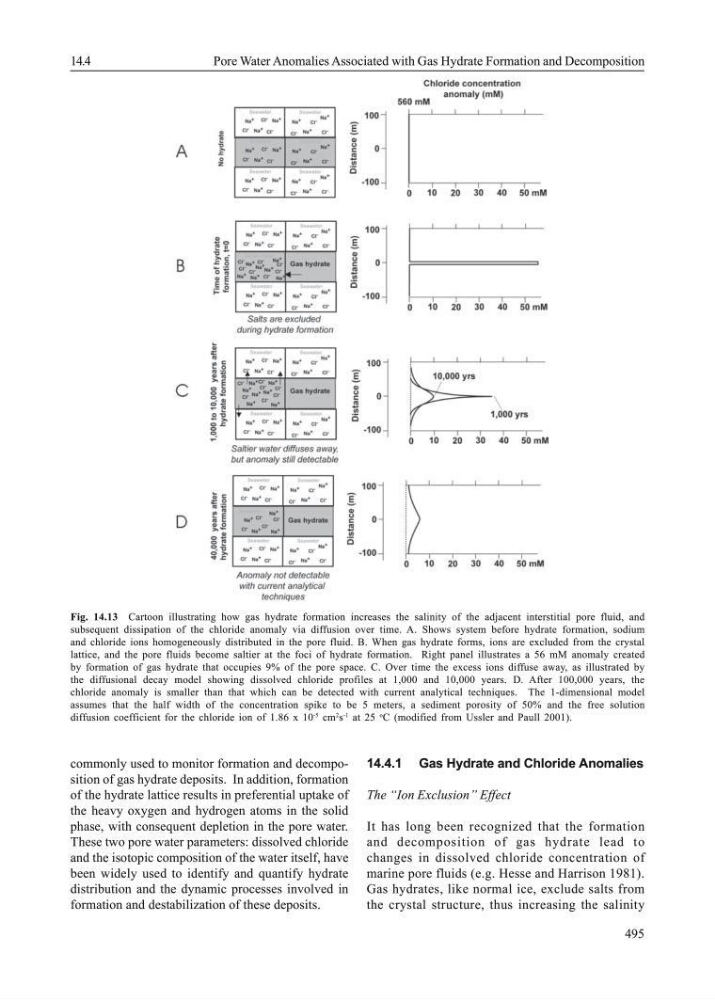
Fig. 14.13 Cartoon illustrating how gas hydrate formation increases the salinity of the adjacent interstitial pore fluid, and
subsequent dissipation of the chloride anomaly via diffusion over time. A. Shows system before hydrate formation, sodium
and chloride ions homogeneously distributed in the pore fluid. B. When gas hydrate forms, ions are excluded from the crystal
lattice, and the pore fluids become saltier at the foci of hydrate formation. Right panel illustrates a 56 mM anomaly created
by formation of gas hydrate that occupies 9% of the pore space. C. Over time the excess ions diffuse away, as illustrated by
the diffusional decay model showing dissolved chloride profiles at 1,000 and 10,000 years. D. After 100,000 years, the
chloride anomaly is smaller than that which can be detected with current analytical techniques. The 1-dimensional model
assumes that the half width of the concentration spike to be 5 meters, a sediment porosity of 50% and the free solution
diffusion coefficient for the chloride ion of 1.86 x 10
-5 cm
2 s
-1 at 25
o C (modified from Ussler and Paull 2001).
14.4
Pore Water Anomalies Associated with Gas Hydrate Formation and Decomposition
commonly used to monitor formation and decomposition of gas hydrate deposits. In addition, formation
of the hydrate lattice results in preferential uptake of
the heavy oxygen and hydrogen atoms in the solid
phase, with consequent depletion in the pore water.
These two pore water parameters: dissolved chloride
and the isotopic composition of the water itself, have
been widely used to identify and quantify hydrate
distribution and the dynamic processes involved in
formation and destabilization of these deposits.
14.4.1 Gas Hydrate and Chloride Anomalies
The “Ion Exclusion” Effect
It has long been recognized that the formation
and decomposition of gas hydrate lead to
changes in dissolved chloride concentration of
marine pore fluids (e.g. Hesse and Harrison 1981).
Gas hydrates, like normal ice, exclude salts from
the crystal structure, thus increasing the salinity
Fig. 14.13 Cartoon illustrating how gas hydrate formation increases the salinity of the adjacent interstitial pore fluid, and
subsequent dissipation of the chloride anomaly via diffusion over time. A. Shows system before hydrate formation, sodium
and chloride ions homogeneously distributed in the pore fluid. B. When gas hydrate forms, ions are excluded from the crystal
lattice, and the pore fluids become saltier at the foci of hydrate formation. Right panel illustrates a 56 mM anomaly created
by formation of gas hydrate that occupies 9% of the pore space. C. Over time the excess ions diffuse away, as illustrated by
the diffusional decay model showing dissolved chloride profiles at 1,000 and 10,000 years. D. After 100,000 years, the
chloride anomaly is smaller than that which can be detected with current analytical techniques. The 1-dimensional model
assumes that the half width of the concentration spike to be 5 meters, a sediment porosity of 50% and the free solution
diffusion coefficient for the chloride ion of 1.86 x 10
-5 cm
2 s
-1 at 25
o C (modified from Ussler and Paull 2001).