

14 Gas Hydrates in Marine Sediments
488
various proxies for hydrate abundance (e.g. Tréhu et
al. 2004a) will continuously improve our imperfect
knowledge of the distribution of gas hydrate in the
seafloor.
14.3.3 Generation of Gases for Hydrate
Formation
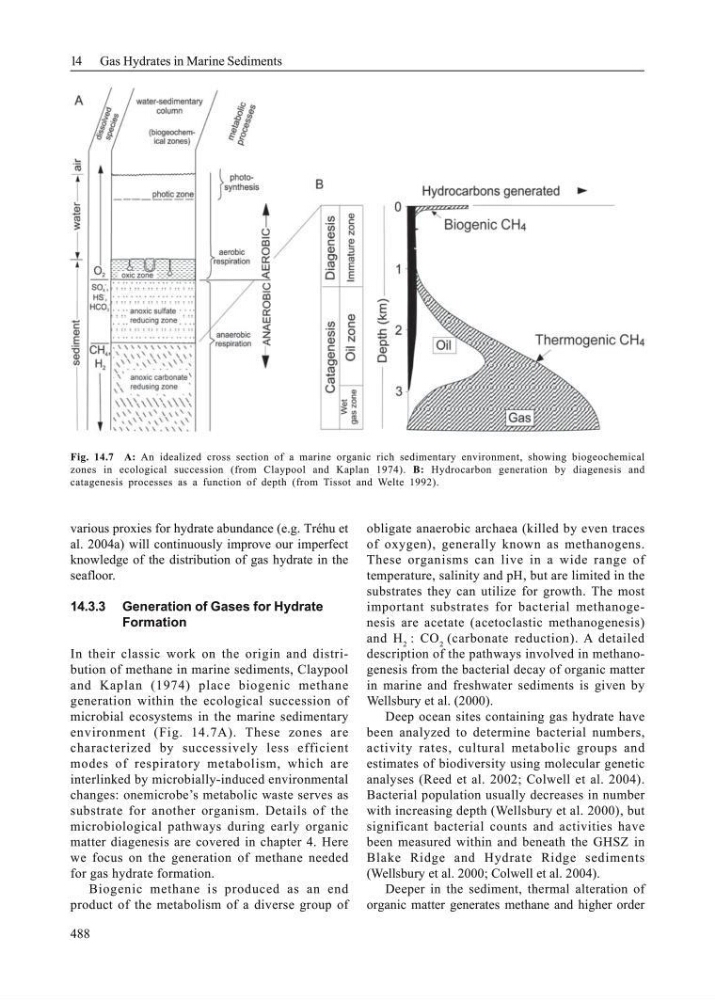
In their classic work on the origin and distribution of methane in marine sediments, Claypool
and Kaplan (1974) place biogenic methane
generation within the ecological succession of
microbial ecosystems in the marine sedimentary
environment (Fig. 14.7A). These zones are
characterized by successively less efficient
modes of respiratory metabolism, which are
interlinked by microbially-induced environmental
changes: onemicrobe’s metabolic waste serves as
substrate for another organism. Details of the
microbiological pathways during early organic
matter diagenesis are covered in chapter 4. Here
we focus on the generation of methane needed
for gas hydrate formation.
Biogenic methane is produced as an end
product of the metabolism of a diverse group of
obligate anaerobic archaea (killed by even traces
of oxygen), generally known as methanogens.
These organisms can live in a wide range of
temperature, salinity and pH, but are limited in the
substrates they can utilize for growth. The most
important substrates for bacterial methanogenesis are acetate (acetoclastic methanogenesis)
and H 2 : CO 2 (carbonate reduction). A detailed
description of the pathways involved in methanogenesis from the bacterial decay of organic matter
in marine and freshwater sediments is given by
Wellsbury et al. (2000).
Deep ocean sites containing gas hydrate have
been analyzed to determine bacterial numbers,
activity rates, cultural metabolic groups and
estimates of biodiversity using molecular genetic
analyses (Reed et al. 2002; Colwell et al. 2004).
Bacterial population usually decreases in number
with increasing depth (Wellsbury et al. 2000), but
significant bacterial counts and activities have
been measured within and beneath the GHSZ in
Blake Ridge and Hydrate Ridge sediments
(Wellsbury et al. 2000; Colwell et al. 2004).
Deeper in the sediment, thermal alteration of
organic matter generates methane and higher order
Fig. 14.7 A: An idealized cross section of a marine organic rich sedimentary environment, showing biogeochemical
zones in ecological succession (from Claypool and Kaplan 1974). B: Hydrocarbon generation by diagenesis and
catagenesis processes as a function of depth (from Tissot and Welte 1992).
488
various proxies for hydrate abundance (e.g. Tréhu et
al. 2004a) will continuously improve our imperfect
knowledge of the distribution of gas hydrate in the
seafloor.
14.3.3 Generation of Gases for Hydrate
Formation
In their classic work on the origin and distribution of methane in marine sediments, Claypool
and Kaplan (1974) place biogenic methane
generation within the ecological succession of
microbial ecosystems in the marine sedimentary
environment (Fig. 14.7A). These zones are
characterized by successively less efficient
modes of respiratory metabolism, which are
interlinked by microbially-induced environmental
changes: onemicrobe’s metabolic waste serves as
substrate for another organism. Details of the
microbiological pathways during early organic
matter diagenesis are covered in chapter 4. Here
we focus on the generation of methane needed
for gas hydrate formation.
Biogenic methane is produced as an end
product of the metabolism of a diverse group of
obligate anaerobic archaea (killed by even traces
of oxygen), generally known as methanogens.
These organisms can live in a wide range of
temperature, salinity and pH, but are limited in the
substrates they can utilize for growth. The most
important substrates for bacterial methanogenesis are acetate (acetoclastic methanogenesis)
and H 2 : CO 2 (carbonate reduction). A detailed
description of the pathways involved in methanogenesis from the bacterial decay of organic matter
in marine and freshwater sediments is given by
Wellsbury et al. (2000).
Deep ocean sites containing gas hydrate have
been analyzed to determine bacterial numbers,
activity rates, cultural metabolic groups and
estimates of biodiversity using molecular genetic
analyses (Reed et al. 2002; Colwell et al. 2004).
Bacterial population usually decreases in number
with increasing depth (Wellsbury et al. 2000), but
significant bacterial counts and activities have
been measured within and beneath the GHSZ in
Blake Ridge and Hydrate Ridge sediments
(Wellsbury et al. 2000; Colwell et al. 2004).
Deeper in the sediment, thermal alteration of
organic matter generates methane and higher order
Fig. 14.7 A: An idealized cross section of a marine organic rich sedimentary environment, showing biogeochemical
zones in ecological succession (from Claypool and Kaplan 1974). B: Hydrocarbon generation by diagenesis and
catagenesis processes as a function of depth (from Tissot and Welte 1992).