

487
2003). Consistent with inferences based on methane
concentration measured on cores collected at in situ
pressures, gas hydrate in these sediments is only
present between 45 and 134 meters, in what is known
as the gas hydrate occurrence zone (GHOZ).
14.3.2
Seismic Evidence for Gas Hydrates
The first indications of methane hydrate in marine
sediments were based on the observation of a seismic
reflection called “bottom-simulating- reflector” or BSR,
because it approximately mimics the sea-floor (Shipley
et al. 1979). The BSR cuts across reflections of stratigraphic origin, making it readily apparent in marine
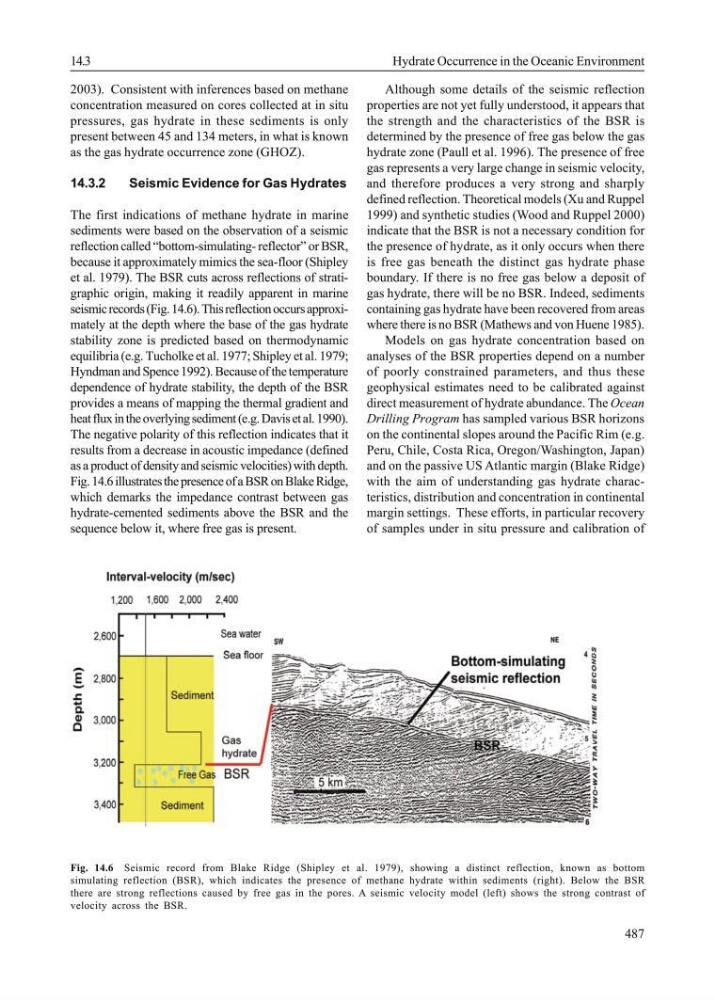
seismic records (Fig. 14.6). This reflection occurs approximately at the depth where the base of the gas hydrate
stability zone is predicted based on thermodynamic
equilibria (e.g. Tucholke et al. 1977; Shipley et al. 1979;
Hyndman and Spence 1992). Because of the temperature
dependence of hydrate stability, the depth of the BSR
provides a means of mapping the thermal gradient and
heat flux in the overlying sediment (e.g. Davis et al. 1990).
The negative polarity of this reflection indicates that it
results from a decrease in acoustic impedance (defined
as a product of density and seismic velocities) with depth.
Fig. 14.6 illustrates the presence of a BSR on Blake Ridge,
which demarks the impedance contrast between gas
hydrate-cemented sediments above the BSR and the
sequence below it, where free gas is present.
Although some details of the seismic reflection
properties are not yet fully understood, it appears that
the strength and the characteristics of the BSR is
determined by the presence of free gas below the gas
hydrate zone (Paull et al. 1996). The presence of free
gas represents a very large change in seismic velocity,
and therefore produces a very strong and sharply
defined reflection. Theoretical models (Xu and Ruppel
1999) and synthetic studies (Wood and Ruppel 2000)
indicate that the BSR is not a necessary condition for
the presence of hydrate, as it only occurs when there
is free gas beneath the distinct gas hydrate phase
boundary. If there is no free gas below a deposit of
gas hydrate, there will be no BSR. Indeed, sediments
containing gas hydrate have been recovered from areas
where there is no BSR (Mathews and von Huene 1985).
Models on gas hydrate concentration based on
analyses of the BSR properties depend on a number
of poorly constrained parameters, and thus these
geophysical estimates need to be calibrated against
direct measurement of hydrate abundance. The Ocean
Drilling Program has sampled various BSR horizons
on the continental slopes around the Pacific Rim (e.g.
Peru, Chile, Costa Rica, Oregon/Washington, Japan)
and on the passive US Atlantic margin (Blake Ridge)
with the aim of understanding gas hydrate characteristics, distribution and concentration in continental
margin settings. These efforts, in particular recovery
of samples under in situ pressure and calibration of
Fig. 14.6 Seismic record from Blake Ridge (Shipley et al. 1979), showing a distinct reflection, known as bottom
simulating reflection (BSR), which indicates the presence of methane hydrate within sediments (right). Below the BSR
there are strong reflections caused by free gas in the pores. A seismic velocity model (left) shows the strong contrast of
velocity across the BSR.
14.3
Hydrate Occurrence in the Oceanic Environment
2003). Consistent with inferences based on methane
concentration measured on cores collected at in situ
pressures, gas hydrate in these sediments is only
present between 45 and 134 meters, in what is known
as the gas hydrate occurrence zone (GHOZ).
14.3.2
Seismic Evidence for Gas Hydrates
The first indications of methane hydrate in marine
sediments were based on the observation of a seismic
reflection called “bottom-simulating- reflector” or BSR,
because it approximately mimics the sea-floor (Shipley
et al. 1979). The BSR cuts across reflections of stratigraphic origin, making it readily apparent in marine
seismic records (Fig. 14.6). This reflection occurs approximately at the depth where the base of the gas hydrate
stability zone is predicted based on thermodynamic
equilibria (e.g. Tucholke et al. 1977; Shipley et al. 1979;
Hyndman and Spence 1992). Because of the temperature
dependence of hydrate stability, the depth of the BSR
provides a means of mapping the thermal gradient and
heat flux in the overlying sediment (e.g. Davis et al. 1990).
The negative polarity of this reflection indicates that it
results from a decrease in acoustic impedance (defined
as a product of density and seismic velocities) with depth.
Fig. 14.6 illustrates the presence of a BSR on Blake Ridge,
which demarks the impedance contrast between gas
hydrate-cemented sediments above the BSR and the
sequence below it, where free gas is present.
Although some details of the seismic reflection
properties are not yet fully understood, it appears that
the strength and the characteristics of the BSR is
determined by the presence of free gas below the gas
hydrate zone (Paull et al. 1996). The presence of free
gas represents a very large change in seismic velocity,
and therefore produces a very strong and sharply
defined reflection. Theoretical models (Xu and Ruppel
1999) and synthetic studies (Wood and Ruppel 2000)
indicate that the BSR is not a necessary condition for
the presence of hydrate, as it only occurs when there
is free gas beneath the distinct gas hydrate phase
boundary. If there is no free gas below a deposit of
gas hydrate, there will be no BSR. Indeed, sediments
containing gas hydrate have been recovered from areas
where there is no BSR (Mathews and von Huene 1985).
Models on gas hydrate concentration based on
analyses of the BSR properties depend on a number
of poorly constrained parameters, and thus these
geophysical estimates need to be calibrated against
direct measurement of hydrate abundance. The Ocean
Drilling Program has sampled various BSR horizons
on the continental slopes around the Pacific Rim (e.g.
Peru, Chile, Costa Rica, Oregon/Washington, Japan)
and on the passive US Atlantic margin (Blake Ridge)
with the aim of understanding gas hydrate characteristics, distribution and concentration in continental
margin settings. These efforts, in particular recovery
of samples under in situ pressure and calibration of
Fig. 14.6 Seismic record from Blake Ridge (Shipley et al. 1979), showing a distinct reflection, known as bottom
simulating reflection (BSR), which indicates the presence of methane hydrate within sediments (right). Below the BSR
there are strong reflections caused by free gas in the pores. A seismic velocity model (left) shows the strong contrast of
velocity across the BSR.
14.3
Hydrate Occurrence in the Oceanic Environment