

14 Gas Hydrates in Marine Sediments
486
hydrate occurrence in sediments is deeper in closed
ocean basins where the temperature of the bottom
water is higher. For example, within the Black Sea where
the bottom water temperature is 9°C, the upper limit of
hydrate stability is around 700 m water depth
(Bohrmann et al. 2003). In contrast, in the polar
oceans, gas hydrate can be stable in 300 m of water
(Kvenvolden 1998).
The local geothermal gradient in marine settings
determines the temperature profile below the sea-floor
(Fig. 14.4 dashed line in the sediment sequence). As
temperature in the sediments increases with depth,
the sediment temperature will eventually get high
enough to cross the phase boundary, such that gas
hydrate will no longer be stable beneath this depth.
Other factors like the gas composition and salt content
of the pore water influence the precise location of the
lower boundary of the gas hydrate stability zone
(GHSZ). Thus, the base of the GHSZ is itself a phase
boundary. Since the geothermal gradient is often quite
uniform across broad regions beneath the seafloor,
the thickness of the GHSZ is quite constant for a given
water depth. However, a change in water depth will
influence the thickness of the hydrate stability zone
(Fig. 14.4). Due to the P/T conditions for hydrate
stability, the thickness of the GHSZ can reach 800 to
1000 m below seafloor in deep water areas, and the
base of the GHSZ will shoal up as water depth
decreases (Fig. 14.4).
Even though P/T conditions in most of the ocean
floor lie within the hydrate stability field, no such
deposits are found in the abyssal plain because there
is not enough gas in these sediments to stabilize the
hydrate structure. This fact illustrates the third fundamental requirement for gas hydrate formation. In
addition to moderately high pressures and low
temperatures, gas hydrates will only form if the mass
fraction of methane exceeds its solubility. Methane
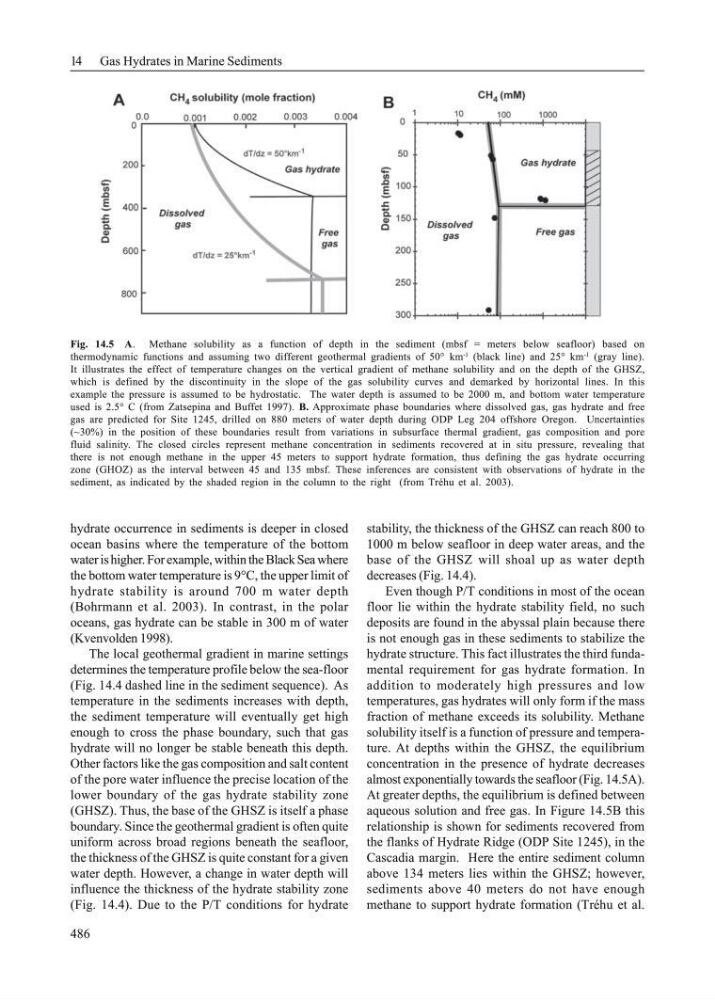
solubility itself is a function of pressure and temperature. At depths within the GHSZ, the equilibrium
concentration in the presence of hydrate decreases
almost exponentially towards the seafloor (Fig. 14.5A).
At greater depths, the equilibrium is defined between
aqueous solution and free gas. In Figure 14.5B this
relationship is shown for sediments recovered from
the flanks of Hydrate Ridge (ODP Site 1245), in the
Cascadia margin. Here the entire sediment column
above 134 meters lies within the GHSZ; however,
sediments above 40 meters do not have enough
methane to support hydrate formation (Tréhu et al.
Fig. 14.5 A. Methane solubility as a function of depth in the sediment (mbsf = meters below seafloor) based on
thermodynamic functions and assuming two different geothermal gradients of 50° km
-1 (black line) and 25° km
-1 (gray line).
It illustrates the effect of temperature changes on the vertical gradient of methane solubility and on the depth of the GHSZ,
which is defined by the discontinuity in the slope of the gas solubility curves and demarked by horizontal lines. In this
example the pressure is assumed to be hydrostatic. The water depth is assumed to be 2000 m, and bottom water temperature
used is 2.5° C (from Zatsepina and Buffet 1997). B. Approximate phase boundaries where dissolved gas, gas hydrate and free
gas are predicted for Site 1245, drilled on 880 meters of water depth during ODP Leg 204 offshore Oregon. Uncertainties
(~30%) in the position of these boundaries result from variations in subsurface thermal gradient, gas composition and pore
fluid salinity. The closed circles represent methane concentration in sediments recovered at in situ pressure, revealing that
there is not enough methane in the upper 45 meters to support hydrate formation, thus defining the gas hydrate occurring
zone (GHOZ) as the interval between 45 and 135 mbsf. These inferences are consistent with observations of hydrate in the
sediment, as indicated by the shaded region in the column to the right (from Tréhu et al. 2003).
486
hydrate occurrence in sediments is deeper in closed
ocean basins where the temperature of the bottom
water is higher. For example, within the Black Sea where
the bottom water temperature is 9°C, the upper limit of
hydrate stability is around 700 m water depth
(Bohrmann et al. 2003). In contrast, in the polar
oceans, gas hydrate can be stable in 300 m of water
(Kvenvolden 1998).
The local geothermal gradient in marine settings
determines the temperature profile below the sea-floor
(Fig. 14.4 dashed line in the sediment sequence). As
temperature in the sediments increases with depth,
the sediment temperature will eventually get high
enough to cross the phase boundary, such that gas
hydrate will no longer be stable beneath this depth.
Other factors like the gas composition and salt content
of the pore water influence the precise location of the
lower boundary of the gas hydrate stability zone
(GHSZ). Thus, the base of the GHSZ is itself a phase
boundary. Since the geothermal gradient is often quite
uniform across broad regions beneath the seafloor,
the thickness of the GHSZ is quite constant for a given
water depth. However, a change in water depth will
influence the thickness of the hydrate stability zone
(Fig. 14.4). Due to the P/T conditions for hydrate
stability, the thickness of the GHSZ can reach 800 to
1000 m below seafloor in deep water areas, and the
base of the GHSZ will shoal up as water depth
decreases (Fig. 14.4).
Even though P/T conditions in most of the ocean
floor lie within the hydrate stability field, no such
deposits are found in the abyssal plain because there
is not enough gas in these sediments to stabilize the
hydrate structure. This fact illustrates the third fundamental requirement for gas hydrate formation. In
addition to moderately high pressures and low
temperatures, gas hydrates will only form if the mass
fraction of methane exceeds its solubility. Methane
solubility itself is a function of pressure and temperature. At depths within the GHSZ, the equilibrium
concentration in the presence of hydrate decreases
almost exponentially towards the seafloor (Fig. 14.5A).
At greater depths, the equilibrium is defined between
aqueous solution and free gas. In Figure 14.5B this
relationship is shown for sediments recovered from
the flanks of Hydrate Ridge (ODP Site 1245), in the
Cascadia margin. Here the entire sediment column
above 134 meters lies within the GHSZ; however,
sediments above 40 meters do not have enough
methane to support hydrate formation (Tréhu et al.
Fig. 14.5 A. Methane solubility as a function of depth in the sediment (mbsf = meters below seafloor) based on
thermodynamic functions and assuming two different geothermal gradients of 50° km
-1 (black line) and 25° km
-1 (gray line).
It illustrates the effect of temperature changes on the vertical gradient of methane solubility and on the depth of the GHSZ,
which is defined by the discontinuity in the slope of the gas solubility curves and demarked by horizontal lines. In this
example the pressure is assumed to be hydrostatic. The water depth is assumed to be 2000 m, and bottom water temperature
used is 2.5° C (from Zatsepina and Buffet 1997). B. Approximate phase boundaries where dissolved gas, gas hydrate and free
gas are predicted for Site 1245, drilled on 880 meters of water depth during ODP Leg 204 offshore Oregon. Uncertainties
(~30%) in the position of these boundaries result from variations in subsurface thermal gradient, gas composition and pore
fluid salinity. The closed circles represent methane concentration in sediments recovered at in situ pressure, revealing that
there is not enough methane in the upper 45 meters to support hydrate formation, thus defining the gas hydrate occurring
zone (GHOZ) as the interval between 45 and 135 mbsf. These inferences are consistent with observations of hydrate in the
sediment, as indicated by the shaded region in the column to the right (from Tréhu et al. 2003).