

14 Gas Hydrates in Marine Sediments
484
Structure I cages can therefore enclose gas molecules
that occur naturally in marine sediments and are smaller
in diameter than propane, such as CH 4 , CO 2 or H 2 S.
The natural occurrence of this crystal structure
depends on the presence of biogenic gas in sufficient
amounts, as commonly found in sediments of the
ocean floor underlying areas of high biologic
productivity. Cubic structure II generally occurs with
guest molecules ranging between 6-7 Å. Hence, it
contains natural mixtures of gases with molecules
bigger than ethane and smaller than pentane, and it is
therefore usually confined to areas where a thermogenic gas is present in the sediment. Hexagonal
structure H may be present in either environment, but
only with mixtures of both small and very large (8-9 Å)
molecules, such as methylcyclohexane.
The smallest guest molecules that form hydrate
structure II have diameters smaller than 4 Å, ( e.g. Ar,
Kr, O 2 and N 2 ). Such nitrogen and oxygen clathrates
are known as air clathrates, and have been observed
in ice-cores from Antarctica and Greenland below ~
1100 m. In these samples, individual air bubbles have
reacted with polar ice under high pressure to form
clathrates (Shoji and Langway 1982).
14.2.3 Stability and Phase Boundaries
of Gas Hydrates
The presence of gas hydrates is controlled by several
factors, among which, temperature, pressure, ionic
strength of the water and gas composition and
abundance are key parameters (Sloan 1998). The
pressure/temperature conditions required for pure
methane hydrate stability are illustrated in Fig. 14.3. In
this case, methane hydrate is stable at temperatures
higher than 15°C only at high pressures (> 10 MPa).
At lower pressures, the stability of methane hydrate
requires colder temperatures (e.g. for P < 6 MPa; T< 10°C).
In the pressure/temperature field, the phase boundary
is determined by the gas composition and also by the
ionic strength of the water. The presence of CO 2 , H 2 S,
ethane and/or propane will have the effect of shifting
the stability curve to a higher temperature at a given
pressure, increasing the stability of methane hydrate.
The presence of dissolved ions in the pore fluids, on
the other hand, inhibits the stability of hydrate. There
is a –1.1°C offset in dissociation temperature of
methane hydrate in 33% NaCl, relative to that of
hydrate formation in pure water (e.g. Dickens and
Quinby-Hunt 1994). Thus, an increase in salinity of
the fluids from which the hydrate is forming shifts the
phase boundary to the left (Fig. 14.3).
Accurate and precise prediction of the P/T
conditions for natural gas hydrate stability is a field of
active research, and numerous methods for predicting
methane hydrate stability can be found in the literature
(summarized in Sloan 1998). Dickens and Quinby-Hunt
(1994) estimate the P/T conditions for hydrate stability
by interpolating experimentally determined
dissociation data. Since their experiments were
conducted in both seawater and freshwater matrices,
their results are useful in evaluating the effects of pore
fluid salinity. Other methods to estimate the stability
conditions are based on minimizing the Gibbs Free
Energy of the system. The most commonly used of
these computer-based methods is the Sloan (1998) PCDOS program CSMHYD, which allows for stability
estimates at varying salinities. Simpler calculation
methods are also available for the rapid estimation of
hydrate formation conditions (Carroll 2003).
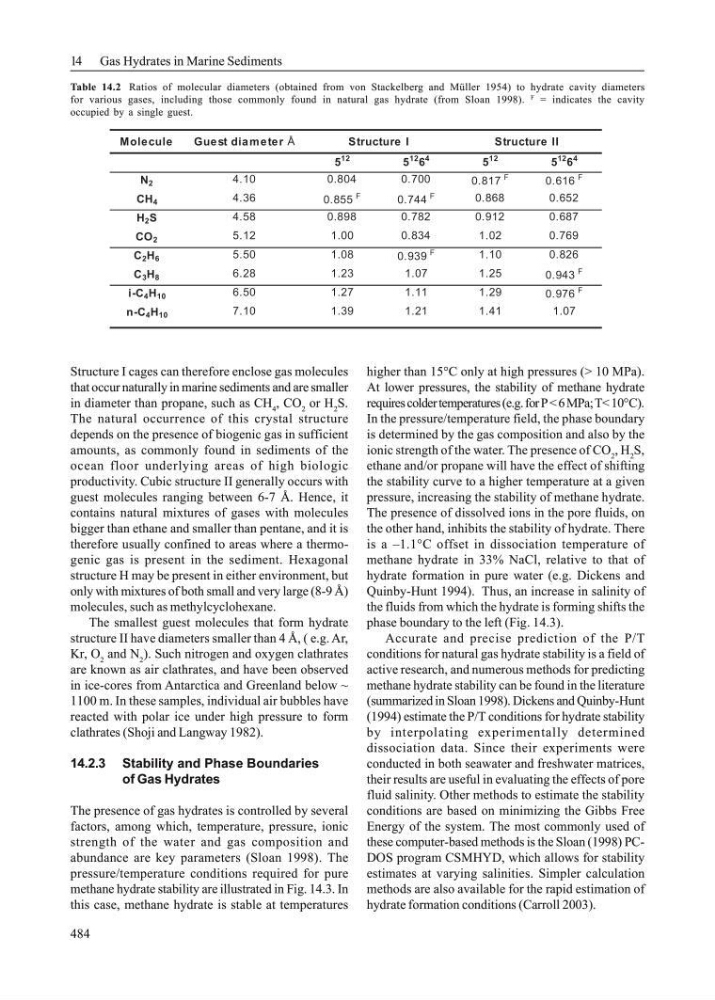
Table 14.2 Ratios of molecular diameters (obtained from von Stackelberg and Müller 1954) to hydrate cavity diameters
for various gases, including those commonly found in natural gas hydrate (from Sloan 1998).
F = indicates the cavity
occupied by a single guest.
Molecule
Guest diameter Å
5
12
5
12 6
4
5
12
5
12 6
4
N 2
4.10
0.804
0.700
0.817
F
0.616
F
CH 4
4.36
0.855
F
0.744
F
0.868
0.652
H 2 S
4.58
0.898
0.782
0.912
0.687
CO 2
5.12
1.00
0.834
1.02
0.769
C 2 H 6
5.50
1.08
0.939
F
1.10
0.826
C 3 H 8
6.28
1.23
1.07
1.25
0.943
F
i-C 4 H 10
6.50
1.27
1.11
1.29
0.976
F
n-C 4 H 10
7.10
1.39
1.21
1.41
1.07
Structure I
Structure II
484
Structure I cages can therefore enclose gas molecules
that occur naturally in marine sediments and are smaller
in diameter than propane, such as CH 4 , CO 2 or H 2 S.
The natural occurrence of this crystal structure
depends on the presence of biogenic gas in sufficient
amounts, as commonly found in sediments of the
ocean floor underlying areas of high biologic
productivity. Cubic structure II generally occurs with
guest molecules ranging between 6-7 Å. Hence, it
contains natural mixtures of gases with molecules
bigger than ethane and smaller than pentane, and it is
therefore usually confined to areas where a thermogenic gas is present in the sediment. Hexagonal
structure H may be present in either environment, but
only with mixtures of both small and very large (8-9 Å)
molecules, such as methylcyclohexane.
The smallest guest molecules that form hydrate
structure II have diameters smaller than 4 Å, ( e.g. Ar,
Kr, O 2 and N 2 ). Such nitrogen and oxygen clathrates
are known as air clathrates, and have been observed
in ice-cores from Antarctica and Greenland below ~
1100 m. In these samples, individual air bubbles have
reacted with polar ice under high pressure to form
clathrates (Shoji and Langway 1982).
14.2.3 Stability and Phase Boundaries
of Gas Hydrates
The presence of gas hydrates is controlled by several
factors, among which, temperature, pressure, ionic
strength of the water and gas composition and
abundance are key parameters (Sloan 1998). The
pressure/temperature conditions required for pure
methane hydrate stability are illustrated in Fig. 14.3. In
this case, methane hydrate is stable at temperatures
higher than 15°C only at high pressures (> 10 MPa).
At lower pressures, the stability of methane hydrate
requires colder temperatures (e.g. for P < 6 MPa; T< 10°C).
In the pressure/temperature field, the phase boundary
is determined by the gas composition and also by the
ionic strength of the water. The presence of CO 2 , H 2 S,
ethane and/or propane will have the effect of shifting
the stability curve to a higher temperature at a given
pressure, increasing the stability of methane hydrate.
The presence of dissolved ions in the pore fluids, on
the other hand, inhibits the stability of hydrate. There
is a –1.1°C offset in dissociation temperature of
methane hydrate in 33% NaCl, relative to that of
hydrate formation in pure water (e.g. Dickens and
Quinby-Hunt 1994). Thus, an increase in salinity of
the fluids from which the hydrate is forming shifts the
phase boundary to the left (Fig. 14.3).
Accurate and precise prediction of the P/T
conditions for natural gas hydrate stability is a field of
active research, and numerous methods for predicting
methane hydrate stability can be found in the literature
(summarized in Sloan 1998). Dickens and Quinby-Hunt
(1994) estimate the P/T conditions for hydrate stability
by interpolating experimentally determined
dissociation data. Since their experiments were
conducted in both seawater and freshwater matrices,
their results are useful in evaluating the effects of pore
fluid salinity. Other methods to estimate the stability
conditions are based on minimizing the Gibbs Free
Energy of the system. The most commonly used of
these computer-based methods is the Sloan (1998) PCDOS program CSMHYD, which allows for stability
estimates at varying salinities. Simpler calculation
methods are also available for the rapid estimation of
hydrate formation conditions (Carroll 2003).
Table 14.2 Ratios of molecular diameters (obtained from von Stackelberg and Müller 1954) to hydrate cavity diameters
for various gases, including those commonly found in natural gas hydrate (from Sloan 1998).
F = indicates the cavity
occupied by a single guest.
Molecule
Guest diameter Å
5
12
5
12 6
4
5
12
5
12 6
4
N 2
4.10
0.804
0.700
0.817
F
0.616
F
CH 4
4.36
0.855
F
0.744
F
0.868
0.652
H 2 S
4.58
0.898
0.782
0.912
0.687
CO 2
5.12
1.00
0.834
1.02
0.769
C 2 H 6
5.50
1.08
0.939
F
1.10
0.826
C 3 H 8
6.28
1.23
1.07
1.25
0.943
F
i-C 4 H 10
6.50
1.27
1.11
1.29
0.976
F
n-C 4 H 10
7.10
1.39
1.21
1.41
1.07
Structure I
Structure II