

13 Input from the Deep: Hot Vents and Cold Seeps
470
Edmond et al. 1995; Table 13.3) and certain metals
such as Cu, Co, Mo, and Se appear to show a
strong positive temperature-concentration relationship which likely accounts for observed enrichments of these elements in the sulfides from highCH 4 [nl/l]
Mn [nmol/kg]
0
10
15
5
20
25
0
50
100
150
200
250
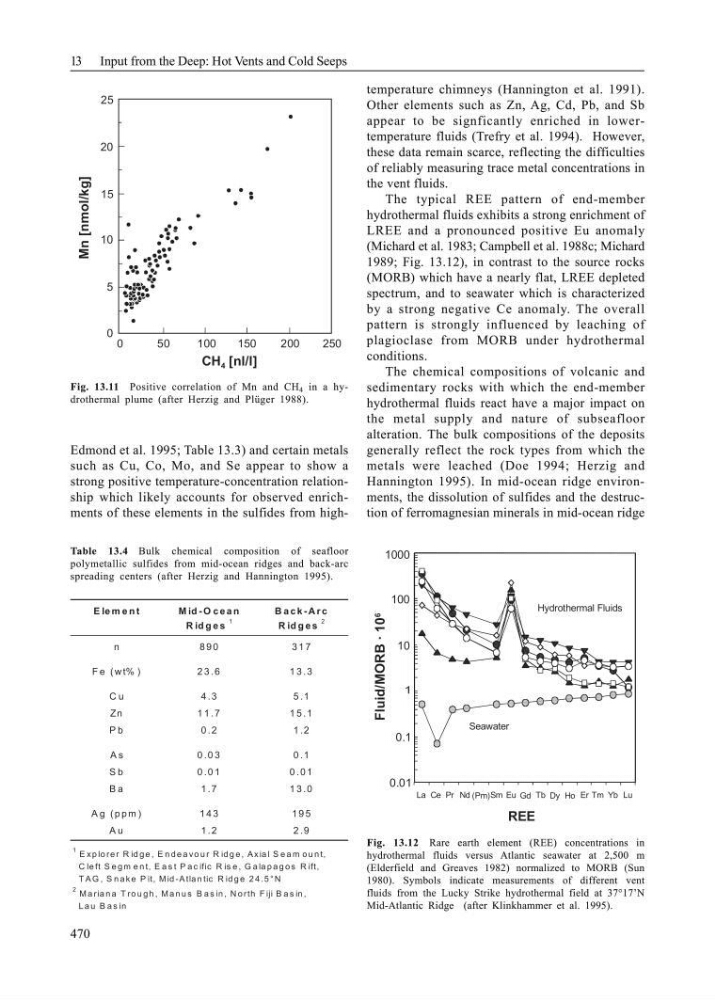
Fig. 13.11 Positive correlation of Mn and CH 4 in a hydrothermal plume (after Herzig and Plüger 1988).
1000
100
10
1
0.1
0.01
La Ce Pr Nd (Pm)Sm Eu Gd Tb Dy Ho Er Tm Yb Lu
REE
Hydrothermal Fluids
Seawater
Fluid/MORB · 10
6
Fig. 13.12 Rare earth element (REE) concentrations in
hydrothermal fluids versus Atlantic seawater at 2,500 m
(Elderfield and Greaves 1982) normalized to MORB (Sun
1980). Symbols indicate measurements of different vent
fluids from the Lucky Strike hydrothermal field at 37°17’N
Mid-Atlantic Ridge (after Klinkhammer et al. 1995).
Table 13.4 Bulk chemical composition of seafloor
polymetallic sulfides from mid-ocean ridges and back-arc
spreading centers (after Herzig and Hannington 1995).
E le m e n t
M id - O c e a n
B a c k - A r c
R id g e s
1
R id g e s
2
n
8 9 0
3 1 7
F e ( w t% )
2 3 .6
1 3 .3
C u
4 .3
5 .1
Zn
1 1 .7
1 5 .1
P b
0 .2
1 .2
A s
0 .0 3
0 .1
S b
0 .0 1
0 .0 1
B a
1 .7
1 3 .0
A g ( p p m )
1 4 3
1 9 5
A u
1 .2
2 .9
1 E x p lo re r R id g e , E n d e a vo u r R id g e , A x ia l S e a m o u n t,
C le ft S e g m e n t, E a s t P a c ific R is e , G a la p a g o s R ift,
T A G , S n a k e P it, M id -A tla n tic R id g e 2 4 .5 ° N
2 M a ria n a T ro u g h , M a n u s B a s in , N o rth F iji B a s in ,
L a u B a s in
temperature chimneys (Hannington et al. 1991).
Other elements such as Zn, Ag, Cd, Pb, and Sb
appear to be signficantly enriched in lowertemperature fluids (Trefry et al. 1994). However,
these data remain scarce, reflecting the difficulties
of reliably measuring trace metal concentrations in
the vent fluids.
The typical REE pattern of end-member
hydrothermal fluids exhibits a strong enrichment of
LREE and a pronounced positive Eu anomaly
(Michard et al. 1983; Campbell et al. 1988c; Michard
1989; Fig. 13.12), in contrast to the source rocks
(MORB) which have a nearly flat, LREE depleted
spectrum, and to seawater which is characterized
by a strong negative Ce anomaly. The overall
pattern is strongly influenced by leaching of
plagioclase from MORB under hydrothermal
conditions.
The chemical compositions of volcanic and
sedimentary rocks with which the end-member
hydrothermal fluids react have a major impact on
the metal supply and nature of subseafloor
alteration. The bulk compositions of the deposits
generally reflect the rock types from which the
metals were leached (Doe 1994; Herzig and
Hannington 1995). In mid-ocean ridge environments, the dissolution of sulfides and the destruction of ferromagnesian minerals in mid-ocean ridge
470
Edmond et al. 1995; Table 13.3) and certain metals
such as Cu, Co, Mo, and Se appear to show a
strong positive temperature-concentration relationship which likely accounts for observed enrichments of these elements in the sulfides from highCH 4 [nl/l]
Mn [nmol/kg]
0
10
15
5
20
25
0
50
100
150
200
250
Fig. 13.11 Positive correlation of Mn and CH 4 in a hydrothermal plume (after Herzig and Plüger 1988).
1000
100
10
1
0.1
0.01
La Ce Pr Nd (Pm)Sm Eu Gd Tb Dy Ho Er Tm Yb Lu
REE
Hydrothermal Fluids
Seawater
Fluid/MORB · 10
6
Fig. 13.12 Rare earth element (REE) concentrations in
hydrothermal fluids versus Atlantic seawater at 2,500 m
(Elderfield and Greaves 1982) normalized to MORB (Sun
1980). Symbols indicate measurements of different vent
fluids from the Lucky Strike hydrothermal field at 37°17’N
Mid-Atlantic Ridge (after Klinkhammer et al. 1995).
Table 13.4 Bulk chemical composition of seafloor
polymetallic sulfides from mid-ocean ridges and back-arc
spreading centers (after Herzig and Hannington 1995).
E le m e n t
M id - O c e a n
B a c k - A r c
R id g e s
1
R id g e s
2
n
8 9 0
3 1 7
F e ( w t% )
2 3 .6
1 3 .3
C u
4 .3
5 .1
Zn
1 1 .7
1 5 .1
P b
0 .2
1 .2
A s
0 .0 3
0 .1
S b
0 .0 1
0 .0 1
B a
1 .7
1 3 .0
A g ( p p m )
1 4 3
1 9 5
A u
1 .2
2 .9
1 E x p lo re r R id g e , E n d e a vo u r R id g e , A x ia l S e a m o u n t,
C le ft S e g m e n t, E a s t P a c ific R is e , G a la p a g o s R ift,
T A G , S n a k e P it, M id -A tla n tic R id g e 2 4 .5 ° N
2 M a ria n a T ro u g h , M a n u s B a s in , N o rth F iji B a s in ,
L a u B a s in
temperature chimneys (Hannington et al. 1991).
Other elements such as Zn, Ag, Cd, Pb, and Sb
appear to be signficantly enriched in lowertemperature fluids (Trefry et al. 1994). However,
these data remain scarce, reflecting the difficulties
of reliably measuring trace metal concentrations in
the vent fluids.
The typical REE pattern of end-member
hydrothermal fluids exhibits a strong enrichment of
LREE and a pronounced positive Eu anomaly
(Michard et al. 1983; Campbell et al. 1988c; Michard
1989; Fig. 13.12), in contrast to the source rocks
(MORB) which have a nearly flat, LREE depleted
spectrum, and to seawater which is characterized
by a strong negative Ce anomaly. The overall
pattern is strongly influenced by leaching of
plagioclase from MORB under hydrothermal
conditions.
The chemical compositions of volcanic and
sedimentary rocks with which the end-member
hydrothermal fluids react have a major impact on
the metal supply and nature of subseafloor
alteration. The bulk compositions of the deposits
generally reflect the rock types from which the
metals were leached (Doe 1994; Herzig and
Hannington 1995). In mid-ocean ridge environments, the dissolution of sulfides and the destruction of ferromagnesian minerals in mid-ocean ridge