

469
are summarized in Von Damm (1990) and Von
Damm (1995), and some examples are given in
Table 13.3. Time series measurements on the order
of a decade at a number of sites have indicated
that the chemical composition of vent fluids at
individual sites does not show significant temporal variablity and is essentially „steady state”
once the system has stabilized after a new
volcanic event (Von Damm 1995). Phase separation
is responsible for much of the chemical variability
observed (cf., Von Damm 1995), but major differences are also recognized between fluids
originating in different volcanic and tectonic
settings with different host rock compositions
(Hannington et al. 2005; see below). In some
areas, contributions from a degassing magma are
also inferred (Lupton et al. 1991; de Ronde 1995).
The salinities of vent fluids have been shown to
range from values of about 30% (176 mM/kg; Von
Damm and Bischoff 1987) to 200% (1090 mM/kg;
Massoth et al. 1989) seawater values (546 mM/kg).
These variations are important because Cl is the
major complexing anion in the hydrothermal fluids.
The observed salinities cannot be accounted for
by hydration of the oceanic crust (Cathles 1983)
or by precipitation and dissolution of Cl-bearing
mineral phases (Edmond et al. 1979b; Seyfried et
al. 1986) but are interpreted to be a result of phase
separation at the top of the magma chamber
followed by mixing of the brines and more dilute
hydrothermal fluids during ascent to the seafloor
(cf. Butterfield 2000).
In mid-ocean ridge hydrothermal fluids,
3
He is
significantly enriched over air-saturated seawater,
with
3
He/
4
He ratios between about 7 and 9. These
ratios represent typical mantle values and correspond to
3
He originating from MORB magma that
has degassed into the hydrothermal system
(Lupton 1983; Baker and Lupton 1990). Lupton
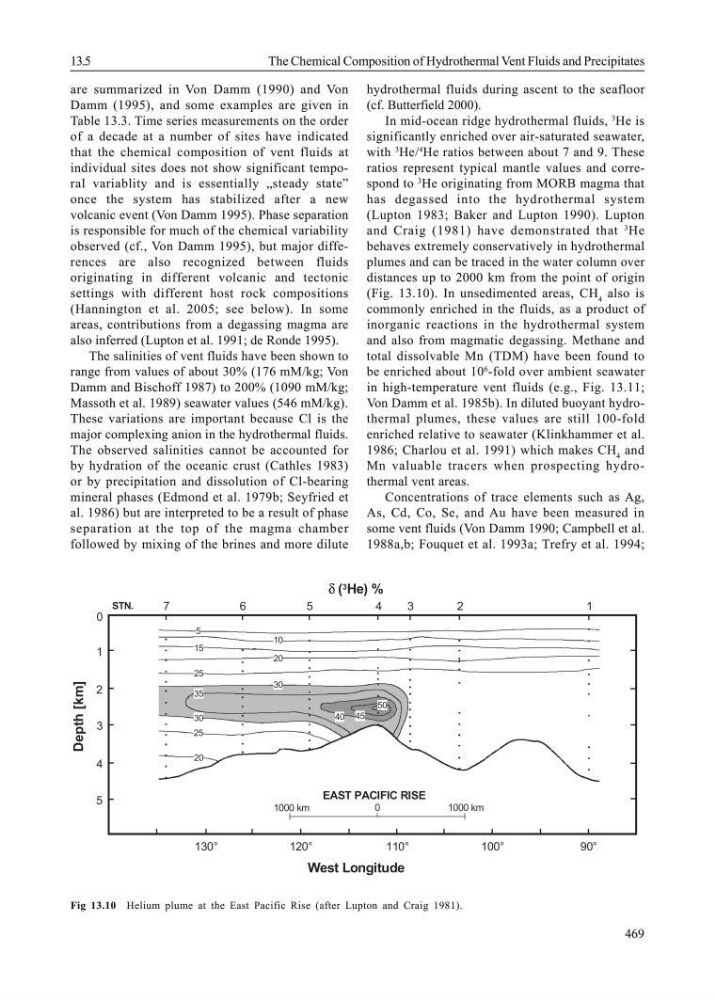
and Craig (1981) have demonstrated that
3
He
behaves extremely conservatively in hydrothermal
plumes and can be traced in the water column over
distances up to 2000 km from the point of origin
(Fig. 13.10). In unsedimented areas, CH 4 also is
commonly enriched in the fluids, as a product of
inorganic reactions in the hydrothermal system
and also from magmatic degassing. Methane and
total dissolvable Mn (TDM) have been found to
be enriched about 10
6
-fold over ambient seawater
in high-temperature vent fluids (e.g., Fig. 13.11;
Von Damm et al. 1985b). In diluted buoyant hydrothermal plumes, these values are still 100-fold
enriched relative to seawater (Klinkhammer et al.
1986; Charlou et al. 1991) which makes CH 4 and
Mn valuable tracers when prospecting hydrothermal vent areas.
Concentrations of trace elements such as Ag,
As, Cd, Co, Se, and Au have been measured in
some vent fluids (Von Damm 1990; Campbell et al.
1988a,b; Fouquet et al. 1993a; Trefry et al. 1994;
1000 km
0
1000 km
50
45
40
30
20
10
5
15
25
35
30
25
20
EAST PACIFIC RISE
West Longitude
130°
120°
110°
100°
90°
0
1
2
3
4
5
7
6
5
4
3
2
1
STN.
δ ( 3 He) %
Depth [km]
Fig 13.10 Helium plume at the East Pacific Rise (after Lupton and Craig 1981).
13.5
The Chemical Composition of Hydrothermal Vent Fluids and Precipitates
are summarized in Von Damm (1990) and Von
Damm (1995), and some examples are given in
Table 13.3. Time series measurements on the order
of a decade at a number of sites have indicated
that the chemical composition of vent fluids at
individual sites does not show significant temporal variablity and is essentially „steady state”
once the system has stabilized after a new
volcanic event (Von Damm 1995). Phase separation
is responsible for much of the chemical variability
observed (cf., Von Damm 1995), but major differences are also recognized between fluids
originating in different volcanic and tectonic
settings with different host rock compositions
(Hannington et al. 2005; see below). In some
areas, contributions from a degassing magma are
also inferred (Lupton et al. 1991; de Ronde 1995).
The salinities of vent fluids have been shown to
range from values of about 30% (176 mM/kg; Von
Damm and Bischoff 1987) to 200% (1090 mM/kg;
Massoth et al. 1989) seawater values (546 mM/kg).
These variations are important because Cl is the
major complexing anion in the hydrothermal fluids.
The observed salinities cannot be accounted for
by hydration of the oceanic crust (Cathles 1983)
or by precipitation and dissolution of Cl-bearing
mineral phases (Edmond et al. 1979b; Seyfried et
al. 1986) but are interpreted to be a result of phase
separation at the top of the magma chamber
followed by mixing of the brines and more dilute
hydrothermal fluids during ascent to the seafloor
(cf. Butterfield 2000).
In mid-ocean ridge hydrothermal fluids,
3
He is
significantly enriched over air-saturated seawater,
with
3
He/
4
He ratios between about 7 and 9. These
ratios represent typical mantle values and correspond to
3
He originating from MORB magma that
has degassed into the hydrothermal system
(Lupton 1983; Baker and Lupton 1990). Lupton
and Craig (1981) have demonstrated that
3
He
behaves extremely conservatively in hydrothermal
plumes and can be traced in the water column over
distances up to 2000 km from the point of origin
(Fig. 13.10). In unsedimented areas, CH 4 also is
commonly enriched in the fluids, as a product of
inorganic reactions in the hydrothermal system
and also from magmatic degassing. Methane and
total dissolvable Mn (TDM) have been found to
be enriched about 10
6
-fold over ambient seawater
in high-temperature vent fluids (e.g., Fig. 13.11;
Von Damm et al. 1985b). In diluted buoyant hydrothermal plumes, these values are still 100-fold
enriched relative to seawater (Klinkhammer et al.
1986; Charlou et al. 1991) which makes CH 4 and
Mn valuable tracers when prospecting hydrothermal vent areas.
Concentrations of trace elements such as Ag,
As, Cd, Co, Se, and Au have been measured in
some vent fluids (Von Damm 1990; Campbell et al.
1988a,b; Fouquet et al. 1993a; Trefry et al. 1994;
1000 km
0
1000 km
50
45
40
30
20
10
5
15
25
35
30
25
20
EAST PACIFIC RISE
West Longitude
130°
120°
110°
100°
90°
0
1
2
3
4
5
7
6
5
4
3
2
1
STN.
δ ( 3 He) %
Depth [km]
Fig 13.10 Helium plume at the East Pacific Rise (after Lupton and Craig 1981).
13.5
The Chemical Composition of Hydrothermal Vent Fluids and Precipitates