

13 Input from the Deep: Hot Vents and Cold Seeps
468
hydrostatic pressure is equivalent to about 1,600
m of water depth (160 bars or 16 Mpa; Fig. 13.8). If
the water depth is less than 1,600 m, the fluid will
boil beneath the seafloor and may separate a
vapor-rich phase. At these lower pressures, the
density difference between the vapor and liquid is
large, which facilitates the separation of a lowsalinity, gas-rich phase. Such fluids were first
documented at vents in the caldera of Axial
Seamount (1,540 m water depth and a fluid
temperature of 349°C) where low salinity and high
gas contents have been measured (Massoth et al.
1989; Butterfield et al. 1990). Similar boiling is now
recognized in a large number of shallow submarine
hydrothermal systems (German and Von Damm
2004; Hannington et al. 2005).
13.5 The Chemical Composition of
Hydrothermal Vent Fluids and
Precipitates
Since the discovery of high-temperature hydrothermal vents at the East Pacific Rise 21°N in 1979,
hydrothermal fluids have been sampled at numerous sites at mid-ocean ridges and back-arc
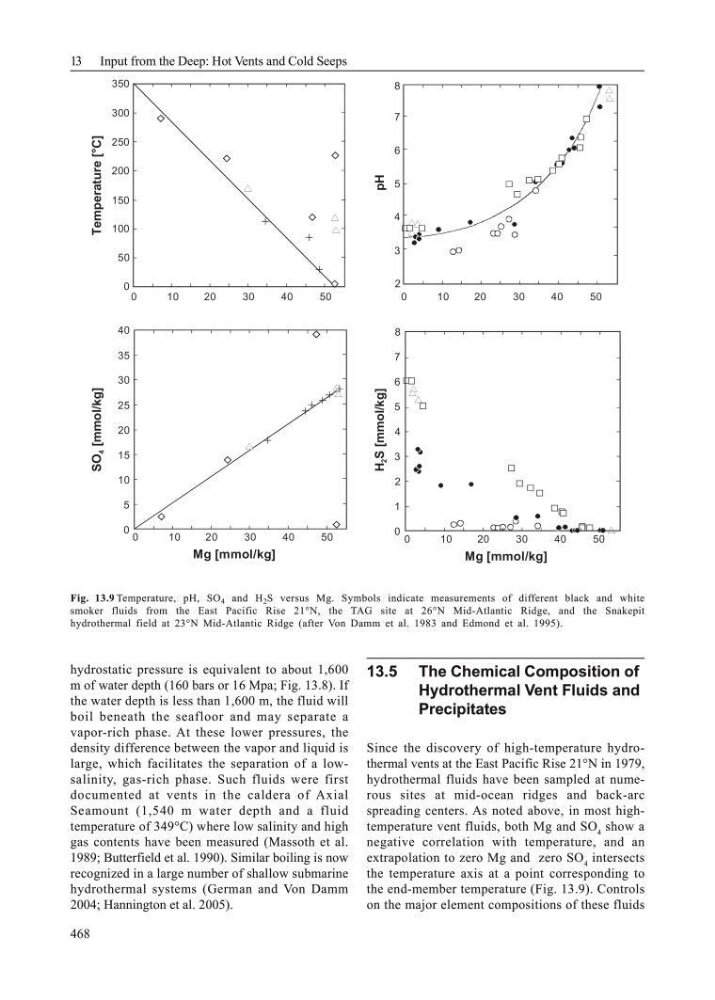
spreading centers. As noted above, in most hightemperature vent fluids, both Mg and SO 4 show a
negative correlation with temperature, and an
extrapolation to zero Mg and zero SO 4 intersects
the temperature axis at a point corresponding to
the end-member temperature (Fig. 13.9). Controls
on the major element compositions of these fluids
Fig. 13.9 Temperature, pH, SO 4 and H 2 S versus Mg. Symbols indicate measurements of different black and white
smoker fluids from the East Pacific Rise 21°N, the TAG site at 26°N Mid-Atlantic Ridge, and the Snakepit
hydrothermal field at 23°N Mid-Atlantic Ridge (after Von Damm et al. 1983 and Edmond et al. 1995).
350
300
250
200
150
100
50
0
0
10
20
30
40
50
Temperature [°C]
40
35
30
25
20
15
5
0
SO
4 [mmol/kg]
10
8
7
6
5
4
3
1
0
H
2 S [mmol/kg]
2
8
7
6
5
4
3
2
pH
0
10
20
30
40
50
Mg [mmol/kg]
0
10
20
30
40
50
Mg [mmol/kg]
0
1 0
2 0
3 0
4 0
5 0
468
hydrostatic pressure is equivalent to about 1,600
m of water depth (160 bars or 16 Mpa; Fig. 13.8). If
the water depth is less than 1,600 m, the fluid will
boil beneath the seafloor and may separate a
vapor-rich phase. At these lower pressures, the
density difference between the vapor and liquid is
large, which facilitates the separation of a lowsalinity, gas-rich phase. Such fluids were first
documented at vents in the caldera of Axial
Seamount (1,540 m water depth and a fluid
temperature of 349°C) where low salinity and high
gas contents have been measured (Massoth et al.
1989; Butterfield et al. 1990). Similar boiling is now
recognized in a large number of shallow submarine
hydrothermal systems (German and Von Damm
2004; Hannington et al. 2005).
13.5 The Chemical Composition of
Hydrothermal Vent Fluids and
Precipitates
Since the discovery of high-temperature hydrothermal vents at the East Pacific Rise 21°N in 1979,
hydrothermal fluids have been sampled at numerous sites at mid-ocean ridges and back-arc
spreading centers. As noted above, in most hightemperature vent fluids, both Mg and SO 4 show a
negative correlation with temperature, and an
extrapolation to zero Mg and zero SO 4 intersects
the temperature axis at a point corresponding to
the end-member temperature (Fig. 13.9). Controls
on the major element compositions of these fluids
Fig. 13.9 Temperature, pH, SO 4 and H 2 S versus Mg. Symbols indicate measurements of different black and white
smoker fluids from the East Pacific Rise 21°N, the TAG site at 26°N Mid-Atlantic Ridge, and the Snakepit
hydrothermal field at 23°N Mid-Atlantic Ridge (after Von Damm et al. 1983 and Edmond et al. 1995).
350
300
250
200
150
100
50
0
0
10
20
30
40
50
Temperature [°C]
40
35
30
25
20
15
5
0
SO
4 [mmol/kg]
10
8
7
6
5
4
3
1
0
H
2 S [mmol/kg]
2
8
7
6
5
4
3
2
pH
0
10
20
30
40
50
Mg [mmol/kg]
0
10
20
30
40
50
Mg [mmol/kg]
0
1 0
2 0
3 0
4 0
5 0