

471
basalt (MORB) are the major sources of Cu, Fe, Zn,
Au, and S in the hydrothermal system. In contrast,
elements such as Pb and Ba are derived mainly from
the destruction of feldspars. Feldspars are particularly abundant in felsic volcanic rocks, but less
so in basalt, so elements such as K, Ba and Pb are
enriched in fluids from environments with a high
proportion of flesic rocks (e.g., volcanic arcs; see
below). Even in mid-ocean ridge settings, the bulk
compositions of the deposits appear to be quite
sensitive to the chemistry of the source rocks
(Table 13.4). For example, the high Ba contents of
some mid-ocean ridge deposits may be related to
the enrichment of incompatible elements in some
lava suites due to an enriched melt source or
greater degrees of fractionation (Perfit et al. 1983;
Delaney et al. 1981; Clague et al. 1981).
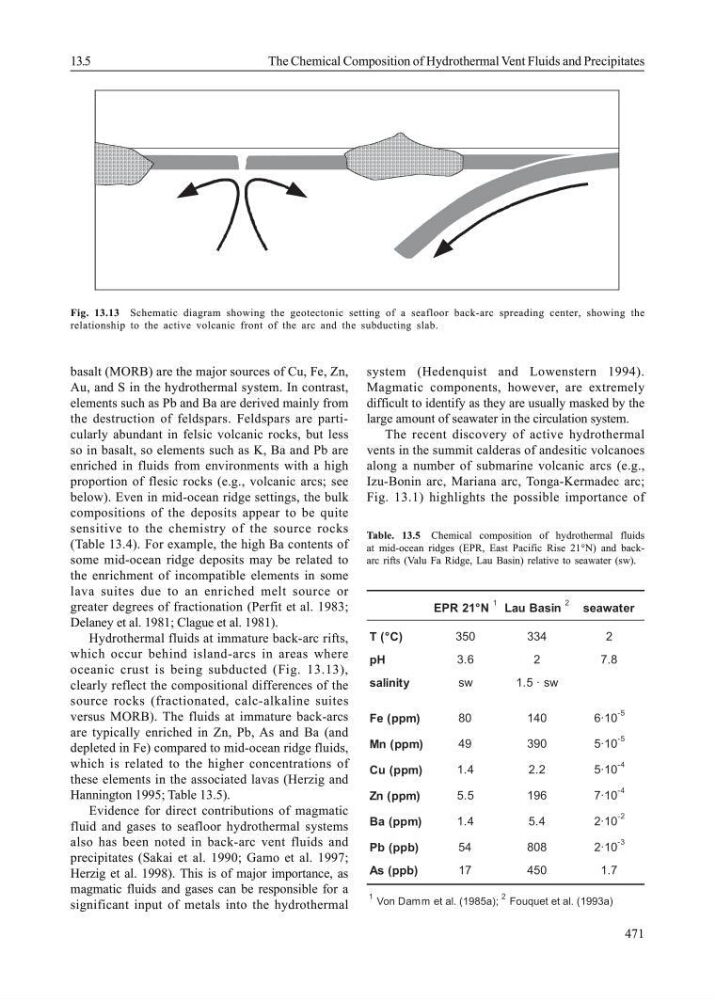
Hydrothermal fluids at immature back-arc rifts,
which occur behind island-arcs in areas where
oceanic crust is being subducted (Fig. 13.13),
clearly reflect the compositional differences of the
source rocks (fractionated, calc-alkaline suites
versus MORB). The fluids at immature back-arcs
are typically enriched in Zn, Pb, As and Ba (and
depleted in Fe) compared to mid-ocean ridge fluids,
which is related to the higher concentrations of
these elements in the associated lavas (Herzig and
Hannington 1995; Table 13.5).
Evidence for direct contributions of magmatic
fluid and gases to seafloor hydrothermal systems
also has been noted in back-arc vent fluids and
precipitates (Sakai et al. 1990; Gamo et al. 1997;
Herzig et al. 1998). This is of major importance, as
magmatic fluids and gases can be responsible for a
significant input of metals into the hydrothermal
system (Hedenquist and Lowenstern 1994).
Magmatic components, however, are extremely
difficult to identify as they are usually masked by the
large amount of seawater in the circulation system.
The recent discovery of active hydrothermal
vents in the summit calderas of andesitic volcanoes
along a number of submarine volcanic arcs (e.g.,
Izu-Bonin arc, Mariana arc, Tonga-Kermadec arc;
Fig. 13.1) highlights the possible importance of
13.5
The Chemical Composition of Hydrothermal Vent Fluids and Precipitates
Table. 13.5 Chemical composition of hydrothermal fluids
at mid-ocean ridges (EPR, East Pacific Rise 21°N) and backarc rifts (Valu Fa Ridge, Lau Basin) relative to seawater (sw).
EPR 21°N
1 Lau Basin
2
seawater
T (°C)
350
334
2
pH
3.6
2
7.8
salinity
sw
1.5 · sw
Fe (ppm)
80
140
6·10
-5
Mn (ppm)
49
390
5·10
-5
Cu (ppm)
1.4
2.2
5·10
-4
Zn (ppm)
5.5
196
7·10
-4
Ba (ppm)
1.4
5.4
2·10
-2
Pb (ppb)
54
808
2·10
-3
As (ppb)
17
450
1.7
1 Von Damm et al. (1985a);
2 Fouquet et al. (1993a)
Fig. 13.13 Schematic diagram showing the geotectonic setting of a seafloor back-arc spreading center, showing the
relationship to the active volcanic front of the arc and the subducting slab.
basalt (MORB) are the major sources of Cu, Fe, Zn,
Au, and S in the hydrothermal system. In contrast,
elements such as Pb and Ba are derived mainly from
the destruction of feldspars. Feldspars are particularly abundant in felsic volcanic rocks, but less
so in basalt, so elements such as K, Ba and Pb are
enriched in fluids from environments with a high
proportion of flesic rocks (e.g., volcanic arcs; see
below). Even in mid-ocean ridge settings, the bulk
compositions of the deposits appear to be quite
sensitive to the chemistry of the source rocks
(Table 13.4). For example, the high Ba contents of
some mid-ocean ridge deposits may be related to
the enrichment of incompatible elements in some
lava suites due to an enriched melt source or
greater degrees of fractionation (Perfit et al. 1983;
Delaney et al. 1981; Clague et al. 1981).
Hydrothermal fluids at immature back-arc rifts,
which occur behind island-arcs in areas where
oceanic crust is being subducted (Fig. 13.13),
clearly reflect the compositional differences of the
source rocks (fractionated, calc-alkaline suites
versus MORB). The fluids at immature back-arcs
are typically enriched in Zn, Pb, As and Ba (and
depleted in Fe) compared to mid-ocean ridge fluids,
which is related to the higher concentrations of
these elements in the associated lavas (Herzig and
Hannington 1995; Table 13.5).
Evidence for direct contributions of magmatic
fluid and gases to seafloor hydrothermal systems
also has been noted in back-arc vent fluids and
precipitates (Sakai et al. 1990; Gamo et al. 1997;
Herzig et al. 1998). This is of major importance, as
magmatic fluids and gases can be responsible for a
significant input of metals into the hydrothermal
system (Hedenquist and Lowenstern 1994).
Magmatic components, however, are extremely
difficult to identify as they are usually masked by the
large amount of seawater in the circulation system.
The recent discovery of active hydrothermal
vents in the summit calderas of andesitic volcanoes
along a number of submarine volcanic arcs (e.g.,
Izu-Bonin arc, Mariana arc, Tonga-Kermadec arc;
Fig. 13.1) highlights the possible importance of
13.5
The Chemical Composition of Hydrothermal Vent Fluids and Precipitates
Table. 13.5 Chemical composition of hydrothermal fluids
at mid-ocean ridges (EPR, East Pacific Rise 21°N) and backarc rifts (Valu Fa Ridge, Lau Basin) relative to seawater (sw).
EPR 21°N
1 Lau Basin
2
seawater
T (°C)
350
334
2
pH
3.6
2
7.8
salinity
sw
1.5 · sw
Fe (ppm)
80
140
6·10
-5
Mn (ppm)
49
390
5·10
-5
Cu (ppm)
1.4
2.2
5·10
-4
Zn (ppm)
5.5
196
7·10
-4
Ba (ppm)
1.4
5.4
2·10
-2
Pb (ppb)
54
808
2·10
-3
As (ppb)
17
450
1.7
1 Von Damm et al. (1985a);
2 Fouquet et al. (1993a)
Fig. 13.13 Schematic diagram showing the geotectonic setting of a seafloor back-arc spreading center, showing the
relationship to the active volcanic front of the arc and the subducting slab.