

13 Input from the Deep: Hot Vents and Cold Seeps
464
temperature Cu-Fe-sulfides as the structure grows
upward and outward. Because of its retrograde
solubility, anhydrite is not well preserved in older
chimney complexes and eventually dissolves at
ambient temperatures and seafloor pressures
(Haymon and Kastner 1981). As a result, many
black smokers that are cemented by anhydrite are
inherently unstable and ultimately collapse to
become part of a growing sulfide mound.
Most chimneys have growth rates that are
rapid in comparison to the half-life of
210
Pb (22.3
years), and radioisotope ages of several days or
less for precipitates of some active vents are consistent with growth rates observed from submersibles (5-10 cm per day: Hekinian et al. 1983;
Johnson and Tunnicliffe 1985). Larger vent complexes commonly have measured ages on the
order of decades (Koski et al. 1994), but the data
for entire vent fields may span several thousands
of years (Lalou et al. 1993).
At typical black smoker vents, a very large
proportion (at least 90%) of the metals and sulfur
carried in solution are lost to a hydrothermal
plume in the overlying water column rather than
deposited as chimneys. The metals are precipitated as sulfide particles in the plume above the
black smokers and are rapidly oxidized and dispersed over distances of several kilometers from
the vent (Feely et al. 1987, 1994a,b; Mottl and
McConachy 1990). Due to oxidation and dissolution, these particles also release some of the
metals back into seawater (Feely et al. 1987; Metz
and Trefry 1993). Particle settling models indicate
that only a small fraction of the metals is likely to
accumulate as plume fallout in the immediate
vicinity of the vents (Feely et al. 1987) and
observations of particulate Fe dispersal confirm
that most of the metals produced at a vent site are
carried away by buoyant plumes (Baker et al.
1985; Feely et al. 1994a,b).
Black smokers usually grow on hydrothermal
mounds that are large enough to be thermally and
chemically insulated from the surrounding
seawater (Fig. 13.5). The sulfide mounds also
serve to trap rising hydrothermal fluids and
impede the loss of metals and sulfur normally
caused by direct venting into the hydrothermal
plume. The largest sulfide deposits are often
composite bodies which appear to have evolved
from several smaller hydrothermal mounds (e.g.,
Embley et al. 1988). Many of the original chimney
structures are overgrown and eventually incorporated in the larger mound, destroying primary
textural and mineralogical relationships by hydrothermal replacement. Large sulfide mounds are
also constructed from the accumulation of sulfide
debris produced by collapsing chimneys, and
most large deposits are littered with the debris of
older sulfide structures. In many places, new
chimneys can be seen growing on top of the
sulfide talus, and this debris is eventually overgrown, cemented, and incorporated within the
mound (Rona et al. 1993; Hannington et al. 1995).
At the same time, high-temperature fluids circulating or trapped beneath the deposit precipitate
new sulfide minerals in fractures and open spaces.
Chimneys that are perched on the outer surface of
an active mound apparently tap these hightemperature fluids but account for only a small
part of the total mass of the deposit.
The common presence of high-temperature
chimneys at the tops of the deposits and lowertemperature chimneys on their flanks suggests
that most large mounds are internally zoned,
similar to many ancient massive sulfide deposits
on land (cf., Franklin et al. 1981). The most
common arrangement of mineral assemblages is a
high-temperature Cu-rich core and a cooler, Znrich outer margin. Mineralogical zonation within a
deposit is principally a result of hydrothermal
reworking, whereby minerals that are soluble at
low-temperature such as sphalerite are dissolved
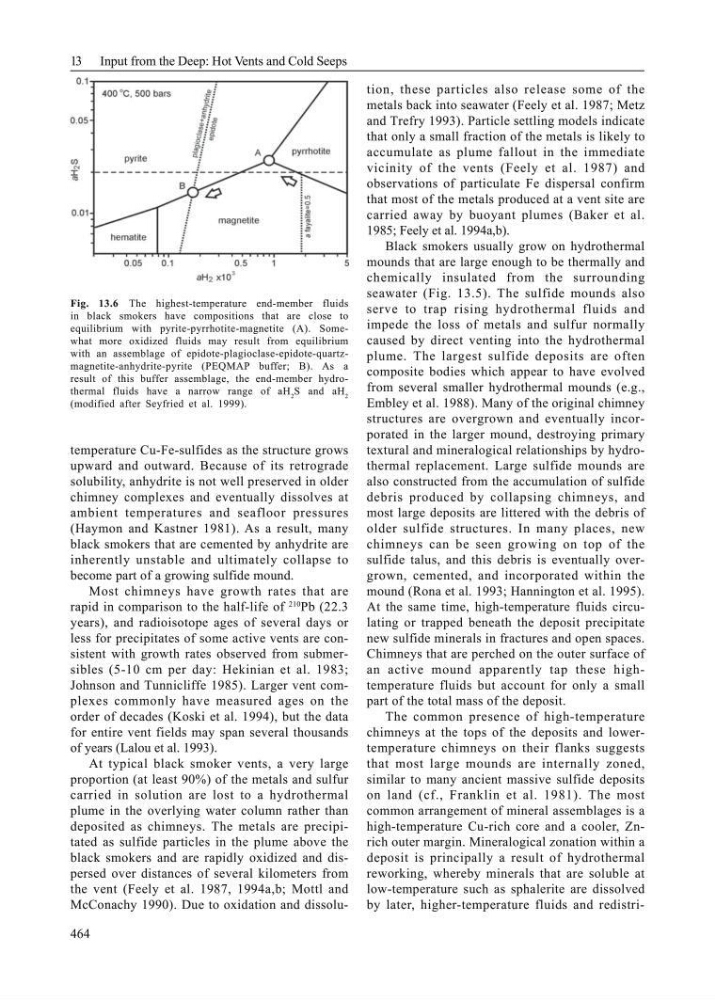
by later, higher-temperature fluids and redistriFig. 13.6 The highest-temperature end-member fluids
in black smokers have compositions that are close to
equilibrium with pyrite-pyrrhotite-magnetite (A). Somewhat more oxidized fluids may result from equilibrium
with an assemblage of epidote-plagioclase-epidote-quartzmagnetite-anhydrite-pyrite (PEQMAP buffer; B). As a
result of this buffer assemblage, the end-member hydrothermal fluids have a narrow range of aH 2 S and aH 2
(modified after Seyfried et al. 1999).
464
temperature Cu-Fe-sulfides as the structure grows
upward and outward. Because of its retrograde
solubility, anhydrite is not well preserved in older
chimney complexes and eventually dissolves at
ambient temperatures and seafloor pressures
(Haymon and Kastner 1981). As a result, many
black smokers that are cemented by anhydrite are
inherently unstable and ultimately collapse to
become part of a growing sulfide mound.
Most chimneys have growth rates that are
rapid in comparison to the half-life of
210
Pb (22.3
years), and radioisotope ages of several days or
less for precipitates of some active vents are consistent with growth rates observed from submersibles (5-10 cm per day: Hekinian et al. 1983;
Johnson and Tunnicliffe 1985). Larger vent complexes commonly have measured ages on the
order of decades (Koski et al. 1994), but the data
for entire vent fields may span several thousands
of years (Lalou et al. 1993).
At typical black smoker vents, a very large
proportion (at least 90%) of the metals and sulfur
carried in solution are lost to a hydrothermal
plume in the overlying water column rather than
deposited as chimneys. The metals are precipitated as sulfide particles in the plume above the
black smokers and are rapidly oxidized and dispersed over distances of several kilometers from
the vent (Feely et al. 1987, 1994a,b; Mottl and
McConachy 1990). Due to oxidation and dissolution, these particles also release some of the
metals back into seawater (Feely et al. 1987; Metz
and Trefry 1993). Particle settling models indicate
that only a small fraction of the metals is likely to
accumulate as plume fallout in the immediate
vicinity of the vents (Feely et al. 1987) and
observations of particulate Fe dispersal confirm
that most of the metals produced at a vent site are
carried away by buoyant plumes (Baker et al.
1985; Feely et al. 1994a,b).
Black smokers usually grow on hydrothermal
mounds that are large enough to be thermally and
chemically insulated from the surrounding
seawater (Fig. 13.5). The sulfide mounds also
serve to trap rising hydrothermal fluids and
impede the loss of metals and sulfur normally
caused by direct venting into the hydrothermal
plume. The largest sulfide deposits are often
composite bodies which appear to have evolved
from several smaller hydrothermal mounds (e.g.,
Embley et al. 1988). Many of the original chimney
structures are overgrown and eventually incorporated in the larger mound, destroying primary
textural and mineralogical relationships by hydrothermal replacement. Large sulfide mounds are
also constructed from the accumulation of sulfide
debris produced by collapsing chimneys, and
most large deposits are littered with the debris of
older sulfide structures. In many places, new
chimneys can be seen growing on top of the
sulfide talus, and this debris is eventually overgrown, cemented, and incorporated within the
mound (Rona et al. 1993; Hannington et al. 1995).
At the same time, high-temperature fluids circulating or trapped beneath the deposit precipitate
new sulfide minerals in fractures and open spaces.
Chimneys that are perched on the outer surface of
an active mound apparently tap these hightemperature fluids but account for only a small
part of the total mass of the deposit.
The common presence of high-temperature
chimneys at the tops of the deposits and lowertemperature chimneys on their flanks suggests
that most large mounds are internally zoned,
similar to many ancient massive sulfide deposits
on land (cf., Franklin et al. 1981). The most
common arrangement of mineral assemblages is a
high-temperature Cu-rich core and a cooler, Znrich outer margin. Mineralogical zonation within a
deposit is principally a result of hydrothermal
reworking, whereby minerals that are soluble at
low-temperature such as sphalerite are dissolved
by later, higher-temperature fluids and redistriFig. 13.6 The highest-temperature end-member fluids
in black smokers have compositions that are close to
equilibrium with pyrite-pyrrhotite-magnetite (A). Somewhat more oxidized fluids may result from equilibrium
with an assemblage of epidote-plagioclase-epidote-quartzmagnetite-anhydrite-pyrite (PEQMAP buffer; B). As a
result of this buffer assemblage, the end-member hydrothermal fluids have a narrow range of aH 2 S and aH 2
(modified after Seyfried et al. 1999).