

463
The sequence of mineral precipitation which
attends mixing of these high-temperature fluids
with cold seawater has been modelled extensively
(Janecky and Seyfried 1984; Bowers et al. 1985;
Tivey 1995; Tivey et al. 1995). Most descriptive
models of the growth of black smoker chimneys
involve an early asssemblage of chalcopyrite,
pyrrhotite, and anhydrite at high temperatures,
followed by pyrite and sphalerite at lower
temperatures (Haymon and Kastner 1981; Haymon
1983; Goldfarb et al. 1983; Oudin 1983; Graham et
al. 1988; Zierenberg et al. 1984; Lafitte et al. 1985;
Fouquet et al. 1993b). The black smoke emitted
from the chimneys consists mainly of Fe-sulfide
and Fe-oxide particles, together with amorphous
silica. At lower-temperature “white and grey
smokers” (<300°C), the smoke consists of amorphous silica and/or barite and anhydrite with
lesser amounts of sulfide.
The characteristic feature that distinguishes
black smoker vents from white smokers is their
central chalcopyrite-lined orifice. In the models of
Haymon (1983) and Goldfarb et al. (1983), anhydrite is precipitated around a black smoker vent at
the leading edge of chimney growth, where hot
hydrothermal fluids first encounter cold seawater
(Fig. 13.4). The anhydrite is precipitated from Ca
2+
in the vent fluids and SO 4
2in ambient seawater,
although some anhydrite in the outer walls of the
chimney or in the interior of hydrothermal mounds
(cf., Humphris et al. 1995) may also be formed
simply by the conductive heating of seawater
above 150°C. The anhydrite which forms the initial
wall of the chimney is gradually replaced by highBLACK SMOKER CHIMNEYS
HYDROTHERMAL PLUME
WHITE SMOKERS
SULFIDE TALUS
METALLIFEROUS
SEDIMENT
400°C
HIGH-TEMPERATURE
REACTION ZONE
OCEANIC
CRUST
OCEANIC
CRUST
SEAWATER
SEAWATER
HIGH PERMEABILITY
LOW PERMEABILITY
HIGH-TEMPERATURE
END-MEMBER
350-400° C
SO
H S
4
2
METAL LEACHING
S
H S
ROCK
2
STOCKWORK
100 M
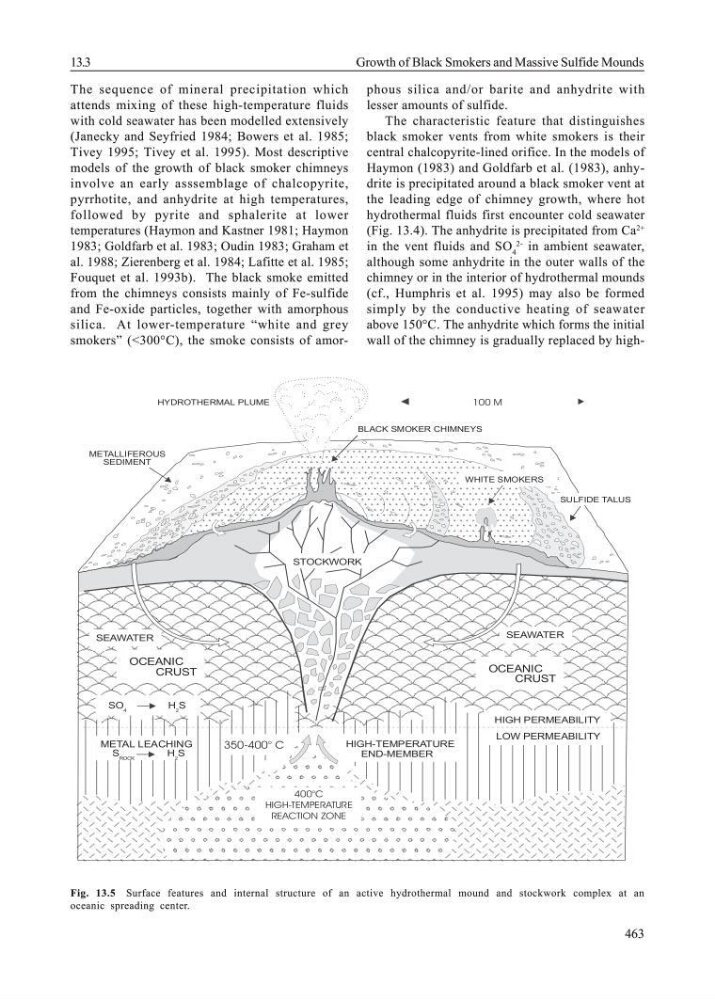
Fig. 13.5 Surface features and internal structure of an active hydrothermal mound and stockwork complex at an
oceanic spreading center.
13.3
Growth of Black Smokers and Massive Sulfide Mounds
The sequence of mineral precipitation which
attends mixing of these high-temperature fluids
with cold seawater has been modelled extensively
(Janecky and Seyfried 1984; Bowers et al. 1985;
Tivey 1995; Tivey et al. 1995). Most descriptive
models of the growth of black smoker chimneys
involve an early asssemblage of chalcopyrite,
pyrrhotite, and anhydrite at high temperatures,
followed by pyrite and sphalerite at lower
temperatures (Haymon and Kastner 1981; Haymon
1983; Goldfarb et al. 1983; Oudin 1983; Graham et
al. 1988; Zierenberg et al. 1984; Lafitte et al. 1985;
Fouquet et al. 1993b). The black smoke emitted
from the chimneys consists mainly of Fe-sulfide
and Fe-oxide particles, together with amorphous
silica. At lower-temperature “white and grey
smokers” (<300°C), the smoke consists of amorphous silica and/or barite and anhydrite with
lesser amounts of sulfide.
The characteristic feature that distinguishes
black smoker vents from white smokers is their
central chalcopyrite-lined orifice. In the models of
Haymon (1983) and Goldfarb et al. (1983), anhydrite is precipitated around a black smoker vent at
the leading edge of chimney growth, where hot
hydrothermal fluids first encounter cold seawater
(Fig. 13.4). The anhydrite is precipitated from Ca
2+
in the vent fluids and SO 4
2in ambient seawater,
although some anhydrite in the outer walls of the
chimney or in the interior of hydrothermal mounds
(cf., Humphris et al. 1995) may also be formed
simply by the conductive heating of seawater
above 150°C. The anhydrite which forms the initial
wall of the chimney is gradually replaced by highBLACK SMOKER CHIMNEYS
HYDROTHERMAL PLUME
WHITE SMOKERS
SULFIDE TALUS
METALLIFEROUS
SEDIMENT
400°C
HIGH-TEMPERATURE
REACTION ZONE
OCEANIC
CRUST
OCEANIC
CRUST
SEAWATER
SEAWATER
HIGH PERMEABILITY
LOW PERMEABILITY
HIGH-TEMPERATURE
END-MEMBER
350-400° C
SO
H S
4
2
METAL LEACHING
S
H S
ROCK
2
STOCKWORK
100 M
Fig. 13.5 Surface features and internal structure of an active hydrothermal mound and stockwork complex at an
oceanic spreading center.
13.3
Growth of Black Smokers and Massive Sulfide Mounds