

447
12.5
Applications
1983). The balances confirm the results of other
studies on the marine silicon cycle (e.g. Tréguer et
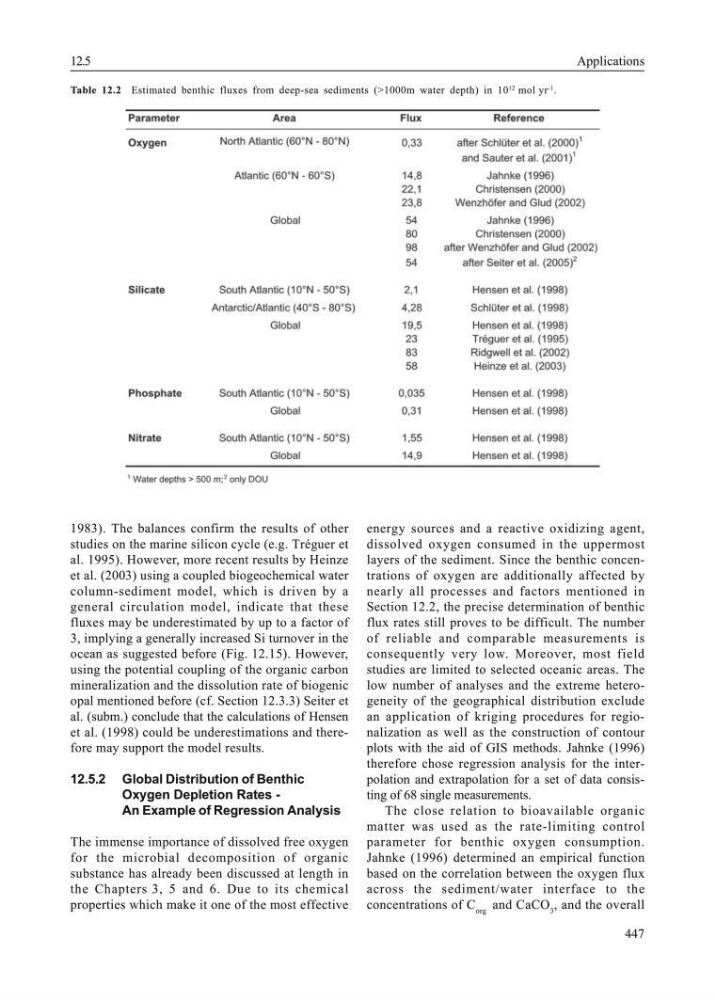
al. 1995). However, more recent results by Heinze
et al. (2003) using a coupled biogeochemical water
column-sediment model, which is driven by a
general circulation model, indicate that these
fluxes may be underestimated by up to a factor of
3, implying a generally increased Si turnover in the
ocean as suggested before (Fig. 12.15). However,
using the potential coupling of the organic carbon
mineralization and the dissolution rate of biogenic
opal mentioned before (cf. Section 12.3.3) Seiter et
al. (subm.) conclude that the calculations of Hensen
et al. (1998) could be underestimations and therefore may support the model results.
12.5.2 Global Distribution of Benthic
Oxygen Depletion Rates -
An Example of Regression Analysis
The immense importance of dissolved free oxygen
for the microbial decomposition of organic
substance has already been discussed at length in
the Chapters 3, 5 and 6. Due to its chemical
properties which make it one of the most effective
energy sources and a reactive oxidizing agent,
dissolved oxygen consumed in the uppermost
layers of the sediment. Since the benthic concentrations of oxygen are additionally affected by
nearly all processes and factors mentioned in
Section 12.2, the precise determination of benthic
flux rates still proves to be difficult. The number
of reliable and comparable measurements is
consequently very low. Moreover, most field
studies are limited to selected oceanic areas. The
low number of analyses and the extreme heterogeneity of the geographical distribution exclude
an application of kriging procedures for regionalization as well as the construction of contour
plots with the aid of GIS methods. Jahnke (1996)
therefore chose regression analysis for the interpolation and extrapolation for a set of data consisting of 68 single measurements.
The close relation to bioavailable organic
matter was used as the rate-limiting control
parameter for benthic oxygen consumption.
Jahnke (1996) determined an empirical function
based on the correlation between the oxygen flux
across the sediment/water interface to the
concentrations of C org and CaCO 3 , and the overall
Table 12.2 Estimated benthic fluxes from deep-sea sediments (>1000m water depth) in 10
12 mol yr
-1 .
12.5
Applications
1983). The balances confirm the results of other
studies on the marine silicon cycle (e.g. Tréguer et
al. 1995). However, more recent results by Heinze
et al. (2003) using a coupled biogeochemical water
column-sediment model, which is driven by a
general circulation model, indicate that these
fluxes may be underestimated by up to a factor of
3, implying a generally increased Si turnover in the
ocean as suggested before (Fig. 12.15). However,
using the potential coupling of the organic carbon
mineralization and the dissolution rate of biogenic
opal mentioned before (cf. Section 12.3.3) Seiter et
al. (subm.) conclude that the calculations of Hensen
et al. (1998) could be underestimations and therefore may support the model results.
12.5.2 Global Distribution of Benthic
Oxygen Depletion Rates -
An Example of Regression Analysis
The immense importance of dissolved free oxygen
for the microbial decomposition of organic
substance has already been discussed at length in
the Chapters 3, 5 and 6. Due to its chemical
properties which make it one of the most effective
energy sources and a reactive oxidizing agent,
dissolved oxygen consumed in the uppermost
layers of the sediment. Since the benthic concentrations of oxygen are additionally affected by
nearly all processes and factors mentioned in
Section 12.2, the precise determination of benthic
flux rates still proves to be difficult. The number
of reliable and comparable measurements is
consequently very low. Moreover, most field
studies are limited to selected oceanic areas. The
low number of analyses and the extreme heterogeneity of the geographical distribution exclude
an application of kriging procedures for regionalization as well as the construction of contour
plots with the aid of GIS methods. Jahnke (1996)
therefore chose regression analysis for the interpolation and extrapolation for a set of data consisting of 68 single measurements.
The close relation to bioavailable organic
matter was used as the rate-limiting control
parameter for benthic oxygen consumption.
Jahnke (1996) determined an empirical function
based on the correlation between the oxygen flux
across the sediment/water interface to the
concentrations of C org and CaCO 3 , and the overall
Table 12.2 Estimated benthic fluxes from deep-sea sediments (>1000m water depth) in 10
12 mol yr
-1 .